Ask any project manager who has had a production line stall because a “cheaper” spring supplier missed a tolerance, and they will tell you the same thing: the sourcing decision was never really about the spring. It was about everything riding on it.
A spring is a small part with an outsized job. It is the thing that keeps a connector making contact, a valve closing on time, a medical device applying exactly the right force — over and over, for years, without anyone thinking about it until it fails. Choosing who makes that part deserves more scrutiny than most buyers give it, and considerably more than a line-item price comparison on a quote sheet.
Here is what we think actually separates a supplier worth building a relationship with from one that simply happens to be available.
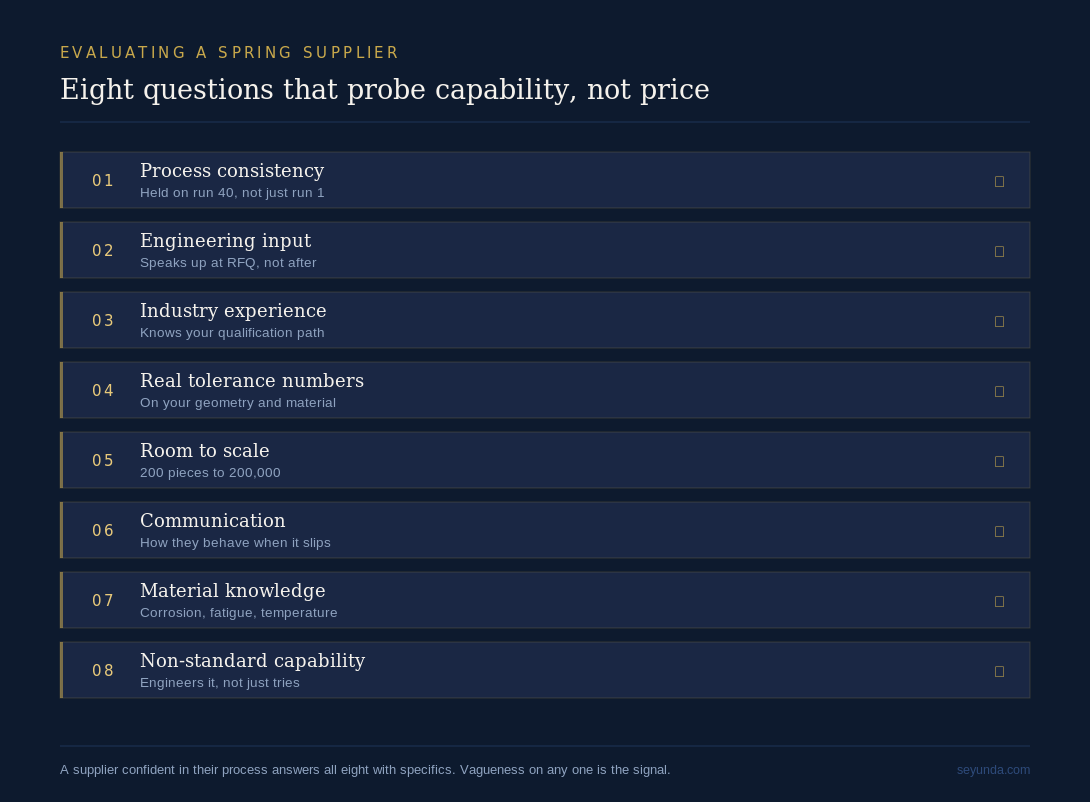
Start with whether they can hold the spec — every time
Anyone can hit a tight tolerance once, on a good batch, with a fresh die. The real question is whether they can hit it on run 40, six months from now, after the tooling has worn a little and a different operator is on shift. That consistency comes down to equipment condition, process discipline, and quality systems that catch drift before it becomes a defect — not just a final inspection that catches it after the fact.
If a supplier is vague about how they control dimensional and load consistency across a production run, that is worth pressing on before you commit, not after your first bad shipment.
Look for an engineer on the other end of the line
The suppliers who save you money over the life of a programme are usually the ones who speak up early — flagging a tolerance tighter than the application needs, suggesting a material swap that solves a fatigue problem, or catching a design detail that would have made the part hard to manufacture at volume. That kind of input only comes from a team that understands spring mechanics, not one that is simply quoting and producing what is on the drawing.
If you can get a real technical conversation going during the RFQ stage, that is a good early signal of what working together will be like.
Ask what they know about your industry
A spring for a consumer electronics device and a spring for an aerospace actuator might look similar on paper, but the standards, documentation and failure consequences around them are worlds apart. A manufacturer who has spent years in your industry already understands the qualification process, the paperwork you will need, and the failure modes that matter most — which means fewer surprises and fewer rounds of back-and-forth to get there.
Get specific about tolerances, and expect a straight answer
“We can hold tight tolerances” is not an answer — it is a marketing line. Ask what tolerance they can realistically maintain on your specific geometry and material, across a full production run, not just on a sample piece. A supplier confident in their process will give you real numbers and explain the reasoning. One who hedges, or offers a vague range, is telling you something too.
Make sure they can grow with the programme
Programmes evolve. A prototype run of 200 pieces can become a production order of 200,000 a year later, and the supplier who nailed the small batch is not automatically equipped to scale into it. Before committing, it is worth understanding how a manufacturer handles the jump from low-volume to high-volume work, and whether they can support you through prototyping, pilot runs and full production without you having to requalify a new vendor at each stage.
Watch how they communicate under normal conditions
Lead time promises are easy to make on a quote. What matters more is how a supplier behaves when a schedule shifts, a raw material run is delayed, or an urgent change comes through. Are they proactive about flagging problems, or do you find out when the shipment does not arrive? Responsiveness during the sales process is often a preview of what production support will look like.
Confirm they know materials, not just processes
The right wire or strip material affects everything from corrosion resistance to fatigue life to how the part behaves at temperature extremes — and getting it wrong does not usually show up until the part is already in the field. A manufacturer with genuine material knowledge can help you choose, or reconsider, a spec before it becomes an expensive lesson, rather than simply processing whatever is written on the drawing.
Weigh the relationship, not just the transaction
The suppliers worth keeping are the ones who improve with you over time — refining processes, catching issues before they reach you, and staying easy to reach when something needs attention. That kind of partnership tends to matter more over the life of a programme than a slightly better unit price on the first order.
If your part is not standard, make sure they are built for that
Unusual geometries, uncommon materials, unusual environmental demands — custom work separates manufacturers who can genuinely engineer a solution from those who are only comfortable running catalogue parts. If your application does not fit a standard mould, ask directly about their experience with parts like yours, not just their willingness to try.
Where this leaves you
None of this is really about springs. It is about finding a manufacturing partner whose process discipline, engineering depth and communication habits you can trust with a part small enough to overlook and important enough to shut down a product if it fails.
That is the standard we hold ourselves to at Seyunda. As a precision springs, wire forms and machinery manufacturer working across a range of industrial applications — 20+ years in precision springs and machinery, IATF 16949 certified since 2021 — we built our process around exactly the things engineers and buyers tell us they wish more suppliers took seriously: tight, repeatable tolerances; real engineering support from quotation through production; and a team that is honest with you when something needs a second look. If you are evaluating spring suppliers for an upcoming programme, we would welcome the conversation.
Send us your drawings, samples or production requirements and our engineering team — 20+ years in precision springs and machinery, IATF 16949 certified since 2021 — will come back to you with a competitive quote and a realistic turnaround.
Email: sales@seyunda.com
Phone: +65 9168 2618
We look forward to supporting your next programme.
Published by the Seyunda Team · 2026