Most delays in quoting an automotive spring or clip are not technical. They are informational. The drawing arrives, something essential is missing, and a week disappears into correspondence before anyone can price the part.
Here is what a supplier actually needs, and why each item changes the answer.
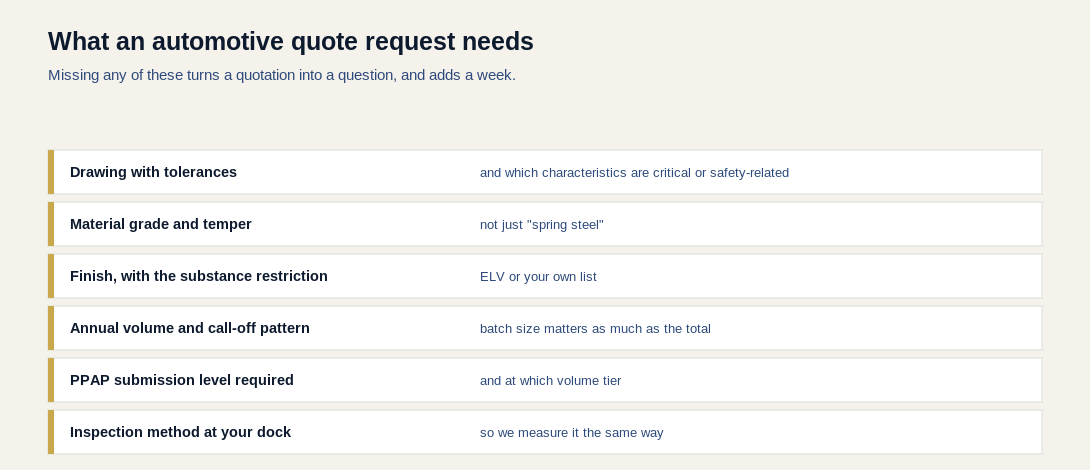
1. THE DRAWING, WITH CRITICAL CHARACTERISTICS MARKED
Not just tolerances — which tolerances matter. A drawing where every dimension carries the same tolerance tells the supplier nothing about where to concentrate process control, and typically produces a higher price because everything has to be treated as critical.
Mark the characteristics that are critical or safety-related. It usually reduces cost rather than increasing it.
2. MATERIAL GRADE AND TEMPER
"Spring steel" is not a specification. Grade determines strength and corrosion behavior; temper determines springback during forming and how the part behaves after heat treatment.
Specifying temper as well as grade reduces lot-to-lot variation noticeably and costs nothing to state.
3. FINISH, WITH THE SUBSTANCE RESTRICTION
Specify chemistry rather than color. "Yellow passivate" was hexavalent historically; trivalent is the compliant replacement, and the drawing should say which.
And one to check on inherited drawings: Dacromet contains hexavalent chromium, despite frequently being described as chrome-free. The ELV Directive restricts Cr(VI) in vehicle components, so Geomet is the correct hexavalent-free specification. This is usually a direct substitution and is far cheaper to fix at drawing stage than at declaration stage.
4. VOLUME AND CALL-OFF PATTERN
Annual volume alone is not enough. Fifty thousand parts called off monthly and fifty thousand called weekly in small batches are different manufacturing problems, because the second is dominated by changeover.
Give both the annual figure and the expected batch size. It changes tooling decisions and it changes price.
5. PPAP SUBMISSION LEVEL
State which level applies and at which volume tier. Level 3 is the default for new tooling at most OEMs, but confirm it rather than assuming.
If your customer requires a particular format or portal submission, say so at quotation. Format rework after the data is compiled is a pure waste of a week.
6. HOW YOU WILL INSPECT IT
The most commonly omitted item and the one that prevents the most disputes. If you measure free length in a fixture and we measure it on a surface plate, both of us can be correct and disagree.
Tell us the method, the fixture, and the working height for any load specification. We will measure it the way you will.
SEND THE MODEL, NOT ONLY THE PDF
A flat PDF is enough to quote a simple compression spring. For anything with three-dimensional geometry — wire forms, clips, multi-plane brackets — a 3D model removes ambiguity that a 2D view cannot.
The specific benefit is in the relationships between features. A drawing dimensions each feature individually; a model shows how they sit relative to one another, which is usually what determines whether the part assembles. Sending a STEP file alongside the drawing typically removes a full round of clarification.
One more item worth including: a sample of the existing part, if one exists. When a part is being re-sourced, the incumbent part answers questions no drawing does — how it was actually made, what the real finish looks like, and which nominal dimensions the previous supplier was hitting in practice.
WHAT YOU GET BACK FROM A COMPLETE PACKAGE
A firm price rather than a conditional one, a realistic lead time, and an early flag on anything that will be difficult. That last part is the most valuable. A supplier who can see the whole requirement can tell you at quotation that a tolerance will require sorting, or that a finish conflicts with a substance restriction — while both are still cheap to change.
Finally, tell us what the part does. A drawing specifies geometry; it rarely explains function. Knowing that a spring returns a lever, or that a clip must be removable by hand for service, frequently reveals that one dimension matters far more than the others — and occasionally that a simpler and cheaper part would do the job better than the one drawn.
A complete package usually takes twenty minutes to assemble and removes a week from the quotation cycle. That trade is available on every inquiry and is declined on most of them.
Send us your drawings, specifications, or automotive program requirements and our engineering team — backed by 20+ years in precision springs and machinery, IATF 16949 certified since 2021 — will get back to you with a competitive quote and realistic turnaround.
Email: sales@seyunda.com
Phone: +65 9168 2618
We look forward to supporting your next automotive program.
Published by the Seyunda Team · 2026