Automotive wire forms rarely come from a catalog. Brackets, retention clips, and custom assemblies are almost always made to a specific drawing, fitting into an existing assembly where the surrounding geometry is already fixed and not negotiable.
That constraint shapes everything about how they should be specified.
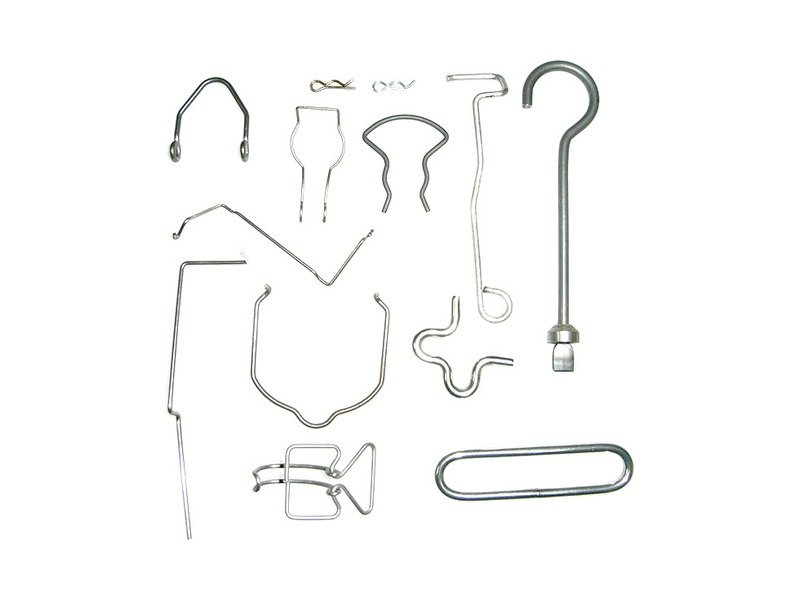
WHAT CUSTOM AUTOMOTIVE WIRE FORMS DEMAND
- Multi-plane geometry: Most automotive wire forms leave a single plane at some point. CNC benders — the WB-4120 with up to sixteen axes, the GWB-570 and the double-head DHB-660 — produce three-dimensional forms a 2D machine cannot make at any price.
- Materials matched to exposure: Stainless and oil-tempered steel, with finishes selected for where the part actually sits in the vehicle.
- Repeatable geometry at volume: A wire form that fits on the bench and fights the fixture at line speed is a failed part, whatever the inspection report says.
- Documentation: PPAP submission and lot traceability for programs that require it.
THE TOLERANCE PROBLEM NOBODY PUTS ON THE DRAWING
Wire forms are usually dimensioned feature by feature. What actually determines whether the part assembles is the accumulated position of the last feature relative to the first, and that is rarely specified.
Each bend carries the error of every bend before it. On a six-bend part, a tolerance that looks generous on each individual bend can stack into a final position error that will not fit. If one relationship on the part really matters — two hooks that must engage the same bracket, say — dimension that relationship directly and let the intermediate features carry looser tolerance.
This single change often converts a part that needs sorting into a part that simply runs.
SPRINGBACK AND MATERIAL LOT
Wire recovers elastically after bending, by an amount that depends on grade, temper, and diameter. Programs compensate for it, but the compensation is established against a material lot. A new coil with slightly different temper can shift results even on a proven program, which is why first-off inspection after a material change is not a formality.
Specifying temper as well as grade on the drawing reduces this variation considerably, and costs nothing.
FINISH: ONE POINT TO GET RIGHT
Zinc, zinc-nickel, Geomet, and Dacromet are all specified on automotive wire forms. Dacromet contains hexavalent chromium, despite occasionally being described as chrome-free. The EU End-of-Life Vehicles Directive restricts Cr(VI), so where that applies, Geomet is the hexavalent-free successor and is the correct specification.
Check this against your customer's substance restrictions before the drawing is released, not when the materials declaration is compiled.
ASSEMBLIES, NOT JUST PARTS
A significant share of automotive wire form work is not a single bent wire. It is a wire form combined with something else: a clip welded to a bracket, a formed wire with a plastic component over-moulded onto it, two wire parts joined into a sub-assembly.
Quoting these well needs one thing the drawing rarely states — which feature is the datum for assembly. When a wire form is welded to a bracket, the tolerance that matters is not the wire form's own geometry but its position relative to the bracket after joining. Those are different specifications, and welding heat can move the first while you were controlling the second.
If your part is an assembly, send the assembly drawing rather than the component drawing alone, and mark the interface that has to fit. It changes what we quote and, more usefully, what we check.
Packaging is worth deciding early on wire forms, more than on most parts. Long, thin, multi-plane components tangle, and a part that arrives bent out of tolerance because of how it travelled is indistinguishable at your dock from a part that was made wrong. Where geometry is delicate, specify layered or compartmented packaging on the drawing rather than leaving it to be resolved after the first damaged delivery.
WHAT MAKES A QUOTABLE DRAWING
- A 3D model alongside the 2D drawing. Multi-plane geometry is ambiguous in two dimensions.
- Material grade and temper.
- Which single relationship on the part is critical, marked as such.
- Finish, with the substance restriction that applies.
- Annual volume and batch size.
- How the part is inspected at your incoming dock, so we can measure it the same way.
That last point prevents more disputes than any other item on the list.
Send us your drawings, specifications, or automotive program requirements and our engineering team — backed by 20+ years in precision springs and machinery, IATF 16949 certified since 2021 — will get back to you with a competitive quote and realistic turnaround.
Email: sales@seyunda.com
Phone: +65 9168 2618
We look forward to supporting your next automotive program.
Published by the Seyunda Team · 2026