OEM and tier-one buyers increasingly consolidate springs, wire forms, and clips with fewer suppliers. The reasoning is rarely piece price. It is the overhead that surrounds each supplier relationship, which is largely fixed regardless of how much you buy.
WHAT ACTUALLY COSTS MONEY
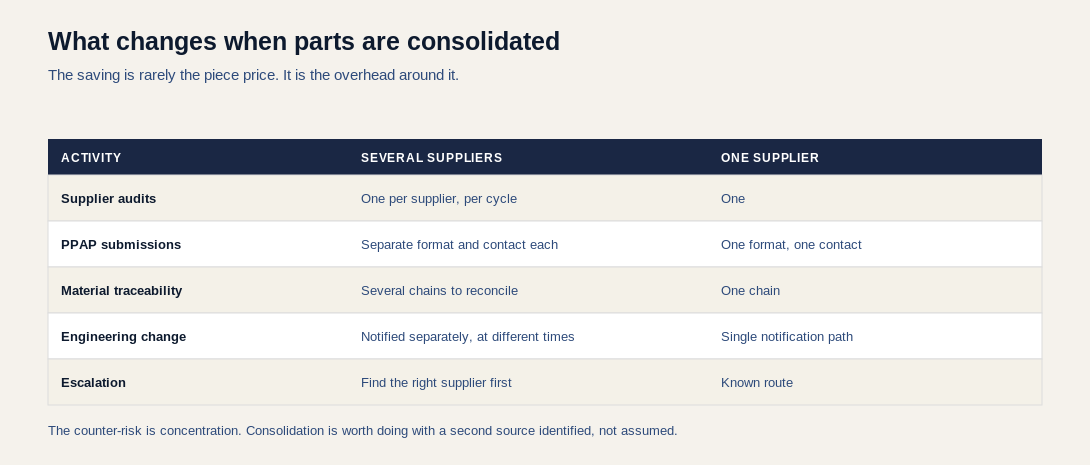
Every supplier carries a fixed administrative load. An audit cycle. A separate PPAP format and contact. Its own traceability chain to reconcile when a question arises. Its own engineering change notification path, arriving on its own schedule.
Three suppliers means three of each. The parts may be cheaper individually and the total cost of ownership higher, because the overhead scales with supplier count rather than with volume.
WHERE THE REAL GAIN SHOWS UP
Engineering change. When a design change affects a spring, a clip, and a wire form in the same assembly, coordinating three suppliers means three notifications, three feasibility responses, and three timelines that must be aligned. One supplier makes it one conversation, and the interactions between the parts get considered together rather than separately.
Problem resolution. When an assembly issue involves two components, separate suppliers each investigate their own part, and both frequently conclude that their part conforms. Both may be right, with the problem living in the interaction. One supplier holding both is able to look at the interface.
Traceability. A single chain from material lot to finished part, rather than several that must be cross-referenced under time pressure during a containment.
THE RISK, STATED HONESTLY
Consolidation concentrates risk. A supplier problem that previously affected one component now affects several, and a capacity constraint or a quality stoppage has a wider blast radius.
The mitigation is not to avoid consolidating. It is to consolidate deliberately: identify a second source for the highest-risk parts before you need it, confirm that tooling could be moved and on what timescale, and understand your supplier's own contingency plan. IATF 16949 requires suppliers to hold one, which makes it a fair question to ask.
WHAT MAKES CONSOLIDATION WORK
- The supplier genuinely makes all the part types in-house, rather than subcontracting some and presenting a single invoice.
- One quality system covering everything, not different arrangements per product line.
- Capacity across the whole range at your volumes, not just at prototype scale.
- A single technical contact who can answer about all the parts.
The first point is the one worth testing. A supplier that subcontracts half the range gives you consolidated purchasing without consolidated control, which is the administrative benefit without the engineering one.
HOW TO RUN A CONSOLIDATION WITHOUT CREATING A PROBLEM
Consolidating badly creates the concentration risk without delivering the administrative saving. A sequence that works:
- Start with new parts, not existing ones. Moving a running part costs tooling, PPAP, and requalification. Directing new work to the consolidating supplier costs nothing extra.
- Move the lowest-risk existing parts next, and only once the new work has demonstrated the supplier performs at your volumes.
- Keep a second source on the highest-risk part, even if it carries a small share. A dormant qualified source is worth its overhead.
- Confirm tooling ownership and transferability in writing before you concentrate. If tooling cannot move, the second source is theoretical.
Done this way, consolidation is reversible at each step. Done as a single migration, it is not.
WHAT WE COVER
Compression, tension, torsion, and spiral springs; wire forms; clips, clamps, clip nuts, and holders; and SMD and EMI spring contacts — all produced in our own facility under one IATF 16949 system. Where a process does go outside, such as specialized plating chemistries, we will tell you which stage and to whom.
One caution about how consolidation is often justified internally. The business case is usually written around piece price, because that is the number a purchasing system reports. The saving is mostly in overhead that no system reports — audit days, PPAP cycles, engineering coordination, containment effort. Building the case on price alone tends to understate the benefit and, worse, sets the wrong success measure afterwards.
Measure supplier count, audit days, and time-to-resolution instead. Those move first, and they are the reason the exercise is worth doing.
The supplier count that is right for you is not necessarily the smallest one. It is the smallest one you can lose a member of without stopping a line.
Send us your drawings, specifications, or automotive program requirements and our engineering team — backed by 20+ years in precision springs and machinery, IATF 16949 certified since 2021 — will get back to you with a competitive quote and realistic turnaround.
Email: sales@seyunda.com
Phone: +65 9168 2618
We look forward to supporting your next automotive program.
Published by the Seyunda Team · 2026