Electrification changes the electrical architecture of a vehicle rather than just its powertrain. Higher voltages, more electronic modules, and more places where current has to cross a mechanical joint. Springs, contacts, and clips end up doing electrical work that used to be purely mechanical.
WHAT CHANGES ELECTRICALLY
Three things follow from electrification that matter for contact design.
- More modules mean more shielding. Power electronics generate substantial electromagnetic interference. Every inverter, converter, and control module needs its emissions contained, and every shield needs a reliable ground.
- Higher voltages raise the consequence of a poor joint. A contact resistance that was tolerable at 12 V becomes a heating problem at higher potential and current.
- Thermal cycling gets harder. Power electronics run hot and cycle with use, which is precisely the condition under which contact materials relax and lose force.
THE FAILURE LOOP WORTH UNDERSTANDING
Contact joints fail in a self-reinforcing sequence. Contact force decays, whether through stress relaxation or fretting. Lower force means higher contact resistance. Higher resistance under current means local heating. Heat accelerates relaxation, which lowers force further.
The point at which to intervene is the beginning: specify a material that holds its force at the temperature the joint will actually reach, rather than at room temperature.
MATERIAL CHOICES, AND THE TRADE INVOLVED
Copper alloys trade conductivity against strength, and there is no option that maximizes both.
- Beryllium copper C17200: about 22% IACS with an excellent elastic limit and strong resistance to stress relaxation at temperature. The choice where contact force must survive.
- Beryllium copper C17510: 48 to 60% IACS with good but lower strength, where current carrying dominates.
- Phosphor bronze C51000: 13 to 15% IACS with very good spring properties, for lower-current signal and grounding paths.
- Brass C26000: around 28% IACS, moderate spring properties, and vulnerable to relaxation at temperature. Suitable for cool, low-load grounding.
PLATING FOR A JOINT THAT VIBRATES
Gold does not oxidize, so the interface it forms initially is close to the interface it has years later. That stability is why it is specified for signal paths and for joints where reliability over service life matters more than unit cost.
Tin is cheaper and solders readily, but under micro-motion it is subject to fretting corrosion. In a vehicle, micro-motion is the normal condition rather than the exception. Where a joint vibrates and carries current, gold or a nickel underlayer with tin is the more durable specification.
WHERE HIGH VOLTAGE CHANGES THE QUESTION
Much of what we supply into electrified vehicles is low-voltage board-level work: grounding, shielding, signal contacts. High-voltage systems are a different engineering problem and worth separating clearly.
At high voltage, creepage and clearance distances govern the design, insulation coordination matters as much as conduction, and components frequently require specific safety approvals. A spring contact specified only on conductivity and force is not a high-voltage component, whatever its material.
If your application is a high-voltage interlock, busbar connection, or anything inside the traction system, the requirement is likely to include approvals we do not hold. We will say so rather than quote it. Where we can contribute usefully is the shielding and grounding work around those systems, which grows substantially with electrification and is squarely within what beryllium copper contacts are for.
WHAT WE SUPPLY INTO THIS
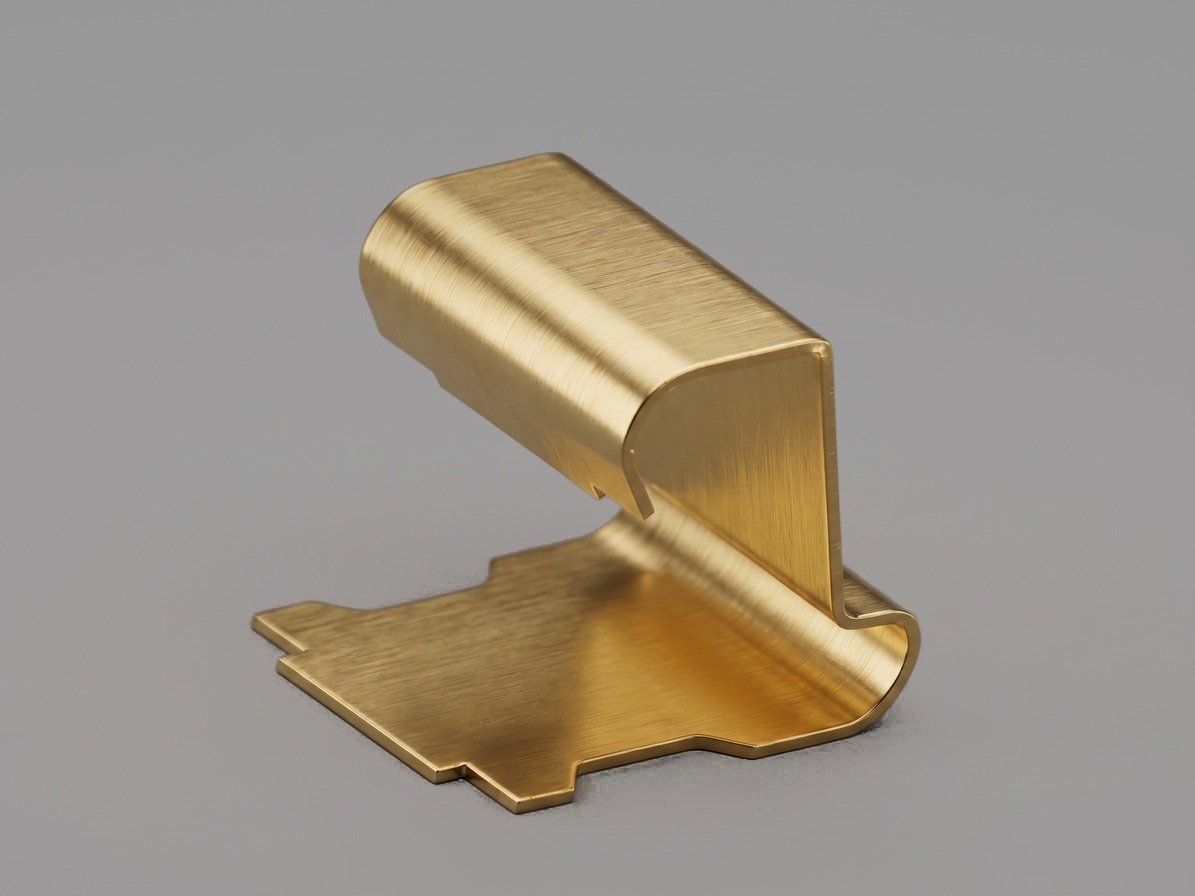
Beryllium copper SMD and EMI spring contacts — 31 variants, 57 part numbers, heights 1.5 to 13.0 mm, tin or gold plated, tape-and-reel packaged. Clips and clamps in phosphor bronze and brass for conductive and grounding applications.
The useful inputs for a recommendation are current, required contact force, operating temperature range, mating material, and expected service life. High-voltage components with safety approval requirements need a supplier holding the relevant approvals, and we will say so if that is what your part needs.
The broader point is that electrification moves a lot of ordinary mechanical parts into electrical service. A clip that was holding a hose is now also carrying a ground path; a spring in a sensor assembly now sits next to a switching converter. Those parts are frequently still specified as though only their mechanical duty mattered, and that gap is where a surprising number of intermittent electrical faults originate.
Send us your drawings, specifications, or automotive program requirements and our engineering team — backed by 20+ years in precision springs and machinery, IATF 16949 certified since 2021 — will get back to you with a competitive quote and realistic turnaround.
Email: sales@seyunda.com
Phone: +65 9168 2618
We look forward to supporting your next automotive program.
Published by the Seyunda Team · 2026