Not every automotive clip is purely mechanical. As vehicles carry more electrical and electronic content, some clips and clamps must also conduct current or provide a ground path. That changes the material conversation completely, because the properties you need now pull against each other.
THE TRADE AT THE CENTER OF IT
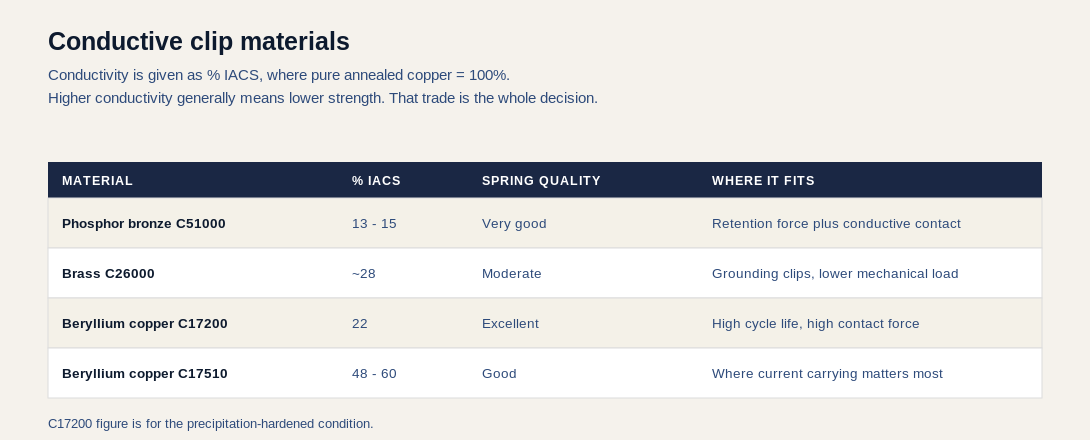
Adding alloying elements to copper raises strength and spring quality, and lowers electrical conductivity. Every material below sits somewhere on that curve. There is no option that is simultaneously the best conductor and the best spring, and choosing well means deciding which property the part actually needs most.
Conductivity is quoted as % IACS, where pure annealed copper is 100 percent.
PHOSPHOR BRONZE (C51000)
Around 13 to 15% IACS, with very good spring properties and good resistance to stress relaxation. This is the common choice where the clip needs genuine retention force and a conductive contact — grounding straps that also hold something in place, retention clips carrying a low-current path.
Worth noting: the material is phosphor bronze. It is occasionally referred to as phosphor copper, which is a different material used as a deoxidizer in casting. If a drawing says phosphor copper, it is worth confirming which is meant before quoting.
BRASS (C26000)
Around 28% IACS — roughly double phosphor bronze — with moderate spring properties. It suits grounding clips and clamps where conducting the current is the main job and mechanical load is light.
Its weakness is stress relaxation. Brass held under constant load at elevated temperature loses force over time. In an engine bay, a brass clip that was tight at assembly may not be tight after three summers.
BERYLLIUM COPPER
BeCu splits into two families, and treating them as one material causes specification errors.
- C17200, high strength: 22% IACS in the precipitation-hardened condition, with excellent elastic limit and fatigue life. The choice where high contact force must survive many cycles. This is the alloy our SMD and EMI spring contacts use.
- C17510, high conductivity: 48 to 60% IACS with good but lower strength. The choice where current carrying dominates.
BeCu costs considerably more than brass or phosphor bronze. It earns that where a cheaper alloy would relax and lose contact.
TWO FAILURE MODES TO DESIGN AGAINST
Stress relaxation. A conductive clip usually works by contact pressure. When the metal relaxes under sustained load and heat, pressure falls, contact resistance rises, and the joint heats — which accelerates the relaxation. Specify the material for the temperature it will actually see.
Galvanic corrosion. A copper alloy clip against an aluminum or steel mating surface, with moisture present, forms a galvanic couple. Plating helps, but the pairing needs checking at design stage rather than after field returns.
PLATING FOR CONTACT, NOT JUST APPEARANCE
Tin is common and economical, and solders well. Its risk is fretting corrosion under micro-motion, where tin oxide builds at the interface and resistance climbs. Where the joint vibrates — which in a vehicle is most places — gold or a nickel underlayer with tin is the more durable specification.
TESTING WHAT YOU SPECIFIED
A conductive clip has two requirements that need separate verification, and checking only one is a common oversight.
Contact resistance should be measured with a four-wire method at the current the joint will actually carry. A two-wire measurement includes lead resistance, which on a milliohm-level contact swamps the result you are trying to read.
Force retention needs measuring after thermal ageing, not on new parts. A clip tested at room temperature on the day of manufacture tells you nothing about whether it will still be tight after a service life in an engine bay. Ageing at the maximum service temperature for a defined period, then re-measuring contact force, is what separates a specification that holds from one that only looked right.
Both belong in the drawing as acceptance criteria, with the method named. "Good electrical contact" is not a specification anyone can test against.
One specification detail that is easy to omit: state whether the conductive path is carrying signal or power. A milliamp signal path and a several-amp ground path have different failure thresholds for the same rise in contact resistance, and they justify very different material and plating budgets.
WHAT TO SEND US
The current the clip must carry, the contact force required, the operating temperature range, the mating material, and the expected service life. Those five decide the alloy. Send the drawing too, but those answers matter more.
Send us your drawings, specifications, or automotive program requirements and our engineering team — backed by 20+ years in precision springs and machinery, IATF 16949 certified since 2021 — will get back to you with a competitive quote and realistic turnaround.
Email: sales@seyunda.com
Phone: +65 9168 2618
We look forward to supporting your next automotive program.
Published by the Seyunda Team · 2026