A spring that fails after two hundred thousand cycles when the specification called for a million has rarely failed because the wrong material was chosen. It has usually failed because something about the surface, or the stress range, was not controlled.
High-cycle fatigue is a process control problem more than a material selection problem, and understanding which variables actually drive it changes what belongs on a drawing.
STRESS RANGE IS THE DESIGN VARIABLE
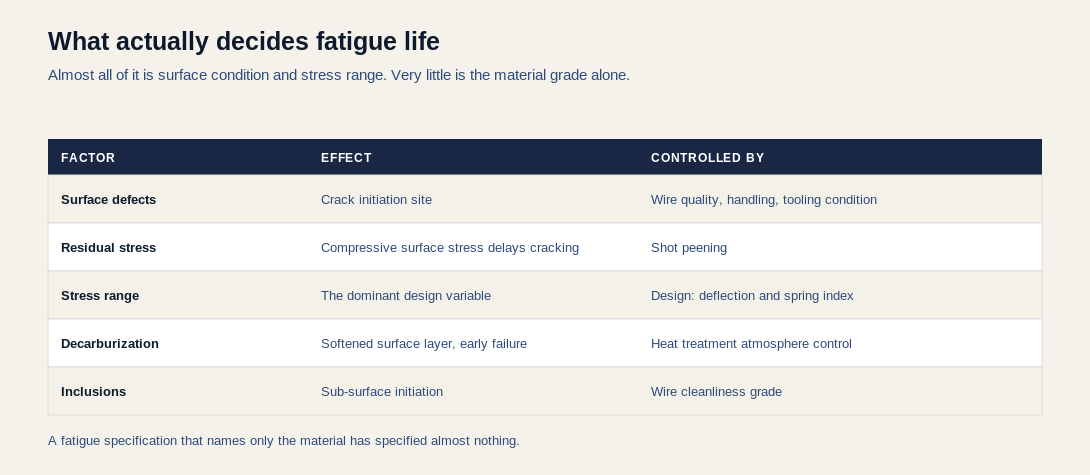
Fatigue is driven by the range of stress a spring experiences, not by its peak. A spring cycling between 40 and 60 percent of its allowable stress will outlast one cycling between 10 and 70 percent, even though the second has a lower peak.
The design levers are deflection and spring index. Reducing working deflection lowers the range directly. Increasing the index — the ratio of mean diameter to wire diameter — lowers stress for the same load, though it costs space and can make the spring less stable. Practical spring index runs roughly 4 to 12; below 4 the wire is difficult to form without damage, above 12 the spring becomes awkward to handle and measure.
SURFACE CONDITION DECIDES WHERE THE CRACK STARTS
Fatigue cracks initiate at the surface, at whatever stress concentration is available. That means a scratch from handling, a tooling mark from coiling, or a corrosion pit all serve the same function: they provide a starting point.
Wire quality matters here in a way that is easy to under-specify. Surface defects in the drawn wire arrive already in the part. So does decarburization — a surface layer depleted of carbon during heat treatment, softer than the core, and a reliable early failure site. Both are controlled at the wire mill and by heat treatment atmosphere, which is why the wire specification deserves as much attention as the geometry.
SHOT PEENING, AND WHY IT MATTERS SO MUCH
Peening induces compressive residual stress at the surface. Because fatigue cracks open under tension, that compressive layer must be overcome before a crack can begin. The improvement is large enough that a peened and an unpeened version of the same spring should be treated as different parts for design purposes.
Which produces the single most common testing mistake in this area: running a fatigue test on unpeened prototypes and applying the result to peened production parts, or the reverse. Test what you will ship, made the way you will make it.
INCLUSIONS AND SUB-SURFACE FAILURE
At very high cycle counts, failures sometimes initiate below the surface at a non-metallic inclusion rather than at the surface. When that happens, improving surface condition further gains nothing — the answer is a cleaner wire specification.
This distinction is worth making at failure analysis. A fracture surface tells you where the crack started, and that determines whether the fix is a process change or a material change.
WHAT A FRACTURE SURFACE TELLS YOU
When a spring fails, the fracture surface identifies the cause more reliably than any process review, and it is worth requesting before assigning blame.
A fatigue fracture has a characteristic appearance: a smooth region where the crack grew progressively, often with beach marks, and a rougher final region where the remaining section failed at once. The origin sits at one edge of the smooth region, and where it sits is the diagnosis.
- Surface origin points at handling damage, tooling marks, corrosion, or decarburization.
- Sub-surface origin at an inclusion points at wire cleanliness, and no amount of surface improvement will fix it.
- Multiple origins usually indicate the stress range was simply too high for the design.
Those three findings lead to three completely different corrective actions, which is why examining the fracture before changing anything is the cheapest step available.
WHAT A USEFUL FATIGUE SPECIFICATION CONTAINS
- Required cycles, and the load or deflection extremes defining the cycle.
- The acceptance criterion — survival, or a permitted load loss percentage.
- Material grade and cleanliness or surface quality requirement.
- Whether shot peening is required, and to what intensity and coverage.
- The test method, including whether parts are tested as-manufactured or after ageing.
A specification naming only the material and a cycle count has left the important variables unstated.
If you take one thing from this: a fatigue requirement is a process specification, not a material specification. Naming the grade is the easy part, and it is the part that decides the least.
Send us your drawings, specifications, or automotive program requirements and our engineering team — backed by 20+ years in precision springs and machinery, IATF 16949 certified since 2021 — will get back to you with a competitive quote and realistic turnaround.
Email: sales@seyunda.com
Phone: +65 9168 2618
We look forward to supporting your next automotive program.
Published by the Seyunda Team · 2026