Choosing a corrosion finish for a spring or clip looks like a cost decision and is usually a compliance decision. The names are used loosely across the industry, and one of them is routinely described as something it is not.
ZINC PLATING
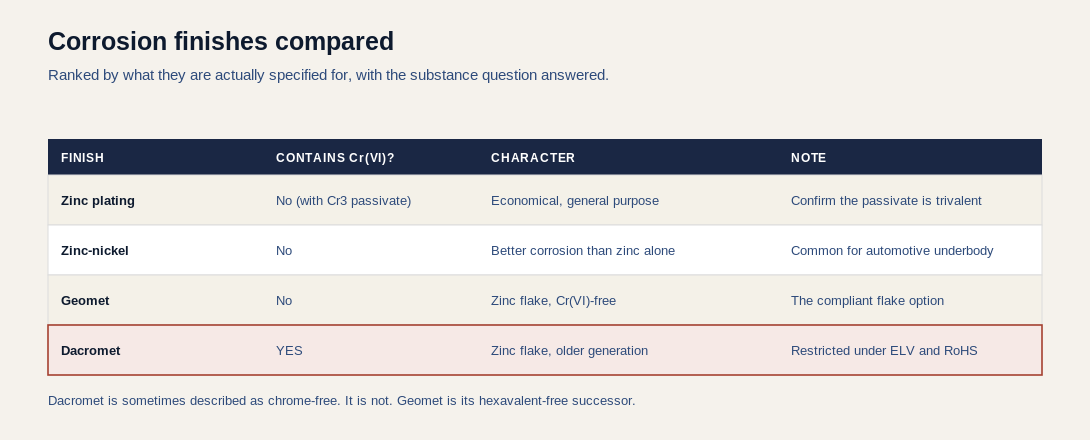
Electrolytically deposited zinc, sealed with a passivate. It is economical, widely available, and adequate for many general-purpose parts.
The detail that matters is the passivate. Traditional yellow and olive chromates were hexavalent. Trivalent (Cr3) passivates are the compliant replacement and are now standard, but drawings written years ago often still specify a color rather than a chemistry. A drawing saying "zinc plate, yellow passivate" without further qualification is ambiguous and worth resolving.
Zinc plating also introduces hydrogen into high-strength steel, so a post-plating bake is required on hardened parts. Timing matters; it is not a step to leave until convenient.
ZINC-NICKEL
An alloy plating with substantially better corrosion resistance than zinc alone, particularly against the underbody environment. It has become common on automotive fasteners and clips for that reason. It is still an electrolytic process, so the hydrogen embrittlement precaution still applies.
GEOMET
A zinc flake coating applied as a dispersion and cured, rather than electroplated. Two consequences follow from that difference. It is hexavalent chromium free, and because there is no electrolytic step, it does not introduce hydrogen — which makes it well suited to high-strength springs where embrittlement is a genuine risk.
It is applied thinly and evenly, which helps where a coating build-up would interfere with fit.
DACROMET, AND THE THING TO GET RIGHT
Dacromet contains hexavalent chromium. It is the older generation of zinc flake coating, and Geomet is its hexavalent-free successor.
This is worth saying plainly because Dacromet is described as chrome-free surprisingly often, including in specifications and supplier literature. It is not. The EU End-of-Life Vehicles Directive restricts Cr(VI) in vehicle components, and RoHS restricts it for equipment in its own scope. A materials declaration listing Dacromet as Cr(VI)-free is a finding waiting to happen.
If you have inherited drawings specifying Dacromet, they are worth reviewing. In most cases Geomet is a direct substitution.
PASSIVATION IS A DIFFERENT THING ENTIRELY
Passivation is often listed alongside these coatings, which causes confusion, because it is not a coating at all. It is a chemical treatment for stainless steel that removes free iron from the surface and allows the natural chromium oxide layer to reform.
It adds no measurable thickness and changes no dimension. It restores corrosion resistance that machining, forming, or handling has compromised. You cannot passivate carbon steel, and passivation is not an alternative to plating — the two apply to different materials for different reasons.
COMPARING COATINGS FAIRLY
Salt spray hours are the figure everyone quotes and the least comparable number in the discussion. The result depends on coating thickness, the passivate or topcoat, the test standard, part geometry, and whether the criterion is white rust or red rust. Two coatings quoted at the same hours under different conditions are not equivalent.
To compare meaningfully, fix three things: the test standard, the failure criterion, and the coating thickness. Without all three, the numbers are marketing rather than data.
It is also worth knowing that cyclic corrosion testing correlates better with real service than continuous salt spray, because it includes wet and dry phases the way a vehicle actually experiences them. If your customer specifies a cyclic schedule, that is why.
CHOOSING, IN ORDER
- Establish the exposure environment and the required service life.
- Check the base material — if it is high-strength steel, hydrogen embrittlement narrows the options.
- Check your customer's substance restrictions before selecting, not after.
- Specify chemistry, not color.
- Agree the test method and acceptance criteria, so "corrosion resistant" means something measurable.
Two habits prevent most finishing problems. Write the chemistry into the drawing rather than a color or a trade name, because trade names change hands and formulations change with them. And re-check inherited drawings when a program is renewed, since a finish specified compliantly ten years ago may name a coating that has since been restricted.
Both take minutes at drawing stage. Neither is cheap once parts are in production and a declaration has been submitted.
Send us your drawings, specifications, or automotive program requirements and our engineering team — backed by 20+ years in precision springs and machinery, IATF 16949 certified since 2021 — will get back to you with a competitive quote and realistic turnaround.
Email: sales@seyunda.com
Phone: +65 9168 2618
We look forward to supporting your next automotive program.
Published by the Seyunda Team · 2026