Clips and clamps look simple next to a coiled spring. The material choice behind them decides whether they hold retention force, resist corrosion, and survive assembly-line handling without cracking. It is the least glamorous decision on the drawing and the one that most often causes warranty returns.
SPCC COLD-ROLLED STEEL
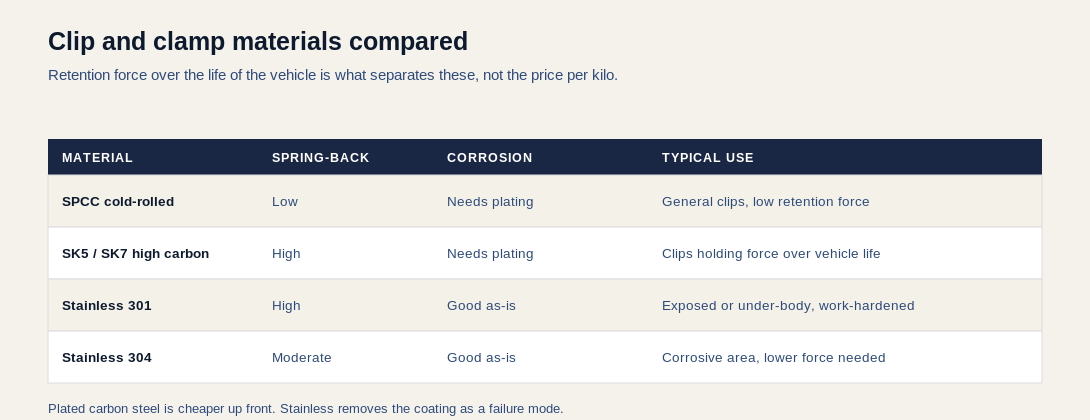
Cost-effective and highly formable. It suits general-purpose clips where sustained spring-back force is not the primary requirement — locating clips, covers, retainers that hold position rather than tension.
Its limitation is exactly that: low spring-back. A clip in SPCC that is over-deflected during assembly tends to stay deflected. If the part will be flexed repeatedly or must maintain clamping load over years, this is the wrong choice however good the price looks.
SK5 AND SK7 HIGH CARBON SPRING STEEL
Higher carbon content, heat treated to a spring temper. These hold clamping force over the life of the vehicle, which is what you want when the clip is the thing keeping a hose, harness, or panel in place.
The trade is formability and corrosion. Higher hardness means tighter bend radii risk cracking, so the drawing needs realistic radii. And bare carbon steel will rust, so a finish is not optional.
STAINLESS 301 AND 304
301 work-hardens substantially during forming, which produces good spring-back with corrosion resistance built into the material rather than applied on top. It is the usual choice for exposed and under-body clips.
304 is more corrosion resistant and easier to form, with lower spring-back. It fits corrosive environments where the retention force required is modest.
Stainless costs more per part. What you get back is the removal of coating as a failure mode. A plated carbon steel clip fails when its coating fails; a stainless clip has no coating to fail.
A FINISH CAUTION WORTH STATING PLAINLY
Where a carbon steel clip needs corrosion protection, zinc plating, zinc-nickel, Geomet and Dacromet are all common specifications. One point is regularly got wrong: Dacromet contains hexavalent chromium. It is sometimes described as chrome-free, and that is the opposite of the truth.
For automotive parts this is not academic. The EU End-of-Life Vehicles Directive restricts hexavalent chromium, and a materials declaration that lists Dacromet as Cr(VI)-free is a compliance failure waiting to be found. Geomet is the hexavalent-free successor, and it is the one to specify where the restriction applies.
HEAT TREATMENT CHANGES WHAT THE MATERIAL CAN DO
SK5 and SK7 arrive as high carbon steel. What turns them into a spring is the heat treatment afterwards, and the same grade can deliver very different retention force depending on how it was treated.
Two things follow for a drawing. First, specifying the grade alone does not specify the property you actually want — state the required hardness or the retention force with its tolerance, and let the supplier reach it. Second, the forming has to happen before hardening, because a fully hardened clip cannot be formed without cracking.
That sequence has a practical consequence: dimensional change during heat treatment is real and must be allowed for. A clip that is dimensionally perfect before treatment and out of tolerance after it is a process planning problem, not a forming problem.
Assembly handling deserves a mention, because it causes failures that look like material problems. A clip that is over-deflected during installation — forced onto a panel thicker than the drawing assumed, or opened by hand to fit — may be taken beyond its elastic limit at that moment. It goes on, it looks correct, and it has already lost part of its retention force before the vehicle leaves the line.
If the clip will be installed by hand, say so at design stage. The opening force and the elastic range need to accommodate a person in a hurry, not just the nominal panel thickness.
HOW TO CHOOSE, IN ORDER
- Decide the retention force the clip must still deliver at end of life, not at installation.
- Establish the exposure environment: under-body, engine bay, cabin, or sealed.
- Choose material from those two answers.
- Then choose the finish, checking it against your customer's substance restrictions.
- Finally, set bend radii that the chosen material can actually take.
Send us the drawing, the exposure environment, and the required retention force with its tolerance, and we will tell you which of these fits — including when the cheaper material is genuinely sufficient.
Send us your drawings, specifications, or automotive program requirements and our engineering team — backed by 20+ years in precision springs and machinery, IATF 16949 certified since 2021 — will get back to you with a competitive quote and realistic turnaround.
Email: sales@seyunda.com
Phone: +65 9168 2618
We look forward to supporting your next automotive program.
Published by the Seyunda Team · 2026