Suspension springs live a hard life. They cycle continuously through road input, carry sustained static load, and sit in the worst corrosion environment on a vehicle — road salt, stone impact, standing water. Material and finish choices decide whether they reach vehicle life, and the two failure modes involved are different problems that need addressing separately.
TWO FAILURE MODES, NOT ONE
Fatigue is cyclic. A crack initiates at a stress concentration, usually at the surface, and propagates until the section fails. Corrosion is chemical, but its real damage is that it creates the surface defects fatigue then exploits. A corrosion pit is a crack initiation site.
This is why a suspension spring specification addresses both, and why treating a coating purely as cosmetic protection misses its structural role.
WHY OIL-TEMPERED ALLOY WIRE DOMINATES
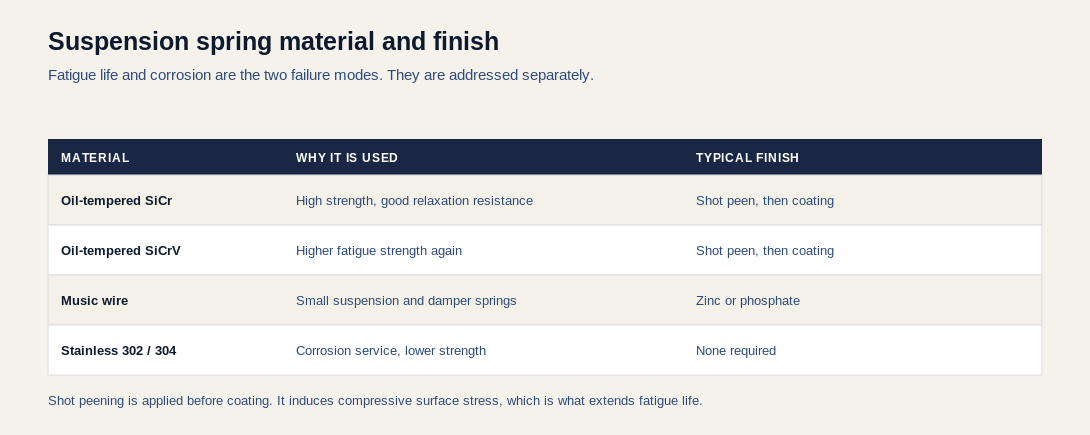
Silicon-chromium (SiCr) oil-tempered wire is the mainstream choice for suspension work. Its advantage over plain carbon spring steel is not simply higher strength — it is resistance to relaxation under sustained load at elevated temperature. A spring that loses free length in service changes vehicle ride height, which is a durability complaint rather than a breakage.
Silicon-chromium-vanadium (SiCrV) raises fatigue strength further and is specified where stress levels are higher or a lighter spring is required for the same load.
Both arrive already heat treated to their final properties. That is what oil-tempered means, and it has a process consequence: the wire is coiled in its hardened condition, then stress relieved, rather than being coiled soft and hardened afterwards.
SHOT PEENING IS NOT OPTIONAL HERE
Shot peening bombards the surface with media, inducing a compressive residual stress layer. Because fatigue cracks initiate under tension at the surface, a compressive layer must first be overcome before a crack can start. The effect on fatigue life is substantial — large enough that peened and unpeened versions of the same spring are, for design purposes, different components.
Two practical points. Peening happens before coating. And a fatigue test on an unpeened prototype tells you almost nothing about a peened production part, which is a common and expensive testing error.
FINISH SELECTION, WITH ONE CAUTION
Zinc plating with trivalent passivate, zinc-nickel, and Geomet zinc flake are the common specifications. Zinc-nickel performs well in the underbody environment; Geomet suits parts where coating thickness and hydrogen embrittlement risk matter.
The caution worth stating: Dacromet contains hexavalent chromium. It is sometimes described as chrome-free, which is the opposite of the truth. The EU ELV Directive restricts Cr(VI), so Geomet is the correct hexavalent-free specification for vehicle parts.
HYDROGEN EMBRITTLEMENT
High-strength spring steel is vulnerable to hydrogen embrittlement from electroplating processes. The mitigation is a post-plating bake, and the timing matters — it must happen promptly after plating, not at the end of the week.
This is one reason zinc flake coatings such as Geomet are favored on high-strength suspension springs: they are applied without the electrolytic step, so the hydrogen route does not exist.
TESTING THAT ACTUALLY PREDICTS SERVICE
Suspension spring validation usually combines three tests, and each answers a different question.
- Load testing confirms the spring delivers the specified force at the specified heights. It says nothing about durability.
- Fatigue testing cycles the spring between defined deflection limits for a specified count. The acceptance criterion should state whether the requirement is survival or a permitted percentage of load loss, because a spring can survive while relaxing out of specification.
- Corrosion testing exposes coated parts to salt spray or a cyclic corrosion schedule.
The combination that predicts service best is corrosion exposure followed by fatigue testing on the exposed parts. Testing them separately misses the interaction that causes most real failures, where a corrosion pit becomes the crack initiation site.
WHAT WE CAN AND CANNOT DO
Our in-house spring production runs 0.1 – 6.0 mm wire depending on spring type. Heavy suspension coils for passenger vehicles sit above that range and need a large-coiler operation — equipment we build and sell, in the SHA series, rather than run for production ourselves. For smaller suspension and damper springs within our range, send the load specification, cycle requirement, and exposure environment.
If you are specifying a suspension spring for the first time, the sequence that avoids most trouble is: establish the load and deflection requirement, then the fatigue requirement, then the corrosion environment, then choose material, then choose finish, then set the dimensional tolerances that follow. Working the other way round — starting from a dimensional envelope — tends to produce a spring that fits and does not last.
Send us your drawings, specifications, or automotive program requirements and our engineering team — backed by 20+ years in precision springs and machinery, IATF 16949 certified since 2021 — will get back to you with a competitive quote and realistic turnaround.
Email: sales@seyunda.com
Phone: +65 9168 2618
We look forward to supporting your next automotive program.
Published by the Seyunda Team · 2026