Automotive electronics content keeps growing, and with it the number of substance declarations moving through the supply chain. There is a widespread and consequential misunderstanding about which rules apply to a vehicle part, and it is worth clearing up before a materials declaration is compiled.
THE POINT MOST DECLARATIONS GET WRONG
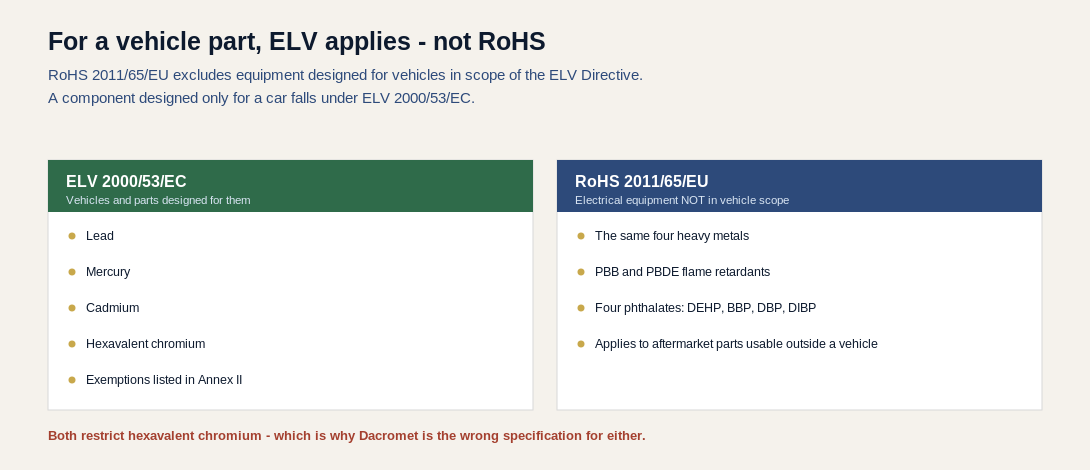
For a component designed for use in a vehicle, the governing rule in the EU is the End-of-Life Vehicles Directive, 2000/53/EC — not RoHS.
RoHS 2011/65/EU explicitly excludes equipment designed for vehicles that fall within ELV scope. A part designed only for a car sits under ELV. The same component designed for general use that can also operate outside a vehicle sits under RoHS. The distinction turns on design intent, not on what the part is made of.
WHAT EACH RESTRICTS
ELV restricts four heavy metals: lead, mercury, cadmium, and hexavalent chromium. Annex II lists the exemptions, which are reviewed periodically — an exemption relied on today may not exist at the next review, which matters for a part expected to stay in production for years.
RoHS restricts those same four plus PBB and PBDE flame retardants and four phthalates: DEHP, BBP, DBP, and DIBP.
For springs, clips, and wire forms the practical overlap is narrow but decisive. These are metal parts. The substance that matters is hexavalent chromium, and it enters through the finish rather than the base material.
WHERE Cr(VI) ACTUALLY COMES FROM
Two routes, both in finishing.
- Chromate passivation over zinc plating. Traditional yellow and olive passivates were hexavalent. Trivalent (Cr3) passivates are the compliant replacement. If a drawing says only "zinc plated, yellow passivate", confirm which chemistry is meant.
- Dacromet. This zinc flake coating contains hexavalent chromium, despite being described as chrome-free with some regularity. Geomet is its hexavalent-free successor and is the correct specification where the restriction applies.
WHAT A USABLE DECLARATION NEEDS
- Base material grade with a mill certificate.
- Finish type and the passivate chemistry, not just a color.
- Any exemption relied on, cited by its Annex II entry.
- The declaration route your customer uses — IMDS is standard in automotive.
IMDS entries are where vague finish specifications become visible. A finish recorded as "zinc" without the passivate chemistry cannot be assessed by anyone downstream.
THE OTHER REGIMES YOU WILL BE ASKED ABOUT
ELV and RoHS are not the only lists a component declaration touches.
- REACH. Substances of Very High Concern are notifiable above threshold, and the candidate list grows at each update. Unlike ELV, it is not a fixed list you can check once and file.
- China RoHS. Separate labelling and disclosure requirements, with its own scope. Meeting EU RoHS does not automatically satisfy it.
- Customer-specific lists. Most OEMs maintain their own restricted substance list, and these are usually stricter than the legislation. The customer list is the one that governs your part in practice.
The practical consequence is that a declaration is a maintained record rather than a one-time document. When a candidate list updates, parts already in production are affected, not just new ones.
WHAT TO DO WITH THIS
Check your existing drawings for two phrases: any yellow or olive chromate that has not been confirmed trivalent, and any occurrence of Dacromet. Both are quick to find and cheap to change at drawing stage.
Seyunda supplies to RoHS requirements and provides material and finish documentation for automotive declarations. If your program needs a specific finish confirmed against ELV Annex II, ask and we will tell you what the coating actually contains rather than what the datasheet name suggests.
A final word on responsibility. Substance compliance is a shared obligation, but the declaration your customer receives is made in your name. A supplier can tell you what a coating contains and provide the material documentation to support it; only you can check that against the restricted substance list your customer applies, because that list is frequently stricter than the legislation and specific to their programs.
What we can do is answer the question accurately. If you ask what is actually in a finish rather than what it is called, you will get the chemistry, including where a familiar trade name carries a substance that its reputation suggests it does not.
Send us your drawings, specifications, or automotive program requirements and our engineering team — backed by 20+ years in precision springs and machinery, IATF 16949 certified since 2021 — will get back to you with a competitive quote and realistic turnaround.
Email: sales@seyunda.com
Phone: +65 9168 2618
We look forward to supporting your next automotive program.
Published by the Seyunda Team · 2026