Before a new spring, clip, or wire form enters serial production for an automotive program, your purchasing and quality teams will expect a documented package proving the process can make the part repeatably. That package is PPAP, and knowing what to ask for saves a round of correspondence at exactly the point in a program where there is no slack.
WHAT PPAP IS, PRECISELY
The Production Part Approval Process comes from the AIAG. It is an automotive tool, and it exists to demonstrate one thing: that the process, as it will actually run, produces parts to the drawing consistently.
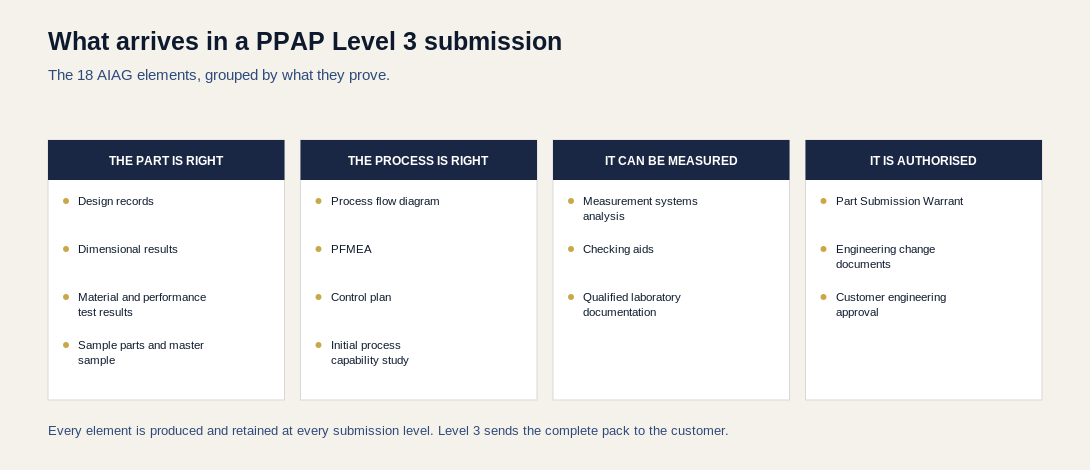
The AIAG manual defines 18 elements. A common misreading is that the submission level describes the quality of the part. It does not. Every element is produced and retained at every level. The level sets only how much is sent to the customer rather than held on file at the supplier.
WHAT LEVEL 3 ACTUALLY CONTAINS
Level 3 is the default for new tooling and engineering changes at most OEMs: the Part Submission Warrant, sample parts, and the complete supporting data pack. That means dimensional results across the sample, material and performance test results, the process flow diagram, PFMEA, control plan, measurement systems analysis, and initial capability study.
Levels 1, 2, 4, and 5 vary what is transmitted. Level 5 is reviewed at the supplier's plant rather than sent at all. None of them changes what the supplier must have produced.
THE THREE DOCUMENTS BUYERS SHOULD READ FIRST
- The control plan. It tells you what is actually monitored in production, how often, and what happens when a reading falls outside limits. If your critical characteristic is not on it, the rest of the pack is decoration.
- The initial capability study. Cp and Cpk on the characteristics that matter, with the sample size stated. A Cpk quoted without a sample size is not a result.
- The MSA. Whether the measurement system can actually distinguish good parts from bad at your tolerance, including operator variation. Many disputes that look like process problems are measurement problems.
WHAT TRIGGERS A RESUBMISSION
This is where programs lose time, because the triggers are broader than people expect. A new part, obviously. But also: a change of material or material source, a change of tooling, a change of process, a change of manufacturing location, and production from tooling that has been inactive for an extended period.
Moving a part between two machines in the same building can require resubmission. Agree the trigger list in writing at sourcing, rather than discovering a disagreement about it mid-program.
WHAT SLOWS SUBMISSIONS DOWN
In practice, three things. Drawings without stated inspection methods, so the supplier measures a feature differently than the customer will. Critical characteristics not marked, so capability is run on the wrong dimension. And gauge disagreements, where both parties measure correctly by their own method and get different numbers.
All three are avoidable at drawing stage and expensive at submission stage.
THE WARRANT IS A SIGNATURE, NOT A FORMALITY
The Part Submission Warrant is the document that carries a signature, and it is worth understanding what is being signed. The supplier is declaring that the parts submitted were made from production tooling, at production rate, in the production location, by the production process.
That declaration is the whole point of PPAP. Parts made carefully on a development machine and submitted as production samples technically breach it, and the breach only surfaces when volume production behaves differently from the submission.
Two questions are worth asking of any submission. Were these parts made on the tooling that will run the job? And were they made at the rate the job will run at? Slow, careful production can hold tolerances that the same process at full rate cannot.
WHAT WE PROVIDE
Seyunda holds IATF 16949 and can supply PPAP documentation for automotive programs. Tell us the submission level required, which characteristics are critical, and how you will inspect them at goods-in. If your customer imposes a specific format or portal, say so early — format rework is a common and entirely avoidable delay.
One last practical note. Agree the submission timeline against your build schedule rather than against the part delivery date. Approval is frequently the critical path at launch, and it depends on your own engineering team reviewing the pack as much as on the supplier producing it. Building a two weeks of review time into the plan costs nothing and prevents the situation where conforming parts sit in a warehouse waiting for a signature.
Send us your drawings, specifications, or automotive program requirements and our engineering team — backed by 20+ years in precision springs and machinery, IATF 16949 certified since 2021 — will get back to you with a competitive quote and realistic turnaround.
Email: sales@seyunda.com
Phone: +65 9168 2618
We look forward to supporting your next automotive program.
Published by the Seyunda Team · 2026