In automotive sourcing, a supplier's certification is a proxy for how reliably that supplier will perform at volume, across plants, and over the life of a vehicle program. For springs and clips, small process deviations compound quickly at automotive scale. That is the specific problem IATF 16949 exists to address.
WHAT IATF 16949 ACTUALLY IS
It was first published in October 2016, replacing ISO/TS 16949. It is not a standalone standard. It is applied together with ISO 9001 and adds automotive-specific requirements on top.
That distinction matters when you read a certificate. A supplier certified to IATF 16949 is necessarily operating an ISO 9001 system as well. A supplier certified only to ISO 9001 is not partway to IATF; the automotive requirements are simply absent.
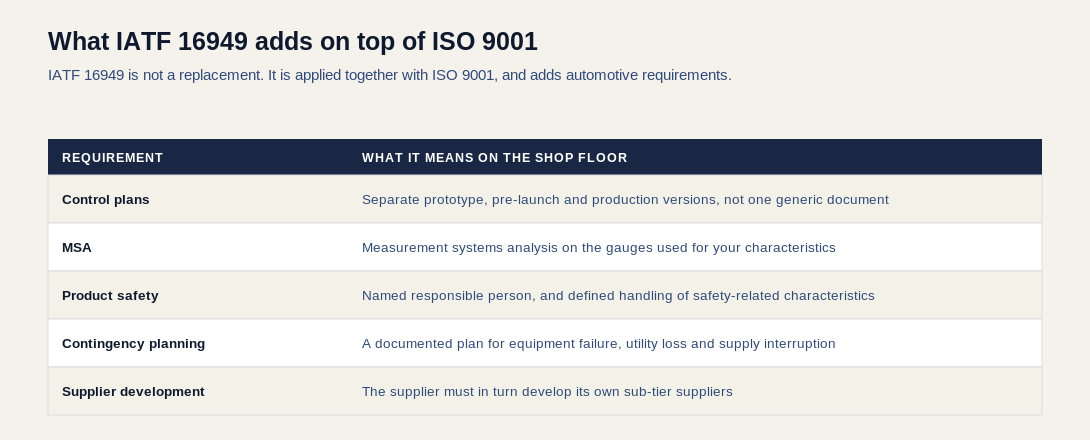
WHAT IT CHANGES ON THE SHOP FLOOR
- Control plans in three versions: Prototype, pre-launch, and production, rather than one generic document that never quite matches what is running.
- Measurement systems analysis: A calibration sticker says the gauge was correct on a date. MSA asks whether the measurement system can actually distinguish good parts from bad at your tolerance, including operator-to-operator variation.
- Product safety: A named responsible person and defined handling of safety-related characteristics through the whole process chain.
- Contingency planning: A documented plan for equipment failure, utility interruption, and supply disruption. Written before it happens, not during.
- Supplier development: The obligation flows downward. Your supplier must develop its own sub-tier suppliers, which is where a surprising number of field problems actually originate.
FULL LOT TRACEABILITY, AND WHY IT EARNS ITS COST
Every batch traceable back to its material lot, process parameters, and inspection records. This looks like paperwork until a field issue appears.
The difference it makes is the size of the containment. With traceability, a suspect batch is bounded: you know which lots, which dates, which vehicles. Without it, containment expands to everything that could possibly be affected. The cost difference between those two outcomes is usually larger than the entire cost of maintaining the system.
THE MISCONCEPTION WORTH CLEARING UP
A certificate is not part approval. IATF 16949 certifies that the supplier runs a conforming quality management system. It says nothing about whether a specific part meets your drawing. That is what PPAP submission and your own first-article inspection are for, and they are separate exercises.
Two things follow. Check the certificate's scope statement names the site that will run your part, because a group certificate held elsewhere does not cover a plant it does not list. And ask for capability data on your critical characteristic separately, because no certificate contains it.
WHERE CERTIFIED SUPPLY CHAINS STILL FAIL
Certification reduces risk. It does not remove it, and knowing where it thins out is useful.
Sub-tier visibility. IATF requires suppliers to develop their own suppliers, but the depth of that control varies. A spring maker's certificate says little about the wire mill three steps back, and material variation is a common root cause of drift that looks like a process problem.
Change notification. The requirement exists. Whether you are told about a tooling change, a material source change, or a process relocation depends on how the supplier interprets significance. Agree in writing what triggers a notification, rather than assuming the standard settles it.
Scope drift over time. A certificate covering one site three years ago may not cover the line your part moved to since. Re-check the scope statement at renewal, not just at sourcing.
A related point on cost. Buyers sometimes treat IATF certification as a price premium to be negotiated away. It is more accurate to see it as a transfer of work. The control plans, the MSA studies, the contingency planning and the traceability records all cost something to maintain, and if the supplier is not carrying that cost, your own quality function generally ends up doing the equivalent work at incoming inspection. The question is not whether it gets paid for, but where.
WHAT TO ASK A SPRING OR CLIP SUPPLIER
- Can I see the certificate, its scope statement, and the accreditation body?
- Is the site that will run my part named on it?
- What PPAP submission level do you propose?
- What is your Cpk on my critical characteristic, and over how many pieces?
- Has an MSA been run on the gauge measuring it?
Seyunda has been IATF 16949 certified since 2021 and ISO 9001 certified since 2013.
Send us your drawings, specifications, or automotive program requirements and our engineering team — backed by 20+ years in precision springs and machinery, IATF 16949 certified since 2021 — will get back to you with a competitive quote and realistic turnaround.
Email: sales@seyunda.com
Phone: +65 9168 2618
We look forward to supporting your next automotive program.
Published by the Seyunda Team · 2026