Country of origin is used as a proxy for quality in machinery marketing, and it deserves examining rather than asserting. What actually matters is the supply chain behind a machine and what the builder does with it.
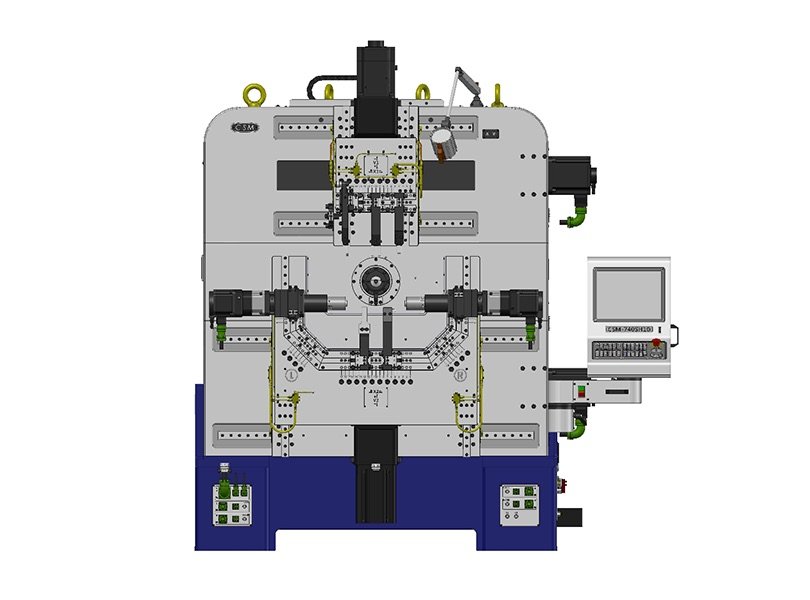
WHAT THE TAIWANESE MACHINE TOOL CLUSTER ACTUALLY PROVIDES
Taiwan has a dense, long-established machine tool industry, and density is the substantive advantage. Castings, linear guides, ball screws, spindles, controls, and servo components are available from established suppliers within a short distance.
That proximity has two practical effects. Development iterations are faster, because a change to a component is a conversation rather than an international procurement. And spares remain available, because the supplier base is stable and serves many builders rather than one.
For a buyer, the second effect is the one that matters over a machine's life.
THE COMPONENTS WORTH ASKING ABOUT
Rather than accepting country of origin as an answer, ask what is inside. Servo motors, drives, controllers, and linear components determine how a machine performs and how long it stays supportable.
Our ZX-250, for example, uses Japanese Yaskawa servo motors. That is a more informative fact than any assembly location, because it tells you about the control performance and about spares availability years from now.
A builder who cannot readily tell you the make of the drives and controller is either not specifying them carefully or would rather you did not ask.
WHERE ORIGIN GENUINELY MATTERS
- Spares availability over the machine's life, which depends on the supplier base rather than the flag.
- Support response, which depends on time zone and whether the builder has people who can help.
- Controller support horizon, which is set by the controller manufacturer, not the machine builder.
None of these is settled by country of origin alone, and all three are answerable with direct questions.
WHAT WE THINK ACTUALLY DISTINGUISHES A BUILDER
The unusual part of our position is not location. It is that we run the machines we sell, in our own production, on customer parts.
That has a specific consequence for the answers you get. When we say a wire diameter and tolerance combination is achievable, it is because we have run it. When we say a bottleneck will move rather than disappear, it is because we have moved one. A machine builder who has never had to hold a production tolerance for six months is giving you a specification, not experience.
WHAT ORIGIN CLAIMS USUALLY MEAN
A word on how these claims work, since we are making one ourselves by writing this.
Country of origin describes where final assembly happened. It says little about where components came from, and modern machinery is assembled from an international supply chain regardless of the label. Servo motors, controllers, and linear components frequently originate somewhere other than the assembly location, which is normal and not a criticism.
So an origin claim is a weak signal on its own. It becomes meaningful only when it is a proxy for something specific — a stable component supply base, spares availability, or support proximity — and those are all directly checkable without reference to origin at all.
Ask the direct questions. They work equally well on any supplier, including us, and they cannot be answered with a flag.
THE QUESTIONS THAT SETTLE IT
- What servo motors, drives, and controller does this machine use?
- How long will the controller be supported, and are spares held?
- What is the lead time on wear parts, and on drives?
- Do you manufacture parts on these machines yourself?
- Can I speak to a customer running this model on similar work?
Those five tell you considerably more than any origin claim, including ours. We would rather be judged on them.
Finally, judge a builder on the specifics of a machine you are actually considering, rather than on a range. Component choices vary between models even from the same builder, and a well-specified machine in one part of a range tells you nothing reliable about another. Ask about the drives, the controller, and the support horizon for the exact model on your shortlist.
Send us your production requirements and our engineering team — backed by 20+ years of spring and machinery manufacturing experience — will get back to you with a competitive quote and realistic turnaround.
Email: sales@seyunda.com
Phone: +65 9168 2618
We look forward to supporting your next project.
Published by the Seyunda Team · 2026