Buying a machine from another country adds stages between the factory floor and your first production run. None is difficult and all take time, and the ones that cause problems are usually the ones nobody assigned to anybody.
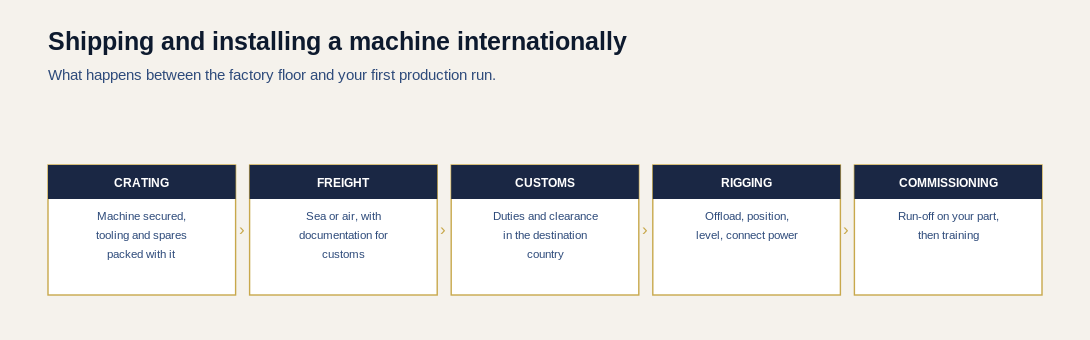
CRATING
The machine is secured for transport, with tooling and spares packed alongside it. Worth confirming: that the tooling you ordered is actually in the crate, and that a packing list identifies what is where.
Machines are shipped with transport restraints holding moving assemblies. These must be removed during installation, and the documentation should identify them. A machine commissioned with a restraint still fitted is a memorable and avoidable problem.
FREIGHT
Sea freight for most machines, air where a schedule justifies the cost difference. The transit time is predictable; the variability sits at either end.
Agree the Incoterms explicitly, because they determine who is responsible at each point and who pays. This is worth settling in the order rather than discovering when something needs collecting from a port.
CUSTOMS
Duties, clearance, and documentation in the destination country. The requirements vary considerably and are the stage most often underestimated, because the timeline depends on an authority rather than on either party.
Establish who is handling clearance and confirm the documentation requirements before shipment. A machine held at a port for a missing document accrues storage charges while nobody is able to do anything about it.
RIGGING AND POSITIONING
Offloading, moving into position, leveling, and connecting services. This needs arranging locally, and it needs the site ready.
Ready means: electrical supply installed at the correct voltage and phase, floor loading confirmed adequate, access route measured, and the position agreed. Machines have been delivered to sites where the route from the door to the position was narrower than the machine.
COMMISSIONING
Setting the machine up, verifying it operates correctly, and running your part. Commissioning is complete when the machine has made your part to your drawing with evidence, not when it powers up.
Agree the acceptance criteria before the engineer arrives. A stated number of consecutive good parts at cycle rate is testable; general satisfaction is not.
WHAT TO CHECK ON ARRIVAL
Before the crate is broken down and before the rigging crew leaves, four checks are worth making.
- External damage to the crate, photographed before opening. Transit damage claims depend on evidence taken at the right moment.
- Packing list against contents, particularly tooling and spares. A missing tooling set found now is a conversation; found at commissioning it is a delay.
- Transport restraints identified and their removal confirmed in the documentation.
- Machine serial and configuration against the order, so any discrepancy is raised before installation rather than after.
Ten minutes at delivery, and it prevents the category of problem that is expensive precisely because it is discovered late.
WHAT TO SETTLE IN THE ORDER
- Incoterms, so responsibility is unambiguous at every stage.
- Who arranges customs clearance, and who pays duties.
- Who arranges rigging, and whether it is included.
- What commissioning covers and what constitutes acceptance.
- Training scope, and whether a follow-up visit is included.
- Spare parts included in the shipment, since the first set arriving with the machine avoids an early wait.
Most delays in international delivery are not transport delays. They are handoffs where each party assumed the other was handling something, and every one of them is prevented by settling the list above before shipment.
One further item worth building into the schedule: the gap between commissioning and stable production. A machine accepted on a good run-off still needs its operators to become fluent, and output during that period sits below rated capability. Plan for it rather than treating it as a problem when it appears — it is normal, it is temporary, and programs that budget for it avoid a difficult conversation that nobody needed.
Send us your production requirements and our engineering team — backed by 20+ years of spring and machinery manufacturing experience — will get back to you with a competitive quote and realistic turnaround.
Email: sales@seyunda.com
Phone: +65 9168 2618
We look forward to supporting your next project.
Published by the Seyunda Team · 2026