A CNC spring machine that is maintained runs for decades. One that is not develops problems that present as quality issues, get investigated as process problems, and turn out to be mechanical.
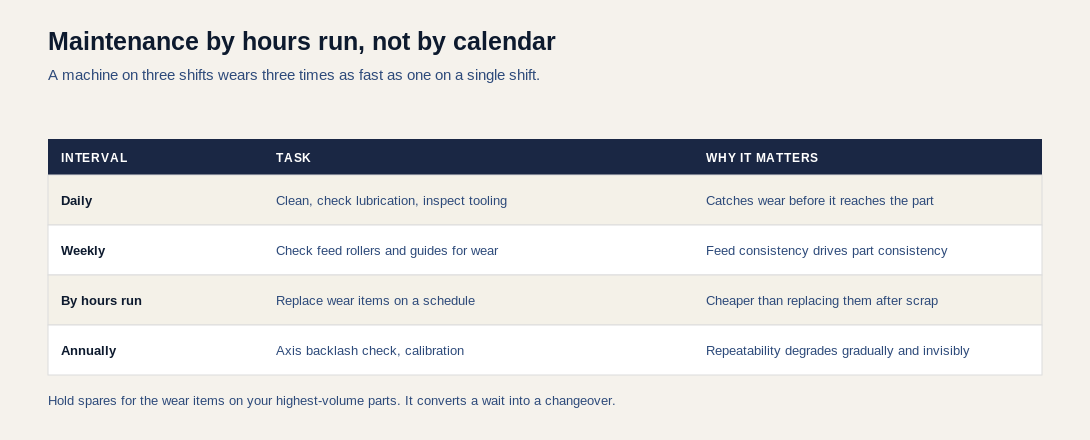
The useful principle is that maintenance intervals belong to hours run, not to the calendar.
WHY HOURS RATHER THAN WEEKS
A monthly schedule treats a machine running one shift the same as one running three. The second is doing three times the work and consuming wear items three times as fast.
Recording hours and scheduling against them is a small administrative change that materially improves outcomes, because it puts the intervention before the wear reaches the part rather than after.
THE DAILY TASKS THAT MATTER MOST
Cleaning, lubrication checks, and a look at the tooling. None of it is sophisticated and all of it catches problems early.
Tooling inspection is the one worth doing attentively. Coiling points, guides, and cutting tools wear gradually, and gradual wear produces gradual dimensional drift — the kind found at final inspection of a finished batch rather than at the machine. An operator who looks at the tooling each shift catches it earlier and cheaper.
WEAR ITEMS AND WHY TO STOCK THEM
Feed rollers, guides, coiling points, and cutting tools are consumables. They are inexpensive relative to a stopped machine, and their lead times are frequently longer than people expect.
Holding a set for your highest-volume parts converts a potential multi-week wait into a changeover. This is among the cheapest risk reductions available on a spring line.
When ordering a machine, ask for the wear parts list checked against the build you actually received rather than the catalog configuration. They are not always identical, and discovering that during a breakdown is the wrong moment.
WHAT TO TRACK
- Hours run, which drives everything else.
- Tooling changes with the part running and the reason — scheduled, or in response to drift.
- Wear part consumption, which becomes a stocking calculation rather than a guess.
- Axis repeatability, checked periodically. It degrades gradually and invisibly.
THE MAINTENANCE THAT IS ACTUALLY RECORD KEEPING
One item is not mechanical at all and matters as much. Programs proven on your machine should be exported and backed up on your own systems.
A machine whose accumulated setups exist only inside its controller, in a proprietary format, is one controller failure away from losing years of process knowledge. Exporting costs nothing and protects work that cannot be quickly recreated.
THE MAINTENANCE THAT PREVENTS THE MOST SCRAP
If only one habit is adopted, make it this: record what a proven setup consisted of, not just its program.
A stored program holds axis positions and feed values. It does not hold which tooling was fitted, what condition that tooling was in, or which material lot was running. Recall the program with different coiling points and the geometry will differ, even though every number is identical.
Shops that record the program alongside the tooling identification and material specification can reproduce a result. Shops that record only the program cannot, and they spend first-off adjusting to find something they already knew once.
It costs a line in a log and it is the difference between a changeover and an investigation.
WHEN TO CALL FOR HELP
A useful diagnostic order when parts go out of tolerance and the program has not changed: check the material first, then the decoiler and straightener, then the tooling, then the machine. The cause is usually earlier in that chain than where the symptom appears.
If the answer is not in the first three, that is the point to call. Most faults resolve on a call with someone who knows the machine, which is why remote diagnostic support is worth asking about at purchase.
One organizational point. Maintenance that depends on one person's memory is not maintenance, it is luck with a good record so far. Write the schedule down, tie it to hours, and make the log something anyone on the shift can read and continue. Machines outlast the people who set them up, and the ones that keep running are the ones whose history is written down.
Send us your production requirements and our engineering team — backed by 20+ years of spring and machinery manufacturing experience — will get back to you with a competitive quote and realistic turnaround.
Email: sales@seyunda.com
Phone: +65 9168 2618
We look forward to supporting your next project.
Published by the Seyunda Team · 2026