Buying capital equipment is a longer commitment than ordering components, and the process has more stages where a decision affects everything after it. Knowing the sequence helps you plan your own timeline around it rather than reacting to ours.
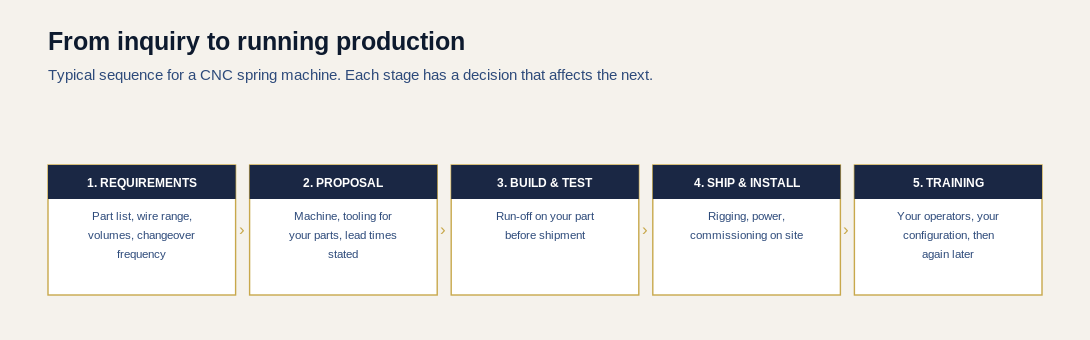
1. REQUIREMENTS
The stage that determines the quality of everything downstream. What is useful is your part list with wire diameters, spring types, and annual volumes; your measured changeover frequency; your shift pattern; and what you currently decline for lack of capability.
That last item is the one nobody sends and the one that most often changes the recommendation, because it describes capability you need rather than capability you have.
2. PROPOSAL
A useful proposal covers the machine, tooling costed against your real parts rather than a sample, wear parts with lead times, training scope, and installation requirements including power and floor loading.
Compare proposals on those items rather than on machine price. Two quotations with a clear price gap frequently invert once tooling for six parts is included, and that comparison is only possible if both are itemized.
3. BUILD AND TEST
Before shipment, ask for a run-off on your part with your material. This is the most valuable thing you can request and the most frequently skipped.
Agree acceptance criteria in advance: a stated number of consecutive good parts at cycle rate is a clear criterion, and "runs satisfactorily" is not. Ask for dimensional results across the sample rather than a single first-off.
4. SHIPPING AND INSTALLATION
Crating, freight, customs clearance, then rigging on site. Power supply and floor loading need confirming before the machine arrives — discovering a supply problem with a crate on the floor is an expensive way to find out.
Have the electrical supply prepared and the floor position agreed before delivery. It sounds obvious and it is a common source of delay.
5. COMMISSIONING AND TRAINING
Commissioning is finished when the machine has made your part to your drawing, with evidence — not when it powers up and cycles.
Training should cover your configuration with your tooling, and should happen twice: once at handover, and again some weeks later when operators have enough hours to ask better questions. Training delivered entirely at handover arrives before anyone knows what to ask.
WHERE PROJECTS ACTUALLY SLIP
In our experience delays cluster in three places, and none of them is manufacturing.
Requirements churn. A part list that changes after tooling is quoted resets the tooling stage. Settling the part list early is worth more to the schedule than any expediting later.
Site readiness. Power supply is the recurring one. Three-phase at the right voltage is an electrical contractor's job with its own lead time, and it needs starting when the machine is ordered rather than when it ships.
Customs documentation. Predictable in principle and delayed in practice whenever responsibility is unassigned. Name who is handling it in the order.
None is difficult. All three are prevented by deciding early who owns them.
WHAT TO PREPARE ON YOUR SIDE
- Electrical supply confirmed at the right voltage and phase.
- Floor position agreed, with loading checked.
- Operators identified and available for training, not pulled onto other work.
- A first part chosen for the run-off, with material available.
- Realistic expectations for the ramp-up period, when output sits below rated capability.
The last one is not administrative. Programs building in a productivity dip survive contact with reality; those assuming rated output from week one generate difficult conversations that nobody needed to have.
One thing worth agreeing early that rarely appears in a proposal: what happens if the run-off does not pass. Who adjusts, at whose cost, and how long the schedule slips. It almost never becomes relevant, and the conversation is much easier before shipment than during commissioning.
Ask for the answer in writing alongside the acceptance criteria. A supplier confident in their machine will not hesitate.
Send us your production requirements and our engineering team — backed by 20+ years of spring and machinery manufacturing experience — will get back to you with a competitive quote and realistic turnaround.
Email: sales@seyunda.com
Phone: +65 9168 2618
We look forward to supporting your next project.
Published by the Seyunda Team · 2026