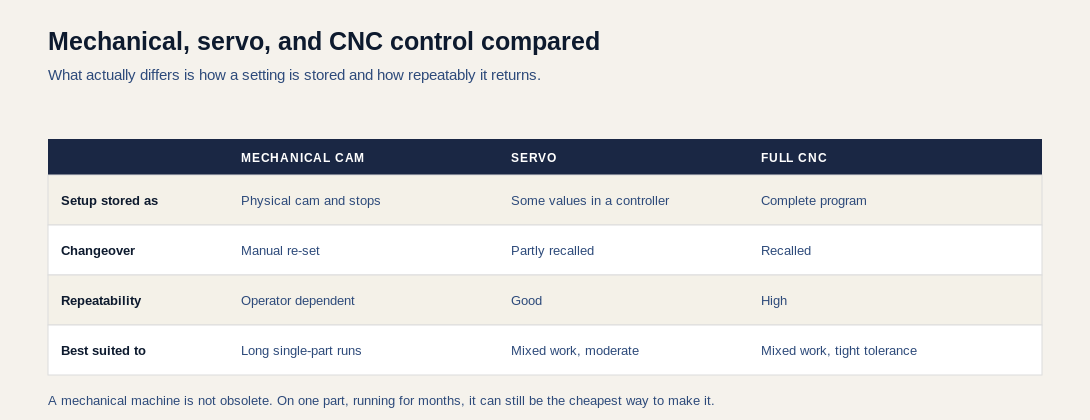
Coilers are described as mechanical, servo-driven, or CNC, and the labels are used loosely enough that they obscure the actual difference. It is not really about age or sophistication. It is about how a setting is stored and how repeatably it comes back.
MECHANICAL CAM MACHINES
Motion comes from cams and linkages driven off a single main shaft. The setup lives in physical hardware — cam profiles, tool positions, mechanical stops.
They are robust, they run fast on a part they are set up for, and a well-maintained one lasts decades. Their limitation is changeover: reproducing a setup means physically re-setting the machine, and how quickly and accurately that happens depends on the operator.
They are not obsolete. For one part running for months, a mechanical machine can still be the cheapest way to make it.
SERVO-DRIVEN MACHINES
Individual servo motors replace some mechanical linkages, so certain values can be set in a controller rather than by hand. This is a middle ground, and the term covers a wide range of implementations — from one servo axis to most of the motions.
The practical question to ask a supplier is not whether a machine is servo-driven but which motions are servo-controlled and which remain mechanical. That determines how much of a changeover is recalled and how much is still manual.
FULL CNC
All forming axes are under programmed control. The complete setup — axis positions, feed lengths, pitch, cut timing — is stored as a program and recalled.
The benefit is repeatability across batches, operators, and time. A program proven two years ago produces the same part today, provided the tooling and material match. It also enables in-cycle monitoring: length detection during the run catches drift at part forty rather than at final inspection.
WHAT ACTUALLY DECIDES THE CHOICE
Changeover frequency, almost every time.
If you change setup several times a day, the value of a recalled program is large and compounds across every changeover in the year. If you run one part for months at a time, that value is close to zero and the extra capability is being paid for without being used.
Count your changeovers over two normal weeks before deciding. It is a more reliable input than any specification comparison.
WHAT CNC DOES NOT SOLVE
It does not remove material variation. A coil running slightly harder than the last still needs a program adjustment, because springback is a property of the material, not the machine.
It does not compensate for worn tooling. It repeats a bad setup as faithfully as a good one, which is worth remembering when a proven program suddenly produces parts out of tolerance — the program has not changed, so something physical has.
And it does not remove the operator. It changes the skill required, from mechanical setting toward program management and process judgment. Shops that buy CNC expecting to reduce skill requirements are frequently disappointed.
WHAT HAPPENS WHEN THE CONTROLLER IS OBSOLETE
A mechanical machine ages gracefully. Its parts wear and are replaced, and a well-maintained one runs for decades. A CNC machine has an additional failure mode: its controller becomes unsupported.
This is worth asking about at purchase, because it determines the machine's real useful life. How long will the controller be supported? Are spares available, and for how long? Can programs be exported in a format that would survive a controller replacement?
That last question is the practical one. A machine whose proven programs exist only inside its own controller, in a proprietary format, is a machine whose accumulated setup knowledge is trapped. Exporting and backing up programs on your own systems costs nothing and protects years of accumulated work.
None of this argues against CNC. It argues for treating the controller as a component with its own lifecycle, rather than as a permanent feature of the machine.
QUESTIONS WORTH ASKING
- Which motions are under program control, and which are set mechanically?
- Can programs be exported and backed up outside the machine?
- What in-cycle monitoring exists, and what does it do when a limit is exceeded?
- How long does a typical changeover take on this machine, with your tooling?
The second question matters more than it sounds. Programs that exist only in one controller are a recovery problem waiting to happen.
Send us your production requirements and our engineering team — backed by 20+ years of spring and machinery manufacturing experience — will get back to you with a competitive quote and realistic turnaround.
Email: sales@seyunda.com
Phone: +65 9168 2618
We look forward to supporting your next project.
Published by the Seyunda Team · 2026