Used CNC spring machinery can be good value. It can also be an expensive way to acquire someone else's problem. The difference is usually visible before purchase, if you know what to inspect and in what order.
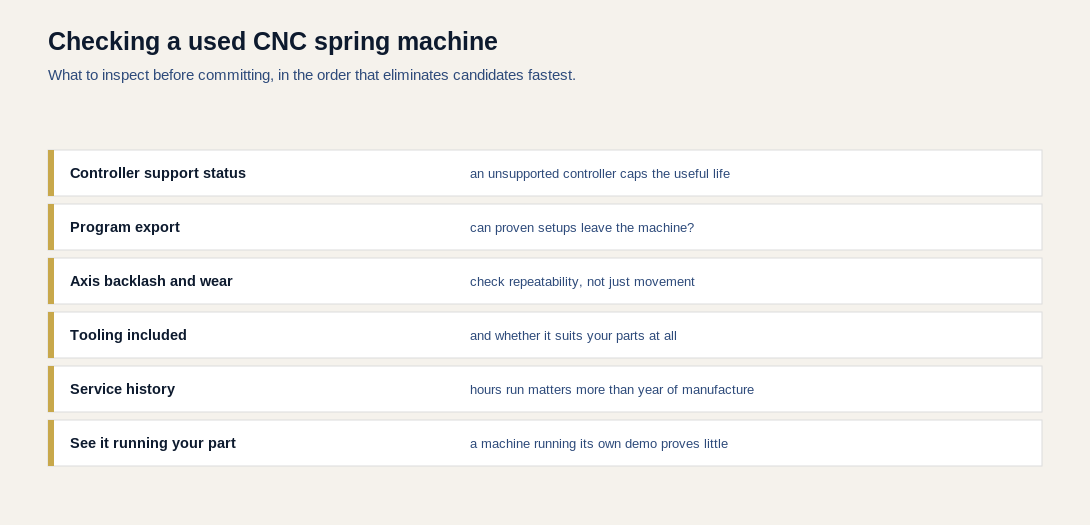
START WITH THE CONTROLLER, NOT THE MECHANICS
This is the check that most often ends the conversation, and it costs nothing to make first.
A CNC machine's useful life is frequently set by controller support rather than by mechanical wear. An unsupported controller means no spares, no service expertise, and no path forward when it fails. A mechanically excellent machine with an obsolete controller is a machine with a hard end date.
Ask what the controller is, whether the manufacturer still supports it, and whether spares are available. Then ask the practical follow-up: can programs be exported in a format that would survive replacing it?
CHECK REPEATABILITY, NOT MOVEMENT
Every axis will move. The question is whether it returns to the same place.
Backlash in a worn axis shows as a difference between approaching a position from one direction and from the other. On a coiler that appears as parts that vary between batches even on an unchanged program — which is exactly the problem CNC was bought to solve.
Ask to see the machine make a run of parts and measure them yourself, rather than accepting a specification figure. Repeatability across fifty consecutive parts tells you more than any inspection of the machine at rest.
TOOLING IS PART OF THE PURCHASE
Find out what tooling is included and whether it suits your parts at all. Tooling for the previous owner's product range may have no relevance to yours, and buying a machine plus a full set of new tooling is a different proposition from the price advertised.
Check condition as well as presence. Worn coiling points and guides look like a machine problem once they are producing parts.
SERVICE HISTORY, MEASURED IN HOURS
Year of manufacture tells you less than hours run. A five-year-old machine on three shifts has seen more work than a ten-year-old on one.
Ask for the maintenance record, and ask what was replaced and when. A machine with a documented history of scheduled maintenance is a substantially better prospect than one with no record, even at the same age and hours.
SEE IT RUNNING YOUR PART
The best test available, and worth insisting on. A machine running the seller's familiar demonstration part proves that the machine and that setup work together. It proves very little about your part.
If you can supply material and a drawing and watch a setup and a run, you learn about the machine, the tooling, and how difficult the machine is to set — all in one afternoon.
WHAT TO BUDGET BEYOND THE PRICE
- Rigging, transport, and installation, including any site work for power.
- Tooling for your parts.
- Commissioning and any training, which is rarely included in a private sale.
- A first set of wear parts, since these are usually consumed by the time a machine is sold.
- Requalification if existing regulated parts will move onto it.
WHERE USED MACHINES COME FROM
The source tells you a good deal about what you are buying.
A machine sold because a shop upgraded is usually a reasonable prospect — it was working when it was replaced, and the seller can describe what it was doing. A machine from a closure or liquidation carries more risk, because it may have been idle for a long period and nobody remains who knows its history.
Idle time matters more than people expect. Machines deteriorate when they sit: seals dry, ways corrode, and electronics fail on restart having been fine at shutdown. A machine that has been standing for two years is a different proposition from one that was running last month, at the same age and hours.
Ask when it last ran production, and be wary of any answer that is vague.
WHEN USED IS THE RIGHT ANSWER
For added capacity on a proven part, for a second machine providing redundancy, or for a capability you want to try before committing, used equipment makes good sense.
It makes less sense as the only machine covering critical production, because you inherit an unknown maintenance history at exactly the point where you have no fallback.
Send us your production requirements and our engineering team — backed by 20+ years of spring and machinery manufacturing experience — will get back to you with a competitive quote and realistic turnaround.
Email: sales@seyunda.com
Phone: +65 9168 2618
We look forward to supporting your next project.
Published by the Seyunda Team · 2026