Buying exactly enough machine capacity for today's volume is a common mistake. Growth usually arrives faster than a machine can be specified, ordered, delivered, installed, and brought up to a stable process. Sizing for where you are heading rather than where you are avoids that gap.
But "buy bigger" is not a plan either. The useful work is separating four different questions that get collapsed into one.
1. VOLUME, CURRENT AND FORECAST
Start with your run rate now and a realistic projection over one to three years. Realistic is the operative word. A forecast built on winning a specific program should be split into two cases, with and without it, because the machine decision may differ between them.
Express volume in machine hours, not part counts. Ten thousand of a simple part and ten thousand of a complex one are not the same demand on a coiler.
2. PART MIX, WHICH IS USUALLY THE REAL CONSTRAINT
A dedicated machine covers one spring type efficiently. A growing product line pushes you toward either several dedicated machines or one versatile former.
The deciding factor is changeover frequency. If you change setup three times a day, changeover time is consuming capacity that no throughput figure will show you. Count your changeovers for two weeks before deciding anything.
3. SHIFT PATTERN
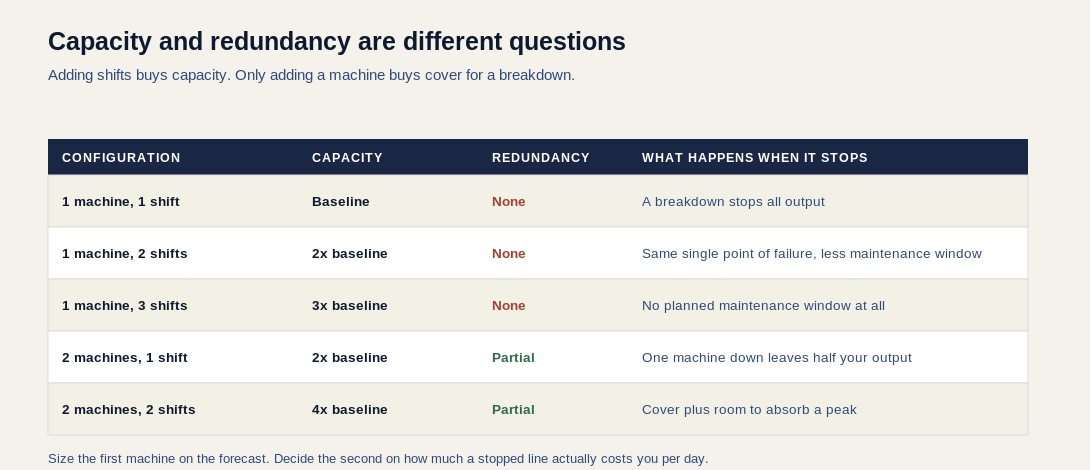
Running one machine across three shifts covers three times the volume of one shift. It also leaves no window for planned maintenance and no cover at all when something breaks.
4. RISK TOLERANCE, PRICED HONESTLY
A single machine covering all of your volume means no backup capacity when it needs unplanned maintenance. Whether that matters is an arithmetic question, not a philosophical one.
Work out what a stopped line costs you per day: lost output, expedited freight to recover a delivery, and the commercial consequence of missing a customer's schedule. Compare that against the cost of holding a second machine. For some shops the answer is clearly one machine and a good service contract. For others, one late delivery to an automotive customer costs more than the machine.
DEDICATED OR VERSATILE
The genuine trade-off, stated without marketing:
- Dedicated machines are typically faster on their one job, simpler to operate, and cheaper per machine. They are inflexible, and every new part type is a new capital decision.
- Versatile formers such as the CSM series, running 0.2 – 2.3 mm with up to 16 axes, cover many part types on one platform. They cost more, demand more programming skill, and are usually slower than a dedicated machine on a long, simple run.
A shop with two high-volume parts and stable demand is usually better served by two dedicated machines. A shop quoting varied work with short runs is usually better served by a versatile former, because its capacity is being eaten by changeovers rather than by cycle time.
A SIZING METHOD THAT SURVIVES SCRUTINY
- Convert current and forecast volume into required machine hours per week.
- Add measured changeover time for your actual part mix, not a nominal figure.
- Apply a realistic uptime factor. Eighty-five percent is a fair planning assumption for a well-maintained line; one hundred percent is not.
- Compare the result against available hours per shift pattern.
- Decide separately, and explicitly, whether you are buying redundancy.
Many buyers size for a twelve to twenty-four month forecast and set a defined volume threshold that triggers ordering the second machine. That avoids both overinvesting now and discovering a capacity gap with a four-month lead time in front of you.
WHAT TO SEND US
Send your current volume, your part mix with wire diameters and spring types, your shift pattern, and your growth plan. We will work through whether one machine, several dedicated machines, or a versatile former fits — and if your bottleneck turns out to be grinding or secondary operations rather than coiling, we will tell you that instead.
Send us your production requirements and our engineering team — backed by 20+ years of spring and machinery manufacturing experience — will get back to you with a competitive quote and realistic turnaround.
Email: sales@seyunda.com
Phone: +65 9168 2618
We look forward to supporting your next project.
Published by the Seyunda Team · 2026