The purchase price of a CNC spring machine is the number that appears in the approval request. It is rarely the number that determines whether the investment works out.
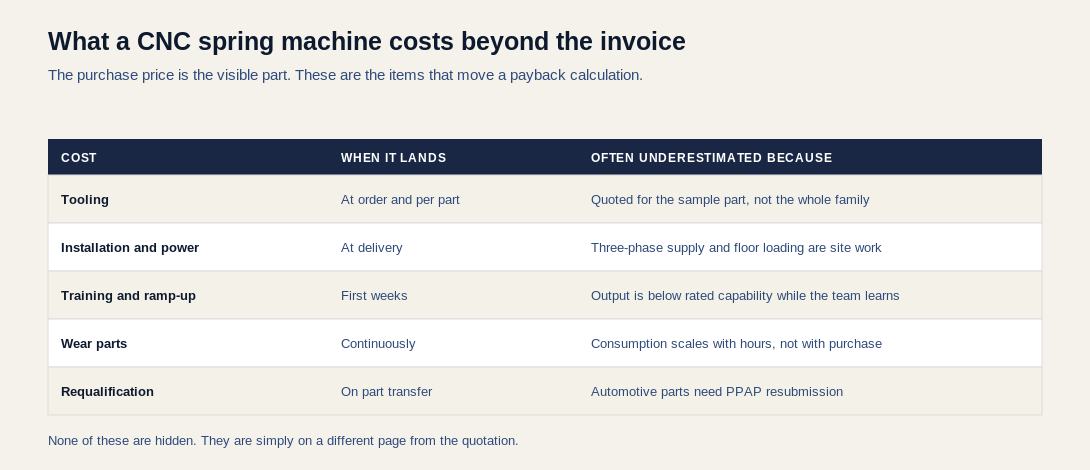
Here is what belongs in a total cost calculation, and why each item is routinely underestimated.
TOOLING
Quotations typically include tooling for a sample part. Production needs tooling for the parts you actually run, which is usually a family rather than one item.
Ask for tooling costed against your real part list before comparing machine prices. Two machines with a price difference between them can invert once tooling for six parts is included.
INSTALLATION AND SITE WORK
Three-phase supply at the right voltage, floor loading adequate for the machine mass, compressed air if required, and routing for swarf and coolant. On an established shop floor these are usually straightforward. In a new bay they are a project with a lead time of their own.
The cost is site-specific, which is precisely why it is left out of comparisons and discovered afterwards.
TRAINING AND THE RAMP-UP DIP
There is a period after commissioning where output sits below rated capability while operators learn. It is normal and it is real, and leaving it out is the most common reason a machine appears to underperform in its first quarter.
Budget reduced output for the first weeks, plus a second training visit once the team has enough hours to ask better questions. Training delivered entirely at handover arrives before anyone knows what to ask.
WEAR PARTS AND MAINTENANCE
Coiling points, cutting tools, guides, and feed rollers are consumed in proportion to hours run. A machine on three shifts consumes them three times as fast as one on a single shift, which is obvious stated plainly and routinely missed in a budget built on an annual figure.
Ask for the wear parts list with prices and lead times, checked against your actual build rather than the catalog configuration.
REQUALIFICATION
This one is specific to regulated work and it is expensive when it is a surprise. Moving an existing automotive part onto a new machine is a process change, and customers will expect a PPAP resubmission.
That means dimensional results, capability studies, an updated control plan, and your customer's review time. If you are buying a machine to move existing parts onto, budget the engineering hours and the calendar time.
THE OLD MACHINE
Either it has residual value or it costs money to remove. Rigging a machine out is not free, and floor space occupied by an idle machine has a cost even when nobody invoices for it.
WHAT MAKES A PAYBACK SURVIVE REVIEW
Build the return from measured figures rather than rated capability.
- Changeover time, measured door to door, multiplied by changeover frequency.
- Setup scrap and running scrap, counted separately.
- Attended minutes per thousand good parts.
- Work you currently decline — the only item that becomes new revenue rather than saved cost.
A case built on those four tends to hold up. One built on peak throughput usually does not, because peak throughput assumes the machine runs one part continuously, which is the situation a versatile machine is bought to avoid.
FINANCING AND THE COST OF WAITING
Two items sit outside the machine entirely and frequently dominate the arithmetic.
The cost of capital. Whether the machine is bought outright, financed, or leased changes the cash profile substantially, and a payback calculated on purchase price alone ignores it. For a machine expected to run seven years or more, the financing structure can matter as much as a price difference between suppliers.
The cost of not buying. This is the one most often omitted and frequently the largest. Work you decline because you lack the capability is revenue that never appears in any calculation, because there is no invoice for it. Logging declined inquiries for two weeks, with the reason for each, converts that invisible cost into a number.
A business case containing both is unusual and considerably harder to argue against than one built purely on cost savings, because it describes growth rather than efficiency.
THE COMPARISON WORTH MAKING
Compare total cost over a realistic life — say seven years — rather than purchase price. Include tooling, wear parts, and the training you will actually need. The cheapest machine to buy is frequently not the cheapest machine to own, and the gap is usually visible in the first two years.
Send us your production requirements and our engineering team — backed by 20+ years of spring and machinery manufacturing experience — will get back to you with a competitive quote and realistic turnaround.
Email: sales@seyunda.com
Phone: +65 9168 2618
We look forward to supporting your next project.
Published by the Seyunda Team · 2026