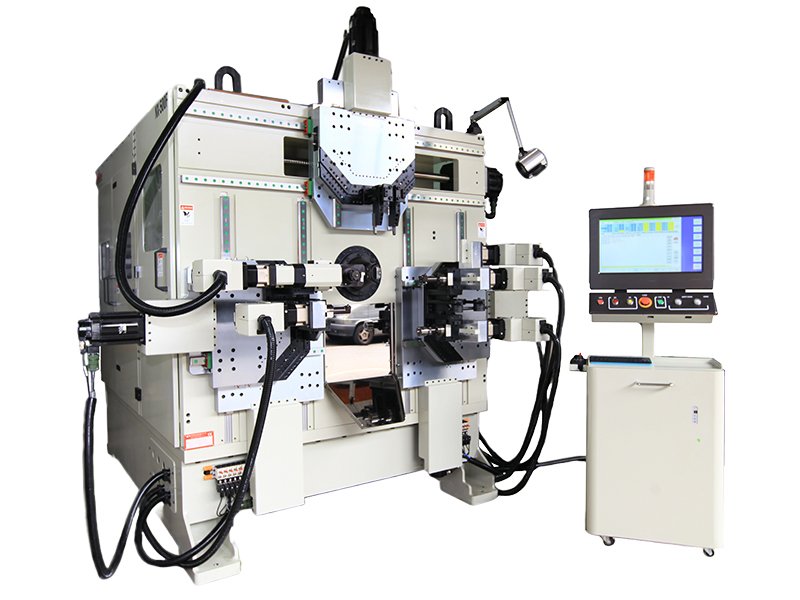
Wire and strip forming machines sit between simple benders and full multi-slide presses. They form material through a sequence of tools rather than by coiling it, which makes them suited to parts that are not springs at all — brackets, clips, contacts, terminals, and formed strip components.
WIRE FORMING AND STRIP FORMING ARE DIFFERENT PROBLEMS
Wire has a round section that behaves the same in any bending direction. The forming challenge is geometry and springback.
Strip has a rectangular section, so its behavior depends on direction. Bending across the width and along the length are different operations with different forces, and the material's rolling direction affects both. A strip part bent against the grain can crack where the same bend with the grain would not.
This is why strip capacity is quoted as two dimensions — thickness by width — rather than as a single figure.
THE RANGE
Our multi-slide and forming machines cover from the CNC-16T1 at 0.2 – 1.6 mm wire with a 5 ton press and up to 200 pieces per minute, through to the CNC-50T at 1.0 – 5.0 mm with a 50 ton press and 14 axes.
The versatile formers overlap this work: the CSM-1320 handles strip to 1.0 × 12 mm and the CSM-1360 to 1.0 × 50 mm, while the ZX-250 covers 0.15 × 12 mm strip alongside its wire capability. The NX-500F runs 11 axes as standard with up to 25 optional, spring OD to 200 mm and feed to 106 m/min.
PRESS CAPACITY IS THE SPECIFICATION THAT MATTERS
For strip work, tonnage determines what you can form. A 5 ton press and a 50 ton press are not the same machine with different labels — they address different material thicknesses and different operations.
Piercing, blanking, and coining all demand force in proportion to material thickness and the length of cut. If a part needs a pierced hole as well as forming, the tonnage requirement is set by the piercing rather than the bending, and that is frequently the calculation people skip.
WHAT MAKES A PART SUIT THESE MACHINES
- Multiple operations in sequence — form, pierce, cut — performed without re-gripping the part.
- Continuous feed from coil, so there is no blank handling.
- High volume, because tooling is a real investment that needs volume to amortize.
- Stable geometry, since changing a formed part means changing tools rather than editing a program.
That last point is the honest limitation. A CNC coiler changes part geometry through the program. A multi-slide former changes it through tooling, which is slower and costs more. For prototype or low-volume work, a bender or a versatile former is usually the better route.
PROGRESSIVE OR MULTI-SLIDE
Two approaches cover most strip forming, and they suit different volumes.
Progressive die work in a press moves strip through a sequence of stations, each performing one operation, with the part carried on a strip until the final cut. It is fast and extremely repeatable at volume, and the tooling is a substantial single investment.
Multi-slide forming works the part from several directions using independently driven slides. It handles geometry that a progressive die struggles with, particularly forms that need bending from opposite sides, and the tooling is generally less expensive to modify.
The rule of thumb: very high volume with stable geometry favors progressive; moderate volume with complex or evolving geometry favors multi-slide. Where a part is expected to change during its life — which in automotive is most parts — the ability to modify tooling cheaply is worth more than the last few percent of cycle time.
TOOLING IS THE REAL LEAD TIME
On these machines, the schedule is set by tool design and manufacture rather than by machine availability. That has a planning consequence: engage on the part geometry early, because a design change after tools are cut is expensive in a way that a program change is not.
Send the part drawing at the earliest sensible point, ideally with a 3D model. Small changes to a radius or a relief made at design stage are free; the same change after tooling is a rebuild.
One material note specific to strip. Rolling direction affects how strip behaves in bending, so a part with bends in two directions may need the blank oriented deliberately relative to the coil. Where that matters, it belongs on the drawing rather than being left for the toolmaker to infer.
Send us your production requirements and our engineering team — backed by 20+ years of spring and machinery manufacturing experience — will get back to you with a competitive quote and realistic turnaround.
Email: sales@seyunda.com
Phone: +65 9168 2618
We look forward to supporting your next project.
Published by the Seyunda Team · 2026