Decoilers and tooling attract very little attention next to a CNC coiler, and they cause a disproportionate share of the problems on a spring line. Both are worth specifying properly rather than treating as accessories.
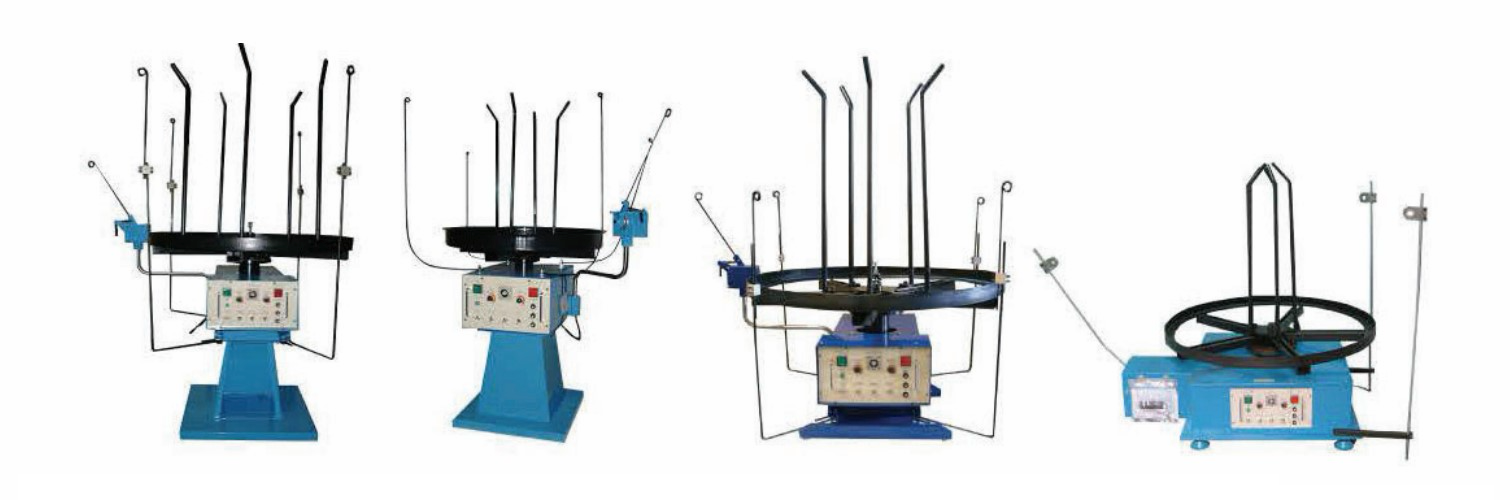
WHY THE DECOILER MATTERS MORE THAN IT LOOKS
A coiler can only be as consistent as the wire arriving at its feed rollers. If wire delivery varies — tension changing as the coil empties, the pack snagging, the stand lagging behind a fast feed — that variation goes straight into the part.
The symptom is a dimension that drifts through a coil and returns when a new one is loaded. It is frequently blamed on the coiler or on material variation, and it is often the decoiler.
PASSIVE OR POWERED
Passive stands rely on the machine pulling wire off. That works on light wire at moderate speed. As wire gets heavier or feed rates rise, the coiler ends up dragging the mass of the pack, and feed tension rises as the coil empties and its effective diameter falls.
Powered decoilers drive the pack and pay wire off at a controlled rate, usually with a sensing loop that keeps a consistent slack. The machine then draws from a constant, low tension regardless of how full the coil is.
Our PH range covers coil weights from 60 kg through 100, 200, 500 and 1,000 kg to 1,500 kg. Sizing is a straightforward question: what coil weight does your material actually arrive in?
THE SIZING MISTAKE
Buying a decoiler for the coil size you use most, then discovering your supplier ships a heavier pack for a better price. A decoiler rated below the coil it carries will not pay off smoothly, and the effect on part consistency shows up immediately.
Check with your wire supplier what pack sizes are actually available and priced before specifying. It is a cheaper conversation than a second decoiler.
TOOLING
Coiling points, arbors, cutting tools, and guides do the actual forming. They wear, and as they wear the part changes — gradually enough that it is often found at final inspection rather than at the machine.
Two habits prevent most tooling problems.
- Tie tooling changes to hours run, not to a calendar. A machine on one shift and a machine on three do not wear at the same rate.
- Record which tooling produced a proven setup. A stored program is only reproducible if the tooling it was proven with is identified. A program recalled with different tooling is not the same setup.
SPARES THAT ARE WORTH HOLDING
Wear items are cheap relative to a stopped machine. Holding a set of the coiling points, cutting tools, and guides for your highest-volume parts converts a potential multi-week wait into a changeover.
When ordering a machine, ask specifically for the wear parts list checked against the build you are receiving, rather than the catalog configuration. They are not always the same, and discovering that during a breakdown is expensive.
WIRE STRAIGHTENING, THE STAGE BETWEEN THEM
Between the decoiler and the forming point sits a straightener, and it does more work than its appearance suggests.
Wire arrives with cast — the natural curvature it holds from being wound on a coil — and with helix, a tendency to spiral out of plane. Both must be removed before forming, because a machine programmed for straight input fed with curved wire produces geometry that drifts.
Straightener rollers are adjustable, and their setting is part of the setup rather than a fixed condition. Cast changes as a coil empties, since the inner wraps have tighter curvature than the outer ones. That is one specific mechanism behind a dimension that drifts through a coil and resets when a new one is loaded.
If you are chasing that symptom, check the straightener before the coiler. It is the cheaper thing to adjust and the more likely cause.
THE GENERAL POINT
Ancillary equipment tends to be specified last and squeezed on price, because it looks peripheral next to the machine. In practice the decoiler determines feed consistency and the tooling determines part geometry. Neither is peripheral.
The broader habit worth adopting: when a part goes out of tolerance and the program has not changed, work backwards through the material path before touching the machine. Coil, decoiler tension, straightener setting, guides, tooling. The cause is usually earlier in that chain than the place the symptom appears.
Send us your production requirements and our engineering team — backed by 20+ years of spring and machinery manufacturing experience — will get back to you with a competitive quote and realistic turnaround.
Email: sales@seyunda.com
Phone: +65 9168 2618
We look forward to supporting your next project.
Published by the Seyunda Team · 2026