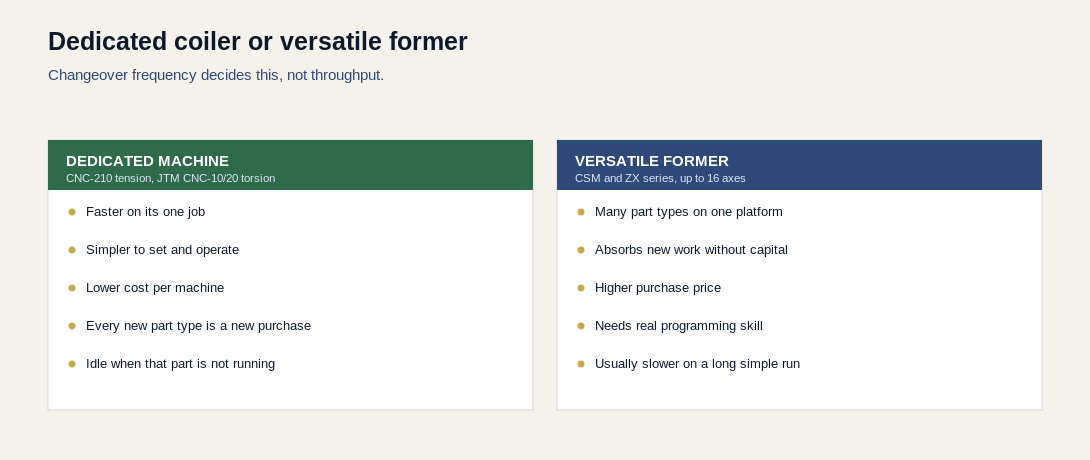
A versatile former that runs several spring types on one platform suits mixed production. It is not always the right answer. When a line runs high volume of a single spring type, a dedicated machine usually wins on throughput, on simplicity, and on how quickly a new operator becomes productive.
THE DEDICATED MACHINES
- CNC-210 tension spring coiler: Purpose-built for extension springs, 0.15 – 1.0 mm wire, spring OD to 10 mm and length to 100 mm, up to 100 pieces per minute with unlimited feed length. Hook formation and pitch control are built into the machine rather than programmed around.
- JTM CNC-10 and CNC-20 torsion coilers: Dedicated torsion machines for precise leg positioning and angular control — the characteristic that most often causes rejects on torsion springs made on general-purpose equipment.
WHEN DEDICATED WINS
High volume of one spring type. If a machine runs the same part for days, the versatility premium buys nothing. You are paying for axes that never move.
A characteristic the machine is built around. Hook geometry on a tension spring and leg angle on a torsion spring are exactly what these machines exist to control. Holding the same tolerance on a general-purpose former is possible but takes more setup skill and more first-off scrap.
Operator availability. A dedicated machine has fewer variables. Training someone to run it competently takes days rather than weeks, which matters if your line runs three shifts or your team turns over.
Redundancy at low cost. Two dedicated machines often cost less than one versatile former, and two machines mean a breakdown halves your output rather than stopping it.
WHEN IT DOES NOT
The moment your part mix broadens, a dedicated machine becomes a stranded asset. It sits idle whenever its part is not running, and every new part type is a fresh capital request with a lead time attached.
The number that decides this is changeover frequency. Count your changeovers over two normal weeks. If you are changing setup several times a day across different spring types, changeover time is eating capacity that no dedicated machine's cycle time will give back.
THE ARITHMETIC, DONE PROPERLY
- Convert each part's annual volume into machine hours at realistic cycle time.
- Add measured changeover time, multiplied by how often it actually happens.
- Apply an uptime factor around 85 percent for a maintained line.
- Compare the total against available hours in your shift pattern.
If one part type dominates the total, buy the dedicated machine for it and let a versatile former absorb the rest. That hybrid is what most growing shops end up with, and it is usually reached by accident rather than by plan. Reaching it deliberately is cheaper.
THE HYBRID MOST SHOPS ACTUALLY NEED
The question is usually posed as dedicated or versatile. In practice, most established shops end up with both, and the ones that get there deliberately spend less than the ones that get there by accident.
The pattern that works: put your highest-volume, most stable part on a dedicated machine and let it run. Give everything else to a versatile former, where changeover flexibility is worth paying for. The dedicated machine earns its keep through utilization; the former earns its keep by absorbing new work without a capital request each time.
What makes this go wrong is buying the versatile machine first and then loading it with the high-volume part because it is the machine you have. The former ends up tied up on work a cheaper dedicated machine would do better, and the flexibility you paid for is unavailable exactly when a new inquiry arrives.
One thing worth checking before any purchase: confirm the constraint really is the coiler. On ground-end compression springs the grinder is frequently the limiting operation, and a faster coiler in front of an unchanged grinder simply builds work in progress. The same applies where secondary operations, inspection, or packing are the actual queue. Measure where parts wait, not where they are made.
WHAT TO SEND US
Your part list with spring types, wire diameters, and annual volumes; your measured changeover time; and your shift pattern. If the answer is that your existing machine is fine and the constraint is elsewhere in the line, we will tell you that.
Send us your production requirements and our engineering team — backed by 20+ years of spring and machinery manufacturing experience — will get back to you with a competitive quote and realistic turnaround.
Email: sales@seyunda.com
Phone: +65 9168 2618
We look forward to supporting your next project.
Published by the Seyunda Team · 2026