Ring coilers and wave spring machines make parts that sit outside what a conventional compression coiler produces. The geometry is different, the applications are specific, and the machines are configured accordingly.
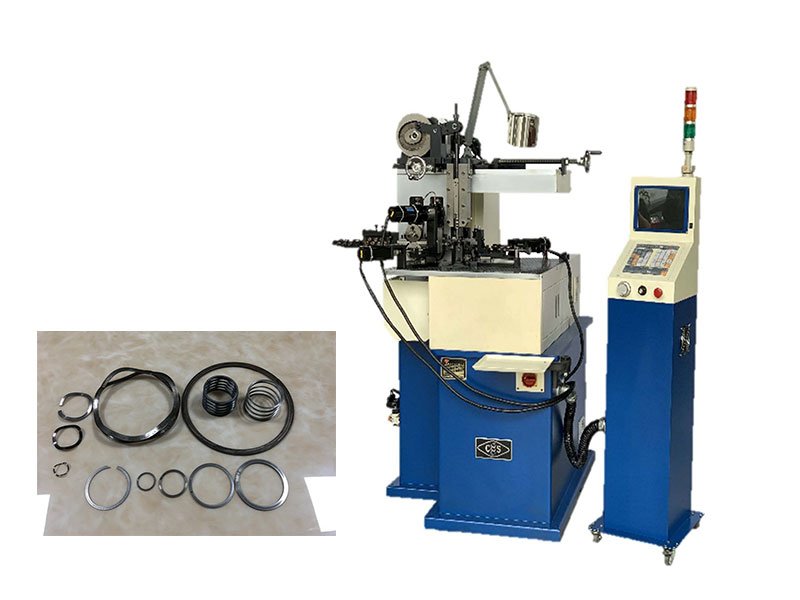
WHAT A WAVE SPRING IS FOR
A wave spring provides axial force in a fraction of the height a conventional coil spring needs for the same load. It is a flattened form with waves along its circumference, and those waves deflect to provide the spring action.
The reason to use one is almost always space. In a bearing preload, a seal, or a valve assembly where axial length is at a premium, a wave spring can deliver the required force in perhaps a third of the working height. That is the whole proposition, and where axial space is not constrained, a conventional spring is usually simpler and cheaper.
WHERE THEY GET SPECIFIED
- Bearing preload. Taking up clearance and controlling axial play without adding stack height.
- Seals and valve assemblies. Maintaining contact pressure in a confined housing.
- Semiconductor and precision equipment. Where assemblies are compact and force consistency matters.
- Electrical contacts and connectors. Providing contact pressure in a flat package.
RING COILING
Ring coiling produces closed circular forms — retaining rings, circlips, snap rings, and similar. The manufacturing challenge is different from compression coiling: the part is essentially planar, and what matters is roundness, flatness, and consistency of the gap or joint.
Springback dominates here more than in most spring work. A ring formed to nominal will open elastically when released, and the compensation depends on material, temper, and section. Establishing that compensation for a given material lot is the setup work.
WHAT TO SPECIFY, AND WHAT IS OFTEN MISSED
For a wave spring, the useful specification is force at working height, not free height. Free height varies with the number of waves and the material thickness, and specifying it alone leaves the force uncontrolled — which is the property the assembly actually needs.
Two further items belong on the drawing. Number of waves and turns, because these determine the load curve. And flatness or squareness in the free state, since a wave spring that does not sit flat will not load evenly around its circumference.
MEASUREMENT IS THE HARD PART
Measuring a wave spring is genuinely more difficult than measuring a coil spring. Force at height requires a fixture that constrains the spring the way the assembly will, without adding friction that shows up as apparent load.
If the assembly locates the spring in a bore, the test fixture should too. Measuring a wave spring unconstrained between platens gives a number, but not the number the assembly will see. Agree the fixture with your supplier before agreeing the tolerance.
MATERIAL AND FINISH FOR THESE PARTS
Wave and ring springs are usually made from flat or round stock in materials chosen for elastic recovery rather than for absolute strength.
Carbon spring steels suit general applications and need a corrosion finish. Stainless 301 and 302 provide corrosion resistance in the material rather than in a coating, and 301 work-hardens usefully during forming. For elevated temperature or aggressive environments, higher alloys become relevant, and the specification should state the service temperature rather than leaving it implied.
A finish consideration specific to these parts: they typically work through surface contact around a large area, so coating thickness matters dimensionally in a way it does not on a coil spring. A thick coating on a wave spring changes its stack height, which is the dimension the assembly was tight on in the first place. Where space is the reason for choosing a wave spring, specify the finish thickness explicitly.
MACHINE CAPABILITY
Our CS-558 runs 5 axes with spring OD from 10 to 200 mm, production to 80 pieces per minute and feed to 135 m/min, with rotary axis travel of plus or minus 360 degrees. That rotational capability is what allows the forms these parts need.
If you are evaluating machines for this work, ask about the rotary axis range and the OD span rather than about production rate. Rate rarely limits this work; geometry does.
If you are evaluating whether a wave spring is the right answer at all, the test is simple: measure the axial space available and the force required. If a conventional coil spring fits, use one. Wave springs earn their higher cost only where that space genuinely is not there.
Send us your production requirements and our engineering team — backed by 20+ years of spring and machinery manufacturing experience — will get back to you with a competitive quote and realistic turnaround.
Email: sales@seyunda.com
Phone: +65 9168 2618
We look forward to supporting your next project.
Published by the Seyunda Team · 2026