Both the CSM and ZX series run mixed work on one platform rather than being dedicated to a single spring type. They are built around different priorities, and the choice between them is usually settled by wire range and envelope rather than by axis count.
THE CSM SERIES
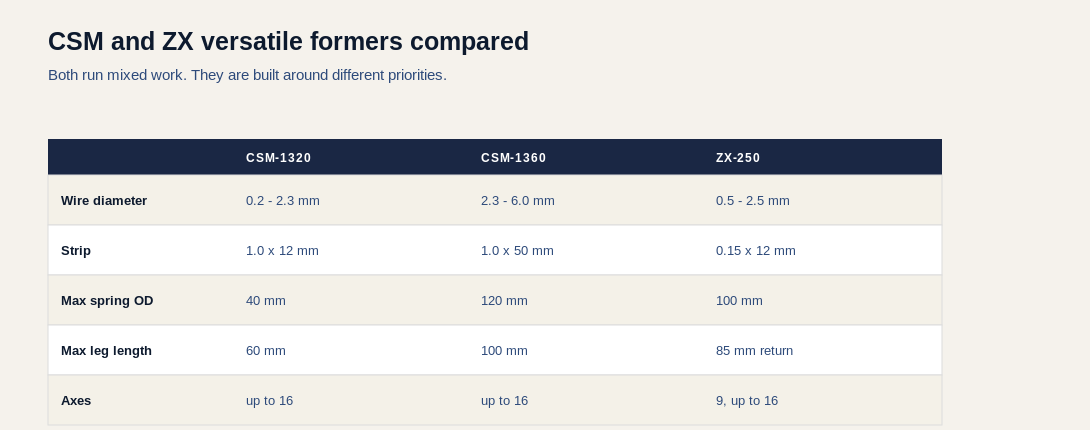
Two frames covering a wide combined range. The CSM-1320 runs 0.2 – 2.3 mm wire, rotary wire 0.4 – 2.3 mm, strip to 1.0 × 12 mm, spring OD to 40 mm and leg length to 60 mm. The CSM-1360 takes 2.3 – 6.0 mm wire, strip to 1.0 × 50 mm, spring OD to 120 mm and leg length to 100 mm.
Together they cover 0.2 to 6.0 mm, which spans most of what a general spring shop quotes. Both run up to 16 axes.
THE ZX SERIES
The ZX-250 handles wire 0.5 – 2.5 mm and strip 0.15 × 12 mm, with spring OD to 100 mm and bending return length to 85 mm. It runs 9 axes as standard, up to 16 optional, on Japanese Yaskawa servo motors.
Its character is a lot of controlled motion within a moderate envelope. For complex geometry on modest wire, that combination is the point.
HOW TO CHOOSE
- Wire range first. Above 2.5 mm the ZX is out and the CSM-1360 is the candidate. Below 0.5 mm the CSM-1320 reaches lower.
- Spring OD and leg length next. These eliminate options faster than anything else. A 100 mm leg needs the CSM-1360.
- Strip work. If you form strip as well as wire, compare the strip capacities directly — 1.0 × 50 mm on the CSM-1360 is a very different capability from 0.15 × 12 mm.
- Geometric complexity. Count the distinct forming motions your most complex part needs. That sets the axis requirement, and it is usually lower than people assume.
AXES ARE NOT A SCORE
More axes is not straightforwardly better. Each axis is another motion to program, another thing to set, and another potential source of variation. A part needing six axes made on a sixteen-axis machine is not made better by the ten that are not moving.
What extra axes buy is future flexibility — the ability to take on a part you have not quoted yet without another capital request. That is genuinely valuable, and it is a different justification from making today's part better. Being clear about which one you are buying keeps the business case honest.
THE COST NOBODY QUOTES
Versatile formers demand more programming skill than dedicated machines. A sixteen-axis machine in the hands of a team without the time to learn it will underperform a simpler machine badly, and the shortfall gets blamed on the equipment.
Before choosing on capability, ask honestly who will program it, how much time they will have, and what happens when that person is on holiday. The answer sometimes points at a simpler machine, and that is a legitimate outcome rather than a compromise.
PROGRAMMING TIME IS A REAL COST
On a versatile former, setting up a new part is a programming exercise rather than a mechanical one. That is the machine's advantage and its hidden cost.
A first program for a complex part on a many-axis machine can take a day or more to develop and prove, and that time is consumed before a single saleable part exists. For a long production run it disappears into the volume. For a short run it can exceed the value of the order.
Two practical consequences. First, versatile formers reward shops that build a program library, because the second and subsequent runs of a part cost almost nothing to set. Second, quoting short-run work on a versatile machine needs the programming time in the price, and it is frequently left out.
Ask any supplier how long a first setup takes on the machine they are recommending, with your kind of part. The answer distinguishes a realistic proposal from an optimistic one.
WHAT TO SEND US
Your part list with wire diameters, spring outside diameters, leg lengths, and any strip work, plus annual volumes and how often you change setup. If most of your volume is one stable part, we may suggest a dedicated machine for it and a versatile former for everything else — which is usually cheaper than one machine trying to do both jobs.
Send us your production requirements and our engineering team — backed by 20+ years of spring and machinery manufacturing experience — will get back to you with a competitive quote and realistic turnaround.
Email: sales@seyunda.com
Phone: +65 9168 2618
We look forward to supporting your next project.
Published by the Seyunda Team · 2026