Large springs are a different manufacturing problem from small ones, and not simply a scaled-up version. Forming heavy wire needs a frame that will not deflect, drive power that can move the material, and tooling that survives the forces involved.
The SHA series covers this work across six frames.
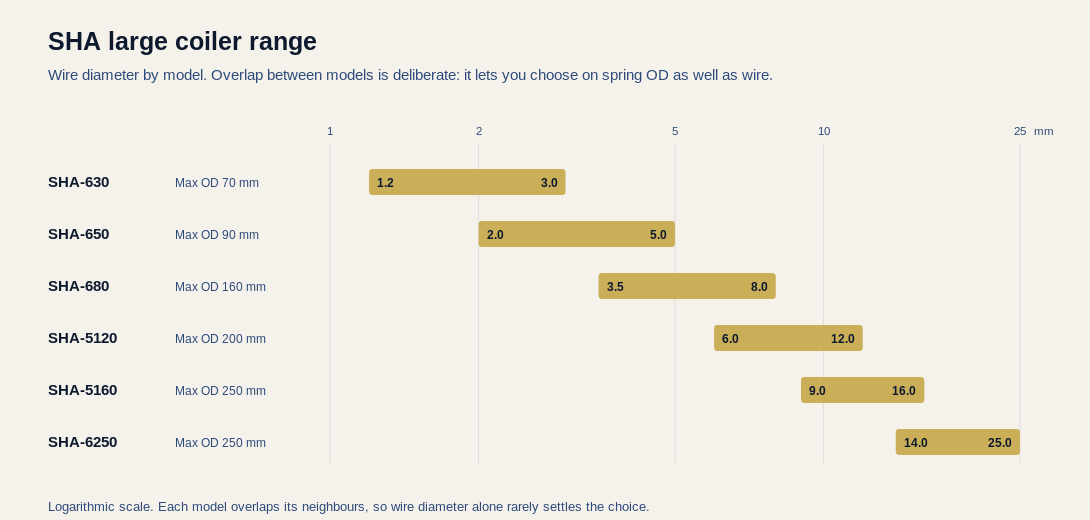
THE RANGE
- SHA-630: 1.2 – 3.0 mm wire, spring OD to 70 mm
- SHA-650: 2.0 – 5.0 mm, OD to 90 mm
- SHA-680: 3.5 – 8.0 mm, OD to 160 mm
- SHA-5120: 6.0 – 12.0 mm, OD to 200 mm
- SHA-5160: 9.0 – 16.0 mm, OD to 250 mm
- SHA-6250: 14.0 – 25.0 mm, OD to 250 mm
WHY THE MODELS OVERLAP
The overlap is deliberate and it is the most useful thing to understand about the range. A 5 mm wire spring can be made on the SHA-650 or the SHA-680. Which is right depends on the spring outside diameter, not on the wire.
The SHA-650 reaches 90 mm OD; the SHA-680 reaches 160 mm. If your 5 mm spring has a 130 mm outside diameter, wire diameter says one machine and OD says the other. OD wins, because the machine physically cannot form a coil larger than its arbor and slide geometry allow.
This is why quoting a machine on wire diameter alone is unreliable, and why we ask for both figures before recommending a frame.
THE AXIS SET, AND WHAT EACH DOES
The SHA machines run feed, OD, upper slide, lower slide, push pitch, and arbor. That configuration is specific to large coiling and worth understanding.
Feed draws wire. OD sets coil diameter through the forming point. Upper and lower slides position the forming tools. Push pitch controls the space between coils, which is what makes a compression spring rather than a closed coil. Arbor supports the coil as it forms, which is the axis that matters most on heavy wire, because without support the coil deflects under its own forming load.
WHAT CHANGES AT THE HEAVY END
Above roughly 10 mm, several practical things change together. Wire is delivered in heavier coils that need powered decoiling rather than a free-running stand. Tooling wear accelerates because forming forces rise. Handling becomes a material handling problem — a large spring is heavy enough that manual movement is a safety consideration rather than an inconvenience.
Heat treatment also shifts. Larger sections need longer at temperature for stress relief to reach the core, which changes oven loading and cycle planning.
WHAT SUPPORTS THE WORK MATTERS AS MUCH AS THE MACHINE
A large coiler does not operate alone, and the equipment around it frequently limits what the cell can actually do.
Decoiling is the first constraint. Heavy wire arrives in heavy packs, and a passive stand cannot pay off 16 mm wire smoothly. A powered decoiler matched to the coil weight — our PH range covers 60 kg to 1,500 kg — is not an accessory on this class of machine, it is a requirement.
Handling is the second. A large spring is heavy enough that moving it manually is a safety question rather than an inconvenience, and that affects cell layout, container choice, and how many parts accumulate between operations.
Heat treatment is the third. Heavier sections need longer at temperature for the core to reach it, so oven capacity and cycle time scale with the work rather than with the piece count.
Budget the cell, not the coiler. The machine is usually the largest line item and rarely the only one that matters.
CHOOSING BETWEEN ADJACENT FRAMES
- List every part you expect to run, with wire diameter and spring OD.
- Plot them against the frames. Parts should sit inside a machine's range, not at its edge.
- Where a part sits at the top of one frame's wire range, look at the next frame up.
- Check the OD constraint separately — it eliminates more options than wire diameter does.
- Consider what you may run in three years, since a coiler is a long-lived asset.
Send the part list rather than a single representative part. The frame that suits your biggest part often does not suit your most frequent one, and knowing both changes the recommendation.
One last practical note on ordering. Lead times on this class of machine are long, and tooling for your specific parts is often longer than the machine itself. If a program has a date attached, start the tooling conversation at the same time as the machine conversation rather than after delivery.
Send us your production requirements and our engineering team — backed by 20+ years of spring and machinery manufacturing experience — will get back to you with a competitive quote and realistic turnaround.
Email: sales@seyunda.com
Phone: +65 9168 2618
We look forward to supporting your next project.
Published by the Seyunda Team · 2026