A spring's route from raw wire to finished component passes through several distinct operations. At Seyunda every one of them happens inside our own facility, on our own machines. That matters less for marketing reasons than for two practical ones: nothing waits on an outside vendor's queue, and the traceability chain never breaks.
ONE DISTINCTION WORTH MAKING FIRST
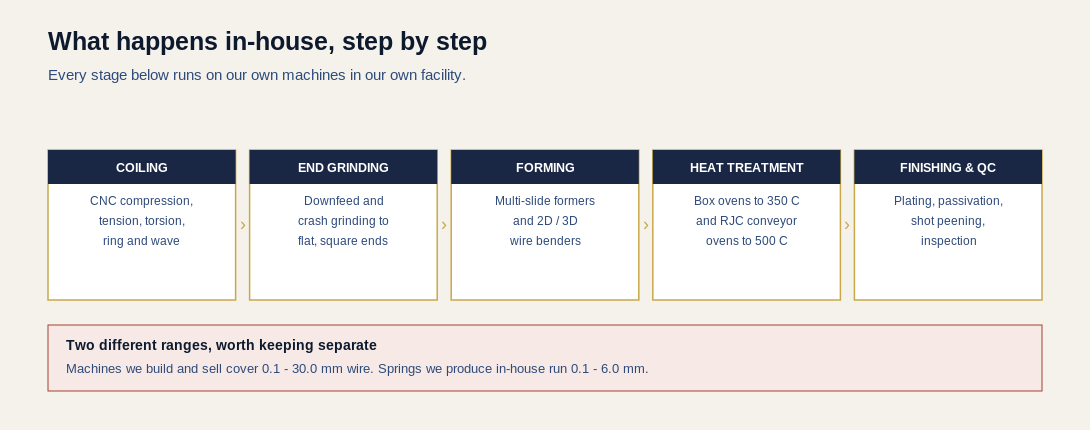
We do two things, and their ranges are different. The machines we build and sell cover wire from 0.1 mm up to 30.0 mm across the full catalog, including the SHA large coilers. The springs we produce in our own plant run 0.1 – 6.0 mm, depending on type: compression 0.1 – 0.8 mm, tension 0.13 – 6.0 mm, torsion 1.5 – 4.5 mm.
If you have seen the 30 mm figure quoted for our production, that is the machinery range, and we would rather correct it here than let you find out at quotation.
COILING
CNC compression, tension, torsion, ring, and wave spring coilers. On the fine end, machines such as the CNC-508 run 0.13 – 0.8 mm on five axes; the CNC-210 covers 0.15 – 1.0 mm at up to 100 pieces per minute. Length detection in-cycle matters more than headline speed: catching a drift at part 40 rather than at the end of the batch is the difference between an adjustment and a scrap lot.
END GRINDING
Downfeed and crash grinding finish compression spring ends flat and square so the spring sits properly in assembly and loads evenly. This is where a coiling bottleneck often turns out not to be a coiling bottleneck at all. A faster coiler feeding an unchanged grinder simply moves the queue.
WIRE AND STRIP FORMING
Multi-slide formers and 2D and 3D wire benders produce hooks, brackets, clips, and multi-plane wire forms. Versatile CSM and ZX platforms cover mixed work where changeover frequency, rather than cycle time, is the real constraint.
HEAT TREATMENT
Two oven types, used for different jobs. Box ovens to 350 °C handle batch stress relief — removing the residual stress that coiling introduces, so the spring holds its free length instead of relaxing in service. RJC conveyor ovens to 500 °C run continuously for higher volumes.
Stress relief is not optional on a coiled spring. Skipping it produces parts that measure correctly on the day and drift afterwards, which is among the harder failures to diagnose because the inspection record looks fine.
FINISHING AND INSPECTION
Plating, passivation, and shot peening, then dimensional and load inspection. Shot peening is worth understanding: it induces compressive residual stress at the surface, which substantially extends fatigue life on cyclically loaded springs. If your part sees high cycle counts, ask about it at drawing stage rather than after the first fatigue result.
WHAT WE DO NOT DO IN-HOUSE
Being clear about the boundary is more useful than claiming everything.
Specialized plating chemistries beyond our standard finishes go to outside processors, as does any process requiring accreditation we do not hold. Material is bought as drawn wire to specification, not drawn in-house. Destructive metallurgical testing and independent laboratory certification are subcontracted to accredited laboratories, which is the correct arrangement in any case, since an independent result should come from an independent party.
Where a process leaves the building, it enters our supplier controls and the traceability record follows it. But it is a subcontracted step, and if that matters to your qualification, ask and we will tell you exactly which stage sits where.
A note on sequencing that catches people out. Heat treatment happens after forming, and it moves dimensions. How much depends on the material, the section, and the geometry, but it is never zero. A part measured perfect before stress relief and out of tolerance afterwards has not failed — the process plan simply did not allow for the movement.
The practical consequence is that final dimensional acceptance belongs after heat treatment, not before it. If your incoming inspection measures a characteristic we control before treatment, we should agree that explicitly rather than discover the mismatch on a rejection report.
WHY ONE FACILITY CHANGES THE ANSWER
- No inter-vendor transit. A part that would otherwise ship to a plater and back stays in the building.
- One traceability chain. Material lot through to finished part, without a gap where records change hands.
- Faster correction. When a dimension drifts, coiling and grinding are on the same floor and the loop closes in hours.
Send us your drawings, samples, or requirements and our engineering team — backed by 20+ years of spring and machinery manufacturing experience — will get back to you with a competitive quote and realistic turnaround.
Email: sales@seyunda.com
Phone: +65 9168 2618
We look forward to supporting your next project.
Published by the Seyunda Team · 2026