Choosing a CNC spring machine supplier on price alone is how shops end up with a capable machine they cannot keep running. The machine is a one-afternoon decision; tooling, support, and spares determine the next ten years.
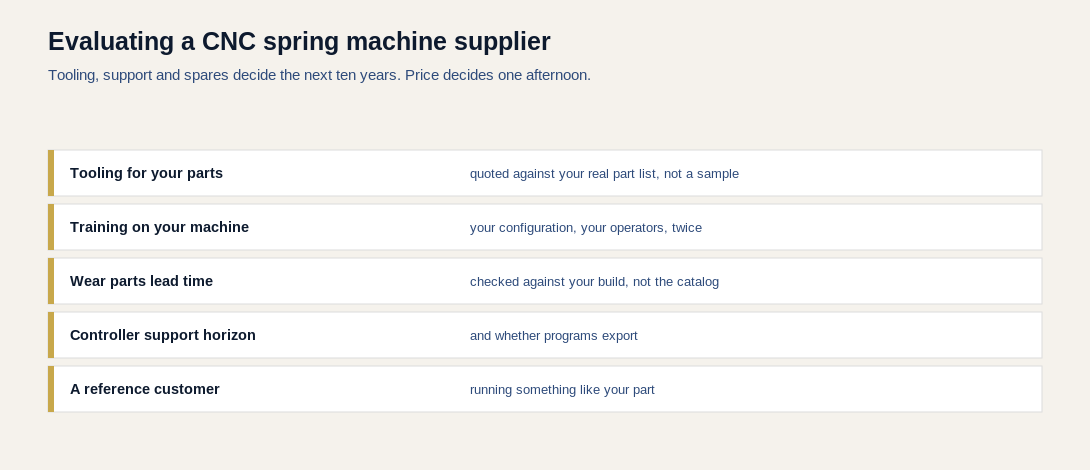
TOOLING, QUOTED AGAINST YOUR REAL PARTS
Quotations typically include tooling for a sample part. Production needs tooling for the family you actually run.
Ask for tooling costed against your real part list before comparing machine prices. Two machines with a clear price difference can invert once tooling for six parts is included, and that comparison is only possible if you ask for it up front.
TRAINING ON YOUR CONFIGURATION
Generic training on a standard build leaves gaps precisely where your machine differs. Ask whether training happens on the machine you bought, with the tooling you ordered.
Ask also for a second session some weeks after commissioning. Training delivered entirely at handover arrives before anyone knows what to ask; a follow-up once operators have real hours is worth more than the original.
WEAR PARTS AND LEAD TIMES
Coiling points, cutting tools, guides, and feed rollers are consumed in proportion to hours run. Ask for the list with prices and lead times, checked against your actual build rather than the catalog configuration — they are not always the same.
Separate the question for controller and servo components. A three-day wait for a wear part is an inconvenience; a twelve-week wait for a drive is a production crisis, and the difference is worth knowing before it happens.
CONTROLLER SUPPORT AND PROGRAM PORTABILITY
A CNC machine has a failure mode a mechanical one does not: the controller becomes unsupported. That, rather than mechanical wear, often sets the real useful life.
Ask how long the controller will be supported, whether spares are held, and — the practical question — whether programs can be exported and backed up outside the machine. Proven setups that exist only inside one controller, in a proprietary format, are accumulated knowledge you cannot recover.
APPLICATION SUPPORT, NOT JUST REPAIR
The more valuable support call is usually "we are trying to make this part and cannot hold this dimension", not "the machine has stopped". Ask whether the supplier can help with the first kind.
A supplier who also runs production has an advantage here, because the answer comes from having made parts rather than from reading a specification. It is worth asking directly whether they manufacture as well as sell.
THE REFERENCE CUSTOMER
Ask to speak to a customer running a similar configuration on similar work. It is the single most informative item on this list and the most frequently skipped.
What you are listening for is not praise. It is the specifics: how long commissioning actually took, what the first three months were like, and what happened the first time something broke.
WHAT COMMISSIONING SHOULD PRODUCE
Commissioning is finished when the machine has run your part to your drawing and produced evidence of it — not when it powers up and cycles.
Agree acceptance criteria in advance. A stated number of consecutive good parts at cycle rate is a clear criterion; "runs satisfactorily" is not. Ask for dimensional results across a meaningful sample rather than a single first-off.
Then record the settings that produced that result and store them with the program, along with the tooling identification and the material specification. That combination is the baseline you will compare against in two years when the same part will not run right and nobody remembers what changed.
A NOTE ON PRICE
Price differences between comparable machines are usually smaller than the cost of a badly supported one. A machine that is down for three weeks waiting on a part has consumed more than the saving that justified choosing it.
That is not an argument for paying more. It is an argument for comparing total cost over a realistic life, including the items above, rather than comparing invoices.
One last question worth asking, because the answer is revealing: does the supplier also manufacture parts? A supplier who runs the machines they sell answers feasibility questions from experience rather than from a specification sheet, and will tell you when a tolerance is difficult because they have tried to hold it.
Send us your drawings, samples, or requirements and our engineering team — backed by 20+ years of spring and machinery manufacturing experience — will get back to you with a competitive quote and realistic turnaround.
Email: sales@seyunda.com
Phone: +65 9168 2618
We look forward to supporting your next project.
Published by the Seyunda Team · 2026