Replacing a working mechanical or older servo coiler is a harder decision than buying a first machine, because the existing one still makes parts. The case has to be built on what changes, and the changes are not the ones usually quoted.
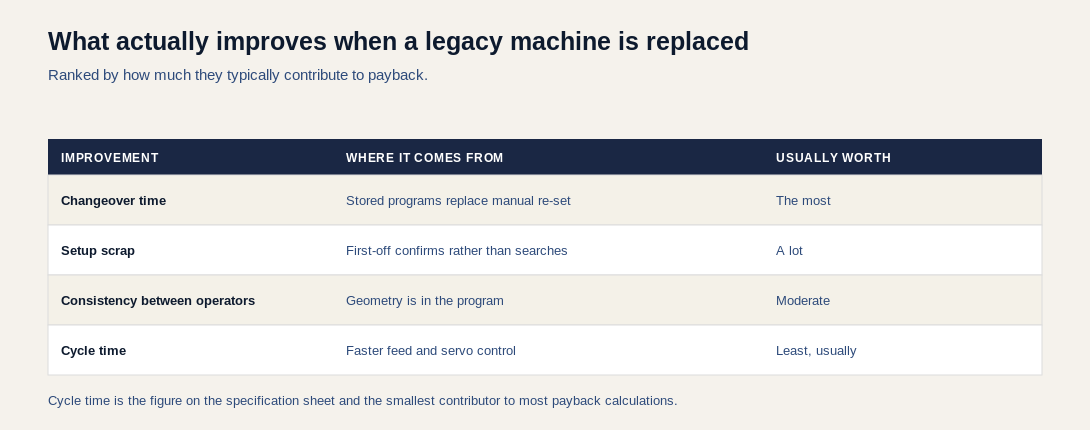
WHERE THE RETURN ACTUALLY COMES FROM
Changeover time is almost always the largest item. On a legacy machine the setup lives in physical tooling positions and stops, so reproducing it means an operator adjusting until first-off parts measure correctly. A stored program replaces that with a recall.
Measure it door to door — last good part of one job to first good part of the next — and multiply by changeovers per week. A shop doing three changeovers a day at 90 minutes each is losing more capacity than any cycle time improvement will return.
Setup scrap is the second, and the most commonly missed. It is the parts consumed reaching first-off approval, and it is usually buried inside a general scrap figure rather than counted separately. Splitting scrap into setup and running is a five-minute change to how you record it and frequently reveals the business case on its own.
WHAT DOES NOT CHANGE
Being clear about this protects the case from being oversold.
A new machine does not remove material variation. A coil running harder than the last still needs a program adjustment, because springback is a property of the wire. It does not compensate for worn tooling — it repeats a bad setup faithfully. And it does not eliminate the operator; it changes the skill required, from mechanical setting toward program management.
Shops that buy CNC expecting to reduce skill requirements are frequently disappointed. Shops that buy it expecting to make skill reproducible generally are not.
THE HIDDEN COST OF KEEPING THE OLD MACHINE
There is a cost to the status quo that rarely appears in a comparison: the work you decline because the machine cannot hold the tolerance, cannot reach the wire size, or cannot be changed over quickly enough to make a short run viable.
Log declined inquiries for two weeks with the reason for each. That log converts an invisible cost into a number, and it is the only item in the calculation that becomes new revenue rather than saved cost.
WHAT REPLACEMENT ACTUALLY INVOLVES
- Tooling for your real part list, not the sample part.
- Site work — three-phase supply, floor loading, swarf and coolant routing.
- Programming every existing part onto the new machine, which is real engineering time before any saving appears.
- Requalification. Moving an automotive part to a new machine is a process change and customers will expect a PPAP resubmission.
- The ramp-up dip, where output sits below capability while the team learns.
Point three is the one most often underestimated. A shop with forty active parts is looking at a substantial programming exercise, and it happens while the old machine is still running production.
WHAT TO MEASURE BEFORE THE MACHINE ARRIVES
Without a baseline, any improvement is a matter of opinion, and opinions do not survive a finance review. Take these over two normal weeks of mixed work before delivery.
- Changeover time, measured door to door, with the number of changeovers per week.
- Scrap, split into setup and running. These are different problems and averaging them hides both.
- Capability on the characteristic that actually causes returns, with sample size recorded.
- Attended minutes per thousand good parts, including inspection.
- Declined inquiries, with the reason for each.
The fifth is the one that turns into revenue rather than saved cost, and it is the one nobody records.
A SEQUENCE THAT WORKS
Keep the legacy machine during transition rather than removing it on delivery. Program the highest-volume parts first, prove them, then migrate progressively. The old machine covers production while the new one is being proven, and it provides redundancy during the period when you have least of it.
One organizational note. The shops that get most from a replacement treat program development as work worth doing carefully once, rather than as setup to be rushed. A program proven properly, with its tooling and material recorded alongside it, pays back every time that part runs again. A program hurried into production becomes a setup somebody re-adjusts every batch, which is the legacy machine problem with extra steps.
Send us your drawings, samples, or requirements and our engineering team — backed by 20+ years of spring and machinery manufacturing experience — will get back to you with a competitive quote and realistic turnaround.
Email: sales@seyunda.com
Phone: +65 9168 2618
We look forward to supporting your next project.
Published by the Seyunda Team · 2026