Wire forms run from a simple flat hook to an intricate multi-plane bracket, and the machine capability required scales with that geometry. The line between 2D and 3D is not a marketing distinction. It is a hard limit on what a machine can physically produce.
THE DIFFERENCE IN ONE SENTENCE
A 2D machine bends wire within a single plane. A 3D machine can rotate the wire about its own axis between bends, which lets a later bend leave the plane of the earlier ones. If your part has any feature that departs from a flat outline, no amount of tooling will let a 2D machine make it.
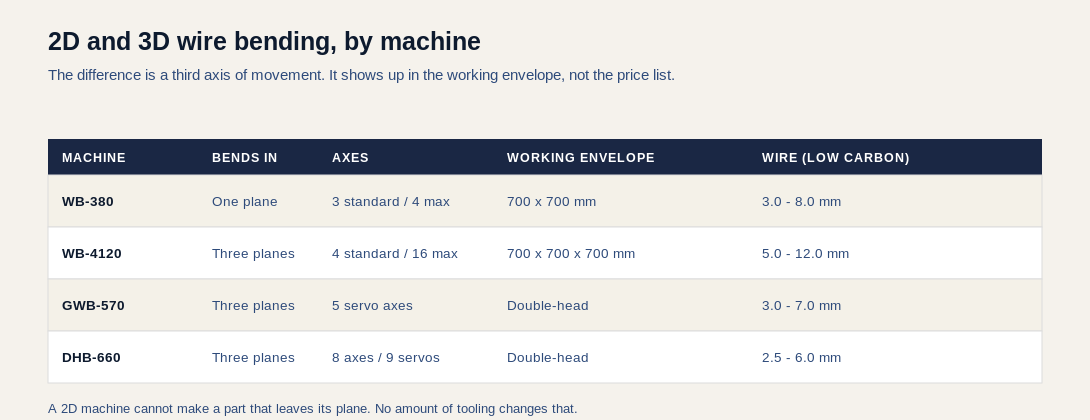
WHAT EACH MACHINE COVERS
- WB-380 (2D): Three standard axes, four maximum, working range 700 x 700 mm, wire 3.0 – 8.0 mm in low carbon steel, feed to 70 m/min with unlimited feed length. Right for hooks, flat brackets, and simple retaining shapes.
- WB-4120 (3D): Four standard axes and up to sixteen, 700 x 700 x 700 mm envelope, 5.0 – 12.0 mm low carbon or 4.0 – 8.0 mm stainless, 360° spinner. The heavy end of the range.
- GWB-570 (3D, double-head): Five servo axes, 3.0 – 7.0 mm low carbon steel.
- DHB-660 (3D, double-head): Eight axes driven by nine servo motors, 2.5 – 6.0 mm. Double-head machines form from both ends, which shortens cycle time on symmetrical parts and reduces handling.
HOW TO TELL WHICH YOUR PART NEEDS
Lay the drawing flat and ask whether every feature can be drawn without lifting the pen off the plane. If the answer is yes, it is a 2D part and a 2D machine will make it faster and more cheaply. If any leg, hook, or offset points out of that plane, it is 3D work.
One caution: a part that is almost flat is still 3D. A single out-of-plane tab decides the machine for the whole part.
WHY 3D COSTS MORE THAN THE EXTRA AXIS SUGGESTS
Tolerance is the reason. On a flat part, errors accumulate in two directions. Add a third and every rotation carries the previous bend's error with it. A tight tolerance on the last feature of a long 3D sequence is much harder to hold than the same tolerance on a 2D part, because it sits at the end of a longer stack.
Springback compounds this. Wire recovers elastically after each bend, and the amount depends on material, temper, and diameter. It is compensated in the program, but that compensation has to be established on the actual material lot. This is why a first-off from a new coil sometimes needs adjustment even on a proven program.
DOUBLE-HEAD MACHINES, AND WHEN THEY EARN THEIR COST
The GWB-570 and DHB-660 form from both ends of the wire. On a symmetrical part that halves the number of forming operations and, more importantly, removes a handling step where the part would otherwise be re-gripped and re-datumed.
That second point is where the quality gain sits. Every time a part is released and re-gripped, the reference for subsequent bends is re-established, and any error in that re-gripping enters the tolerance stack. A double-head machine holding the part throughout produces a tighter relationship between the two ends than two sequential operations will.
The economics follow the part rather than the volume. A symmetrical part with a critical end-to-end dimension benefits immediately. An asymmetric part with loose tolerances may see no gain at all, and a single-head machine will produce it just as well for less.
Feed length is worth a mention because it is often misread. Both the WB-380 and WB-4120 quote unlimited feed length, which means the machine can draw wire continuously rather than being limited to a pre-cut blank. For long brackets and continuous forms that removes a cutting operation and the tolerance that would come with it. It does not mean the working envelope is unlimited — the formed part still has to fit within 700 mm in each controlled direction.
WHAT TO SEND FOR A QUOTE
- The drawing, ideally with a 3D model, and a clear statement of which features are critical.
- Material grade and temper. Springback behavior depends on it.
- Wire diameter and tolerance.
- Annual volume and batch size, which decide whether a double-head machine is worth the setup.
- Finish requirement and the exposure environment it has to survive.
If a 3D part can be redesigned to stay in one plane without losing function, we will say so. It is usually the cheapest change available.
Send us your drawings, samples, or requirements and our engineering team — backed by 20+ years of spring and machinery manufacturing experience — will get back to you with a competitive quote and realistic turnaround.
Email: sales@seyunda.com
Phone: +65 9168 2618
We look forward to supporting your next project.
Published by the Seyunda Team · 2026