Miniature mechanisms, medical devices, instruments, and small electronics all need springs at wire diameters where the manufacturing problem changes character. Below roughly 0.3 mm, several constraints tighten together, and by 0.1 mm the limiting factor is usually not the coiling at all.
THE WIRE ITSELF IS DIFFERENT
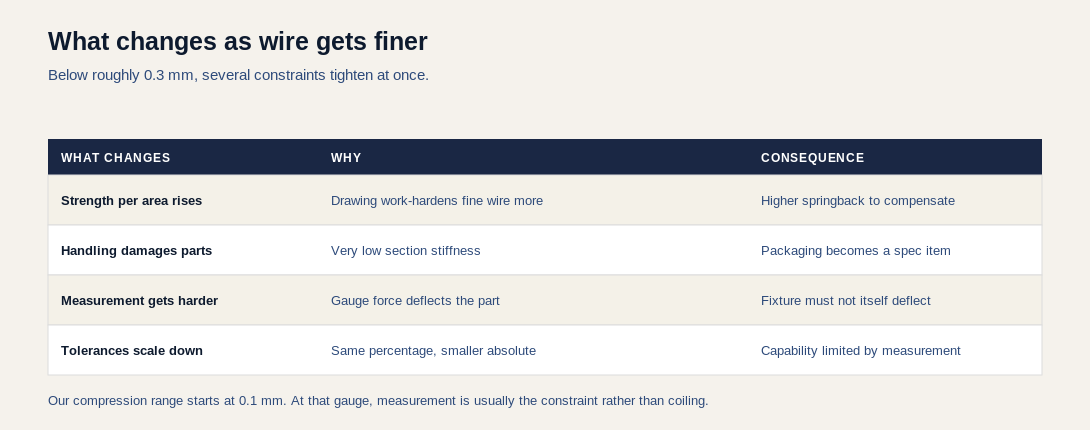
Fine wire has been drawn down further, and drawing work-hardens it. A 0.1 mm music wire is substantially stronger per unit area than the same material at 3 mm.
Higher strength means more springback after forming, so the compensation built into the program is larger and more sensitive to variation between material lots. That is why a first-off after a coil change is not a formality on fine wire — it is where a real difference gets caught.
HANDLING BECOMES A DESIGN CONSTRAINT
A 0.1 mm spring has very little section stiffness. It can be deformed by being picked up carelessly, by tangling with its neighbors in a container, or by the vibration of transport.
The practical consequence is that packaging stops being an afterthought and becomes a specification item. Layered trays, compartmented packaging, or reel packaging cost more and prevent parts arriving out of tolerance for reasons that have nothing to do with how they were made.
This is worth agreeing at quotation. A dispute about parts damaged in transit is unpleasant and entirely avoidable.
MEASUREMENT IS USUALLY THE REAL LIMIT
Measuring a fine-wire spring is harder than making one. Two problems compound.
Gauge force deflects the part. A measuring instrument applying contact force to a 0.1 mm spring may be deflecting it while measuring it. Non-contact or very low force methods become necessary.
Fixtures deflect too. Measuring load at height requires a fixture stiff enough that its own deflection does not appear in the reading. On very light loads, that is a real design problem for the fixture.
The consequence is that a tolerance neither party can measure repeatably will generate disputes regardless of how well the parts are made. Agree the method and the fixture before agreeing the tolerance.
SPRING INDEX STILL APPLIES
Index — mean diameter divided by wire diameter — needs to stay in a workable band of roughly 4 to 12 at any size. On fine wire the practical effect is that very small coil diameters become difficult, because a low index means bending the wire very tightly relative to its section.
If a design calls for a 0.1 mm wire on a 0.4 mm mean diameter, that is an index of 4, at the edge of what is formable. It is worth checking the index before committing a design.
WHERE THESE PARTS GO
- Medical devices: dosing mechanisms, surgical instruments, diagnostic equipment.
- Miniature electronics: battery contacts, switch returns, connector retention.
- Instruments: sensor preload and precision mechanisms where force consistency matters more than magnitude.
WHAT DRIVES COST AT THIS SIZE
Fine wire springs are not simply cheaper because they use less material. The cost drivers move elsewhere.
- Inspection becomes a larger share, because measuring is slow and sometimes requires purpose-made fixtures.
- Packaging becomes a real line item where parts must be presented individually rather than loose.
- Setup takes longer, because first-off adjustment on high-springback material needs more iterations.
- Yield is more sensitive, since handling damage that a heavier spring would shrug off scraps a fine one.
The practical consequence is that tightening a tolerance at this scale can raise cost sharply through inspection and yield rather than through manufacturing. Tolerances worth having are worth stating; tolerances copied from a template are worth reviewing.
WHAT TO SEND US
Our compression range starts at 0.1 mm. What we need to quote well is the load at working height with the tolerance that actually matters, the space envelope, the material, and — specifically at this size — how you will measure it and how you need it packaged.
One design note worth adding. At these sizes, small changes to the coil diameter have a disproportionate effect on both stress and stability, because spring index changes quickly when the wire is thin. If a fine-wire design is marginal, adjusting mean diameter is usually a more effective lever than adjusting the number of coils.
Send us your drawings, samples, or requirements and our engineering team — backed by 20+ years of spring and machinery manufacturing experience — will get back to you with a competitive quote and realistic turnaround.
Email: sales@seyunda.com
Phone: +65 9168 2618
We look forward to supporting your next project.
Published by the Seyunda Team · 2026