Most spring buyers eventually face a make-or-buy decision, and it is rarely a single moment. Volumes grow, outsourcing gets expensive, and at some point bringing production in-house starts to look sensible.
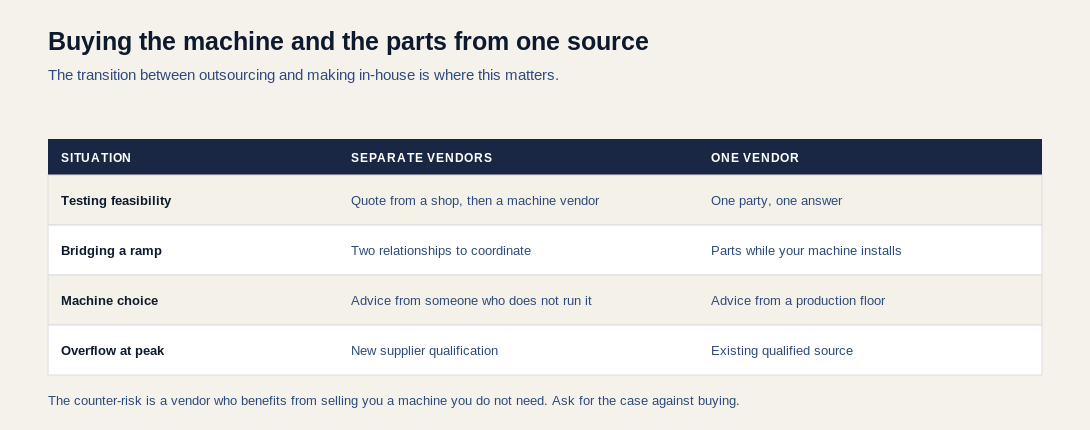
That transition is where sourcing both parts and machinery from one vendor actually matters. The rest of the time it matters less than it is usually claimed to.
TESTING A PART BEFORE COMMITTING TO A MACHINE
Before buying a coiler you want to know the part can be made to tolerance, at rate, in your material. Outsourcing production first answers that question with real parts rather than a specification.
Where the same vendor makes the parts and sells the machine, that answer transfers directly. The setup that produced good parts is known, the tooling is understood, and the machine recommendation comes from having run the job rather than from reading a datasheet.
With separate vendors, the parts supplier has no reason to tell you what machine made them, and the machine vendor has not made your part.
BRIDGING THE RAMP
Machines have lead times, installation takes time, and there is a commissioning and learning period before output is reliable. Meanwhile the parts are still needed.
A supplier who can produce the parts during that period removes the gap. As the machine comes up to rate, outsourced volume tapers. This is straightforward and it is the most practical benefit of the arrangement.
OVERFLOW WITHOUT A NEW QUALIFICATION
Once production is in-house, capacity is finite. A demand peak, a breakdown, or a large one-off order can exceed it.
An existing supplier relationship covers that without a new qualification cycle, which on regulated work is a real saving in time rather than only in money. Qualifying a supplier under time pressure is when mistakes get made.
THE CONFLICT OF INTEREST, STATED PLAINLY
A vendor selling both has an obvious incentive to recommend buying a machine, whether or not it is the right decision.
The way to test it is to ask for the case against. A vendor who cannot articulate why you should keep outsourcing — volumes too low, part mix too varied, capital better spent elsewhere — is not giving you advice. There are genuinely many situations where outsourcing indefinitely is the correct answer, and a supplier who never says so is selling rather than advising.
We would rather keep supplying parts to a customer for whom a machine makes no sense than sell one that sits underused.
WHERE IT DOES NOT MATTER
If you are firmly a parts buyer with no intention of manufacturing, this arrangement offers little beyond what any good parts supplier provides. If you are firmly a manufacturer buying equipment, likewise.
The value is concentrated in the transition, and in the period either side of it.
THE MAKE-OR-BUY CALCULATION, HONESTLY
The arithmetic that decides this is more involved than piece price against machine cost.
On the buy side: piece price, plus the coordination overhead of a supplier relationship, plus lead time risk, minus the capital you did not spend and can deploy elsewhere.
On the make side: machine, tooling, installation, training, and the ramp-up dip — then material, labor, floor space, maintenance, and wear parts as ongoing costs. Plus requalification if regulated parts move onto the new machine.
The item that most often flips the answer is utilization. A machine covering one part at modest volume spends most of its life idle, and idle capital is expensive. A machine that also absorbs work you currently decline is a different proposition entirely.
Which is why the declined-inquiry log matters here as much as the volume forecast.
WHAT TO ASK
- Do you actually run the machines you sell, in production?
- What would make you advise against buying a machine for this part?
- Can you supply parts during our installation and ramp-up?
- If we bring this in-house, will you still quote overflow work?
The second question is the informative one, and the answer tells you what kind of conversation you are having.
A final observation. Customers who eventually bring production in-house are not lost business from our point of view; they typically continue buying machinery, tooling, and overflow parts. That alignment is worth stating openly, because it explains why we are willing to advise against a machine purchase. A supplier whose incentives only point one way is worth being cautious with, ours included.
Send us your drawings, samples, or requirements and our engineering team — backed by 20+ years of spring and machinery manufacturing experience — will get back to you with a competitive quote and realistic turnaround.
Email: sales@seyunda.com
Phone: +65 9168 2618
We look forward to supporting your next project.
Published by the Seyunda Team · 2026