Compression springs that seat squarely in an assembly need their ends ground flat and perpendicular to the axis. Grinding is a straightforward operation with one significant decision inside it: how the wheel approaches the work.
DOWNFEED GRINDING
The wheel advances progressively into the work across multiple passes or a controlled feed rate. Material is removed gradually.
The benefit is heat control. Less material removed per pass means less heat into the spring end, which matters because localized heating can temper the material and change its properties exactly where the spring bears. It also gives a better surface finish and holds squareness more consistently.
The cost is cycle time. Progressive removal takes longer than a single pass.
CRASH GRINDING
The wheels are set at a fixed gap and the spring is ground to length in essentially one pass. It is considerably faster and well suited to high volumes of a stable part.
The trade is heat input and wheel wear. More material removed at once means more heat generated at the contact, and the wheel wears faster, which means dressing more often and monitoring more closely. On thin wire or on a material sensitive to tempering, that heat can matter.
WHICH TO USE
- Downfeed for tight squareness tolerances, for heat-sensitive materials, for fine wire, and for shorter runs where cycle time is not the binding constraint.
- Crash for high volume of a stable part in a material tolerant of the heat, where the tolerance is achievable and the economics favor throughput.
Many shops use both, on different parts, on the same machine. It is a setup decision rather than a machine class.
MATCHING THE FRAME TO THE WORK
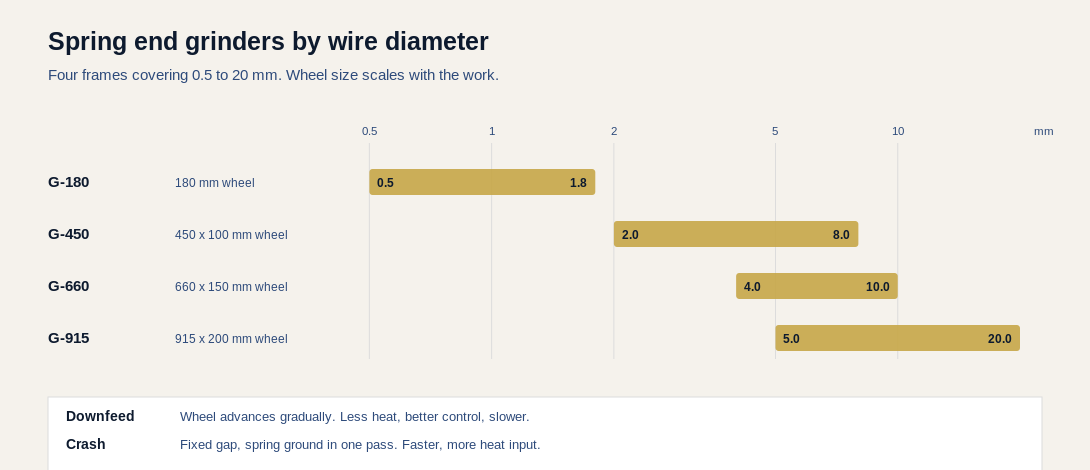
Wheel size scales with wire diameter, because a larger wheel presents more surface and removes heat better on heavier work. The G-180 handles 0.5 – 1.8 mm on a 180 mm wheel. The G-450 covers 2 – 8 mm on a 450 × 100 mm wheel with springs to 60 mm OD. The G-660 runs 4 – 10 mm on a 660 × 150 mm wheel with OD from 20 to 100 mm. The G-915 takes 5 – 20 mm on a 915 × 200 mm wheel.
Loading plate speed matters more than it appears. On the G-450 and G-660 it runs from a half to 30 RPM; the G-915 runs 5 to 50 RPM. That range is what lets a grinder be tuned to the part rather than run at one rate for everything.
WHAT GOES WRONG, AND WHY
Burning. Discoloration at the ground end means the material has been heated enough to temper. It is a process problem — feed rate, wheel condition, or coolant — not a material problem.
Out-of-square ends. Usually fixturing or loading rather than the grinding itself. A spring that is not held perpendicular cannot be ground perpendicular.
Inconsistent free length. Often traceable to wheel wear between dressing intervals rather than to the setup.
WHAT GRINDING TAKES OFF THE SPRING
Grinding removes material, which means the spring arrives at the grinder longer than it leaves. That allowance has to be in the coiling program, and getting it wrong is a common source of scrap on a new part.
The allowance depends on how square the coiled ends are, how much of each end coil is being flattened, and the grinding method. It is established during first-off rather than calculated, which is why a new part needs coiling and grinding proved together rather than as separate operations.
There is a design consequence too. Grinding removes part of the end coil, so the number of active coils changes slightly and the spring rate moves with it. A spring designed to a rate without allowing for ground ends will measure differently once ground. On tight rate tolerances this matters, and it is best resolved at drawing stage.
PLANNING GRINDING CAPACITY
Grinding is frequently the real constraint on a compression spring line, because it does not scale the way coiling does. A coiler producing 200 pieces a minute can easily outrun the grinder behind it.
If you are buying a faster coiler, calculate the grinder capacity in the same exercise. Otherwise the parts simply queue one stage further along, and the money has bought a larger pile of work in progress.
Send us your drawings, samples, or requirements and our engineering team — backed by 20+ years of spring and machinery manufacturing experience — will get back to you with a competitive quote and realistic turnaround.
Email: sales@seyunda.com
Phone: +65 9168 2618
We look forward to supporting your next project.
Published by the Seyunda Team · 2026