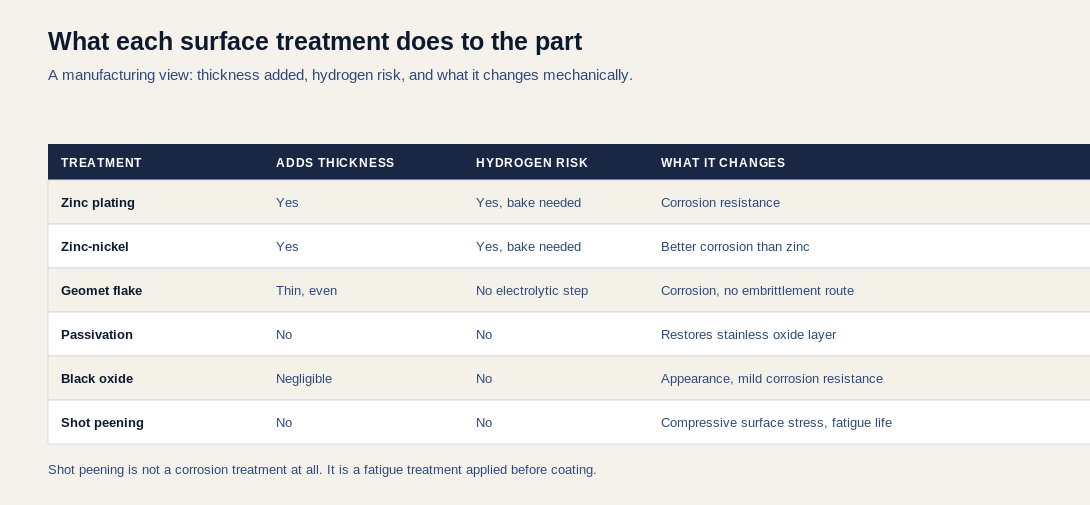
Surface treatments are usually discussed in terms of corrosion resistance. For anyone making or specifying a spring, the more useful question is what each treatment does to the part — how much thickness it adds, whether it introduces hydrogen, and what it changes mechanically.
ZINC PLATING
Electrolytically deposited zinc, sealed with a passivate. It adds measurable thickness, which matters on a part with a tight fit — a clip that must slide into a slot, or a spring working in a close bore.
It also introduces hydrogen into the steel, which for high-strength spring material is a genuine risk. The mitigation is a post-plating bake, and the timing matters: it must happen promptly after plating, not at the end of the week.
The passivate deserves specifying by chemistry rather than color. Traditional yellow and olive chromates were hexavalent; trivalent is the compliant replacement.
ZINC-NICKEL
An alloy plating with substantially better corrosion performance than zinc alone, common on automotive underbody parts. It is still electrolytic, so the hydrogen precaution still applies, and it still adds thickness.
ZINC FLAKE COATINGS
Applied as a dispersion and cured rather than electroplated. Two consequences follow from that difference, and both are mechanical rather than chemical.
There is no electrolytic step, so no hydrogen is introduced. That makes flake coatings well suited to high-strength springs where embrittlement is a real concern. And the coating is applied thinly and evenly, which helps where build-up would interfere with fit.
On substances: Geomet is hexavalent chromium free. Dacromet is not, despite frequently being described as chrome-free. Where a Cr(VI) restriction applies — as it does for vehicle parts under the ELV Directive — Geomet is the correct specification.
PASSIVATION IS NOT A COATING
This one causes real confusion because it is listed alongside coatings. Passivation is a chemical treatment for stainless steel only. It removes free iron from the surface and lets the natural chromium oxide layer reform.
It adds no measurable thickness and changes no dimension. You cannot passivate carbon steel, and it is not an alternative to plating — the two apply to different materials for different reasons. What it does is restore corrosion resistance that machining, forming, or handling has compromised.
SHOT PEENING IS NOT A CORROSION TREATMENT AT ALL
Peening bombards the surface with media to induce compressive residual stress. Because fatigue cracks open under tension, that compressive layer must be overcome before a crack can start, and the effect on fatigue life is large.
It offers no corrosion protection whatsoever. It is applied before coating, and a peened part still needs a finish if the environment demands one. Treating peening and plating as alternatives is a specification error we see regularly.
TESTING WHAT YOU SPECIFIED
Salt spray hours are the most quoted and least comparable figure in surface finishing. The result depends on coating thickness, the passivate or topcoat, the test standard, part geometry, and whether the failure criterion is white rust or red rust.
To compare two finishes meaningfully, fix three things: the standard, the failure criterion, and the coating thickness. Without all three, two numbers quoted in hours are not measuring the same thing.
It is also worth knowing that cyclic corrosion testing, with alternating wet and dry phases, correlates better with real service than continuous salt spray. If a customer specifies a cyclic schedule rather than a straight salt spray hour count, that is why.
SPECIFYING IN THE RIGHT ORDER
- Decide whether fatigue life requires peening. That comes first because it precedes everything else.
- Establish the corrosion environment and service life.
- Check the base material — high-strength steel narrows the options because of hydrogen risk.
- Check the substance restrictions that apply to your part.
- Then choose the treatment, and account for any thickness it adds in the dimensional tolerances.
That last step is the one that catches people. Tolerances set before the finish is chosen frequently do not survive the finish being applied.
Finally, agree who performs the treatment and whether their process is qualified. Coating is frequently subcontracted, and a finish is only as consistent as the line applying it. If the finish is critical to your part, ask which processor does the work and whether they are on the supplier's approved list — the same question you would ask about any other outsourced operation.
Send us your drawings, samples, or requirements and our engineering team — backed by 20+ years of spring and machinery manufacturing experience — will get back to you with a competitive quote and realistic turnaround.
Email: sales@seyunda.com
Phone: +65 9168 2618
We look forward to supporting your next project.
Published by the Seyunda Team · 2026