Automation on a spring line is not one decision. It is a series of separate ones, each with a different payback, and they are frequently bundled into a single proposal that obscures which parts are worth doing.
OPTICAL SORTING
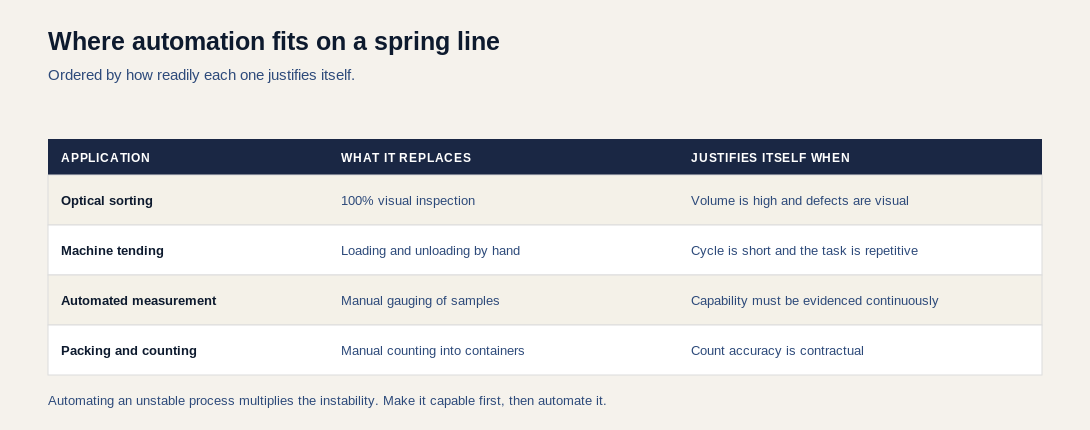
A vision system inspects every part and rejects those outside limits. It replaces 100 percent manual visual inspection, and where volume is high and the defect is visual it is the automation that most reliably pays for itself.
The qualification is that word visual. Optical sorting catches geometry, surface defects, missing features, and gross dimensional error. It does not catch load. A spring can be dimensionally perfect and deliver the wrong force, and no camera will see it.
So optical sorting complements load testing rather than replacing it, and a proposal presenting it as complete inspection is overstating what it does.
MACHINE TENDING
Automated loading and unloading. It suits short cycles and repetitive handling, and it becomes compelling where the same motion happens thousands of times a shift.
The realistic gain is rarely removing an operator. It is one operator supervising two or three machines instead of standing at one. That is a genuine improvement and a smaller number than most business cases assume.
AUTOMATED MEASUREMENT
In-line or at-machine gauging that records dimensions continuously rather than sampling. For regulated work this is increasingly valuable, because it produces the capability evidence that would otherwise be assembled manually.
In-cycle length detection on a coiler is the simplest and most valuable version. Catching drift at part forty rather than at final inspection of a finished batch is the difference between an adjustment and a scrap lot.
PACKING AND COUNTING
Straightforward and easily justified where count accuracy is contractual. Miscounts generate customer complaints out of proportion to their value, and automatic counting removes a category of dispute entirely.
THE SEQUENCING MISTAKE
Automating a process that is not yet stable multiplies the instability. A robot repeats a badly specified operation as faithfully as a good one, and a vision system inspecting a process producing intermittent defects generates a high reject rate and no diagnosis.
Make the process capable first. Record the parameters that produce a good result. Then automate that. Cells commissioned around an unresolved process problem spend their first year being blamed for it.
WHAT AUTOMATION DOES TO THE PEOPLE ON THE LINE
The change is usually described as replacing labor. In practice it changes what the work is, and planning for that determines whether the installation succeeds.
An operator supervising three automated stations needs a different skill set from one loading a single machine: reading a process rather than performing a task, recognizing drift before it becomes scrap, and knowing which adjustments belong to them. That is a more skilled job, not a less skilled one.
Two consequences follow. Training needs budgeting properly rather than treated as an afterthought at commissioning. And the team should be involved before installation, because operators know where time actually goes on the line and will say so if asked.
Installations that struggle usually struggle here rather than technically.
HOW TO DECIDE
- Measure where operator time actually goes over two normal weeks.
- Separate handling time from judgment time. Handling automates well; judgment does not.
- Check the process is stable before automating around it.
- Count the hours a week the automation would actually run at cycle. That sets the ceiling on every saving.
- Automate the largest measured item, not the most visible one.
Our machine automation work covers design, mechanical assembly, calibration, electrical control, and software integration. The useful first conversation is about where time is going, not about what equipment to buy.
One last consideration on sequencing. Automation added to a line changes where the constraint sits, and it rarely removes it entirely. Automating inspection on a line constrained by grinding produces faster inspection of parts that are still waiting. Establish the constraint first, automate around it, then re-measure — because it will have moved.
Send us your drawings, samples, or requirements and our engineering team — backed by 20+ years of spring and machinery manufacturing experience — will get back to you with a competitive quote and realistic turnaround.
Email: sales@seyunda.com
Phone: +65 9168 2618
We look forward to supporting your next project.
Published by the Seyunda Team · 2026