CNC coiling is usually sold on speed. Speed is real, but on most shops it is not where the money is. The change that pays for the machine is that a setting, once proven, comes back exactly.
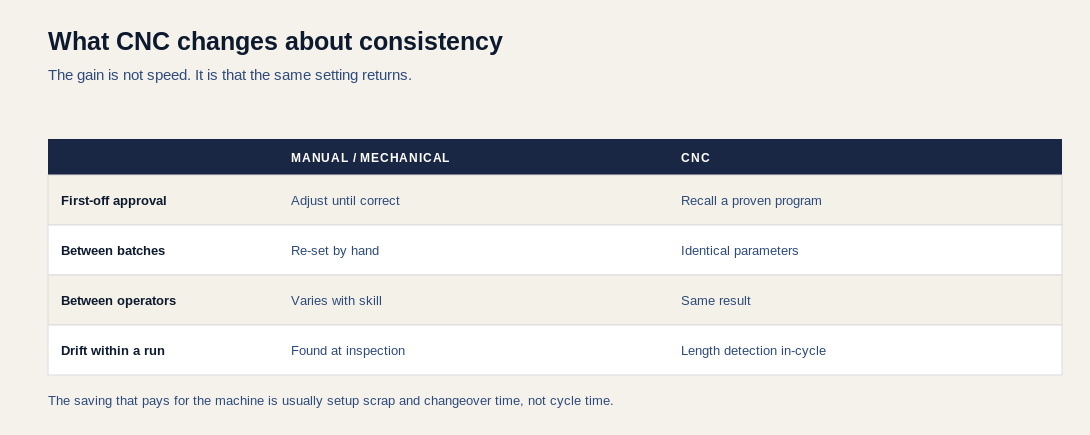
WHAT VARIES ON A MANUAL MACHINE
On a mechanical or manually set coiler, the setup lives in the physical position of tooling and stops. Reproducing it means an operator adjusting until first-off parts measure correctly.
That works, and skilled operators do it well. But the setup is re-created each time rather than recalled, which introduces variation between batches, between operators, and between the beginning and end of a long run as tooling wears and nobody notices immediately.
WHAT CHANGES WITH CNC
- The program is the setup. Axis positions, feed lengths, and pitch values are stored and recalled. The same numbers produce the same part.
- First-off is a check, not a search. On a proven program the first-off confirms the setup rather than discovering it, which is where setup scrap goes.
- Operator dependence falls. Not to zero — loading, tooling condition, and judgment still matter — but the geometry no longer depends on who set the machine.
- Drift can be detected in-cycle. Length detection during the run catches a dimension moving at part forty rather than at final inspection of a finished batch.
WHERE THE SAVING ACTUALLY IS
Two places, and neither is cycle time.
Setup scrap. The parts consumed reaching first-off approval, multiplied by the number of changeovers. On a shop changing setup several times a day, this is frequently the largest single recoverable loss and the least measured, because it is usually buried in a general scrap figure rather than counted separately.
Changeover time. Measured door to door — last good part of one job to first good part of the next. A stored program replaces a manual re-set, and the difference compounds across every changeover in the year.
WHAT CNC DOES NOT FIX
Being honest about the limits matters, because expectations set at purchase determine whether the machine is judged a success.
It does not remove material variation. A coil that runs slightly harder than the last will still need a program adjustment, because springback depends on the material as much as the geometry. It does not compensate for worn tooling — it will repeat a bad setup as faithfully as a good one. And it does not make an operator unnecessary; it changes what the operator needs to know, from mechanical setting skill toward program management and process judgment.
WHAT ACTUALLY LIVES IN A PROGRAM
It is worth being precise about what "stored setup" means, because it determines how reproducible a program really is.
A program holds axis positions, feed lengths, pitch values, and cut timing. It does not hold the tooling that was fitted, the material lot that was running, or the condition either was in. Recall a program with different coiling points and the geometry will differ, even though the numbers are identical.
Shops that get the most from CNC record the program alongside the tooling identification and the material specification that produced a proven result. That combination is reproducible. The program alone is not.
This is also why a program that suddenly produces out-of-tolerance parts is informative. The numbers have not changed, so something physical has — tooling wear, a material change, or a machine condition. It narrows the search considerably.
WHAT TO MEASURE BEFORE AND AFTER
- Changeover time, measured door to door, and the number of changeovers per week.
- Scrap, split into setup scrap and running scrap. These are different problems and averaging them hides both.
- Capability on the characteristic that actually causes returns, with the sample size recorded.
- Attended minutes per thousand good parts, including inspection.
Take these over two weeks of normal mixed work before the machine arrives. Without a baseline, the improvement is a matter of opinion, and opinions do not survive a finance review.
One organizational point. The shops that get most from CNC are the ones that treat program development as work worth doing carefully once, rather than as setup to be rushed. A program proven properly, with its tooling and material recorded, pays back every time the part runs again. A program hurried into production becomes a setup that somebody re-adjusts on every batch, which is the manual machine problem with extra steps.
Send us your drawings, samples, or requirements and our engineering team — backed by 20+ years of spring and machinery manufacturing experience — will get back to you with a competitive quote and realistic turnaround.
Email: sales@seyunda.com
Phone: +65 9168 2618
We look forward to supporting your next project.
Published by the Seyunda Team · 2026