Certification is usually discussed in the abstract. This is what IATF 16949 actually requires when the product is a coiled spring or a stamped clip, and what a buyer auditing a spring supplier should expect to see.
CONTROL PLANS THAT NAME REAL PARAMETERS
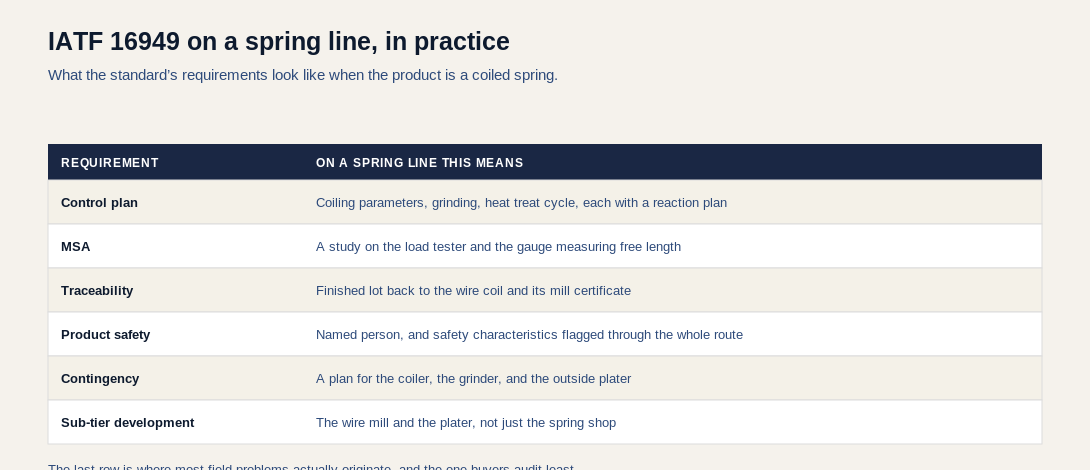
A control plan for a spring should name the parameters actually monitored: coiling feed and pitch settings, grinding wheel condition and dressing interval, heat treatment temperature and time at temperature, and the dimensional checks at each stage.
Each entry needs a reaction plan — what happens when a reading falls outside limits. A control plan listing characteristics without reaction plans describes measurement rather than control.
And there should be three versions: prototype, pre-launch, and production. One generic document covering all three is a common finding and a real weakness, because the checks appropriate at prototype are not the ones appropriate at volume.
MSA ON THE GAUGES THAT ACTUALLY MATTER
For springs the critical measurements are usually free length and load at height. Both deserve a measurement systems analysis, and load testing is the one more often neglected.
A load tester has its own variation, and the fixture holding the spring contributes more. If the fixture deflects under the load being measured, that deflection appears in the reading. On light springs this is not a marginal effect.
Ask whether an MSA has been run on the load tester specifically, not just on the calipers. If the measurement system consumes a large share of the tolerance, the capability figures are describing the gauge as much as the process.
TRACEABILITY BACK TO THE COIL
Full traceability means a finished lot links back to the wire coil it was made from, and that coil links to its mill certificate. For springs this matters more than for many products, because wire properties vary between lots and that variation shows up directly in load.
The test of a traceability system is a question rather than a document: given a finished part, how quickly can you identify the coil, and given a coil, how quickly can you identify every part made from it? The second direction is the one that matters during a containment, and the one more often weak.
CONTINGENCY PLANNING, INCLUDING THE OUTSIDE STAGES
The requirement covers equipment failure, utility interruption, and supply disruption. On a spring line that means a plan for the coiler, for the grinder, and — frequently overlooked — for the outside plater.
A supplier with a documented plan for its own machines and none for its subcontracted finishing has covered the part of the risk it controls and ignored the part it does not.
SUB-TIER DEVELOPMENT, WHERE PROBLEMS ORIGINATE
IATF requires suppliers to develop their own suppliers. For a spring shop the sub-tiers that matter are the wire mill and the finishing processor, and a surprising share of field problems trace to one of them rather than to the spring shop itself.
This is the least audited part of the chain. A certificate says nothing about the mill three steps back, and material variation is a common root cause of drift that presents as a process problem.
WHAT A CERTIFICATE DOES NOT COVER
Two limits are worth holding in mind while auditing, because they are where certified supply chains still fail.
Scope. A certificate covers named sites and activities. A group certificate held by a parent does not automatically cover the plant running your part, and a scope that fitted three years ago may not cover the line your part has since moved to. Re-check at renewal rather than only at sourcing.
Change notification. The requirement exists, but what counts as significant enough to notify is a matter of interpretation. A tooling change, a material source change, or a process relocation may or may not reach you depending on how the supplier reads it.
Agree in writing what triggers a notification for your part specifically. That single agreement prevents more surprises than any clause in the standard.
WHAT TO ASK ON AN AUDIT
- Show me the control plan for this part, in its production version.
- Show me the MSA on the gauge measuring my critical characteristic.
- Given this finished part, identify the wire coil. Then reverse it.
- What is your contingency plan for the outside finishing process?
- How do you develop and monitor the wire mill?
Send us your drawings, samples, or requirements and our engineering team — backed by 20+ years of spring and machinery manufacturing experience — will get back to you with a competitive quote and realistic turnaround.
Email: sales@seyunda.com
Phone: +65 9168 2618
We look forward to supporting your next project.
Published by the Seyunda Team · 2026