A spring that fails early has usually not been made badly. It has been asked to do something its geometry cannot sustain. Fatigue life is set largely at the drawing stage, and the levers available there are cheaper than anything available later.
STRESS RANGE IS THE VARIABLE THAT MATTERS
Fatigue is driven by the range of stress the spring cycles through, not by the peak it reaches. A spring working between 40 and 60 percent of allowable stress will outlast one working between 10 and 70 percent, even though the second has a lower peak.
This is the single most useful idea in spring fatigue, and it inverts the intuition that a lightly loaded spring is a safe one. A spring returning almost to free length on every cycle is experiencing a wide stress range, and that is what fatigue responds to.
THE FOUR LEVERS
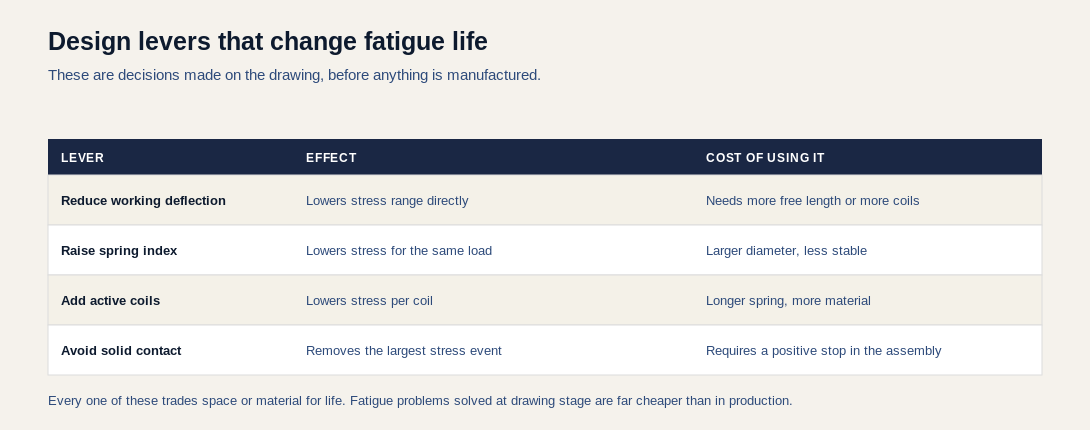
Reduce working deflection. The most direct route. Less travel means a narrower stress range. It costs free length or coils, both of which need space.
Raise the spring index. Index is mean coil diameter divided by wire diameter, and a higher index lowers stress for the same load. Practical range is roughly 4 to 12. Below 4 the wire is bent very tightly and forming becomes difficult; above 12 the spring is unstable to handle and to measure.
Add active coils. More coils share the deflection, so each one works less. It costs length and material.
Avoid solid contact. Compressing a spring to solid is the single most damaging event in its life. Stress rises sharply and a permanent set can occur in one cycle. If the assembly can reach solid, add a positive stop.
WHERE CRACKS ACTUALLY START
Fatigue cracks initiate at the surface, at whatever stress concentration is available. On a compression spring that is the inside of the coil, where stress is highest. On a tension spring it is nearly always the hook, because a hook is a bend and a bend concentrates stress.
That is why hook geometry deserves attention on a tension spring drawing that a body dimension does not. A generous hook radius costs nothing and moves the failure point.
THE DESIGN CHOICE PEOPLE REGRET
Specifying a spring at the top of its stress capability to save space. It works, it passes the initial test, and it has no margin for the variation that real production introduces — wire at the low end of tolerance, a slightly different lot, a marginally rougher surface.
Fatigue is a statistical property. Designing at the limit means a proportion of the population sits beyond it, and those are the field returns.
WHY FATIGUE RESULTS SCATTER
Fatigue life is not a single number. Test ten identical springs and they will fail across a range, sometimes a wide one. That is a property of the phenomenon rather than of the manufacturing.
Cracks initiate at whatever surface feature is most unfavorable on a given part, and that feature varies between parts. So fatigue data is expressed statistically — a life at a stated survival probability — rather than as a guaranteed minimum.
Two consequences for specification. A test on three parts is not a fatigue result; meaningful data needs a sample that reflects the scatter. And designing to the mean life means half the population falls below it, which is why designs are set against a survival probability rather than an average.
WHAT TO PUT ON THE DRAWING
- Required cycles, with the deflection or load extremes that define the cycle.
- The acceptance criterion: survival, or a permitted percentage of load loss.
- Whether shot peening is required — it changes fatigue life substantially and should be a stated requirement, not an assumption.
- Whether the assembly can compress the spring solid.
That last item is the one most often omitted and the one most likely to explain an early failure.
One last point on where fatigue requirements come from. If your specification says a million cycles, it is worth asking where that number originated. Requirements copied from a previous project frequently overstate what the application needs, and an overstated cycle requirement forces a larger spring into a space that did not have room for it. Establishing the real duty cycle sometimes solves a packaging problem for free.
Send us your drawings, samples, or requirements and our engineering team — backed by 20+ years of spring and machinery manufacturing experience — will get back to you with a competitive quote and realistic turnaround.
Email: sales@seyunda.com
Phone: +65 9168 2618
We look forward to supporting your next project.
Published by the Seyunda Team · 2026