Most supplier evaluations cover price, lead time, and certification. Those are necessary and they are not sufficient — every serious supplier passes them. The questions below are the ones that separate a documented process from a confident sales conversation.
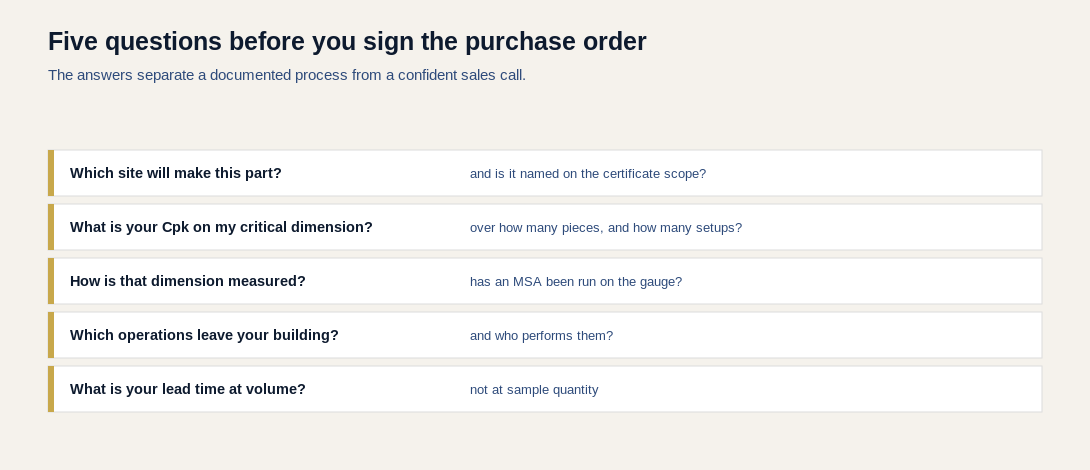
1. WHICH SITE WILL MAKE THIS PART?
Certificates carry a scope statement naming the sites and activities covered. A certificate held by a parent company does not automatically cover the plant that will run your job.
Ask for the certificate itself and check that the manufacturing site appears on it. Also check the accreditation body — an unaccredited certificate is a printed page. This takes two minutes and occasionally changes the decision entirely.
2. WHAT IS YOUR CAPABILITY ON MY CRITICAL DIMENSION?
Not a general quality figure. Pick the dimension that would cause you to reject a batch, and ask for Cp and Cpk on it.
Then ask two follow-ups that matter as much as the number. Over how many pieces? An index from thirty parts is a different claim from one over three hundred. Across how many setups? Between-setup variation is frequently larger than within-setup variation, and a study covering one setup describes a best case rather than production.
3. HOW IS THAT DIMENSION MEASURED?
This question exposes more problems than any other on the list. If the supplier measures free length in a fixture and you measure on a surface plate, both are correct and the numbers will differ.
Ask whether an MSA has been run on the gauge measuring your critical characteristic. If the measurement system consumes a third of the tolerance, the capability target is arithmetically unreachable no matter how the parts are made — and that is worth knowing before rather than after.
4. WHICH OPERATIONS LEAVE YOUR BUILDING?
Nearly every supplier subcontracts something — specialized plating, independent laboratory testing, processes needing accreditation they do not hold. That is normal and not a concern in itself.
What matters is whether they can tell you precisely where the boundary sits, without going to find out. A supplier who cannot answer quickly does not have the visibility to manage that risk either. Ask who performs the outside operations and whether those processors are on their approved list.
5. WHAT IS YOUR LEAD TIME AT VOLUME?
Sample lead time and production lead time are different numbers, and the gap between them is where scaling problems live. A sample can be slotted into a gap in the schedule; a production call-off competes with every other customer.
Ask for lead time at each volume tier you expect, and how much notice a step change requires.
WHAT TO ASK ABOUT THE BAD DAY
The questions above describe a supplier operating normally. These describe what happens when something goes wrong, which is more informative.
- What was your last customer complaint, and what changed as a result? A supplier with no complaints is either very small or not telling you.
- How is a containment handled? Who decides scope, how quickly, and how far back does traceability reach?
- What is your on-time delivery figure, measured against original commitment rather than revised date?
- What happens if you win another large program? Capacity that is comfortable today may not be in six months.
Answers that are specific and slightly uncomfortable are a better sign than answers that are smooth.
ONE MORE, AND IT IS THE BEST ONE
Ask to speak to a customer running something similar to your part. It is the most informative question available and the most frequently skipped, usually out of politeness.
A supplier confident in their work will arrange it. One who deflects has told you something without saying it.
A final observation about how these conversations go. The purpose of these questions is not to catch a supplier out. It is to find out whether the systems described in a certificate actually operate day to day, and a good supplier will welcome being asked because it distinguishes them from one that cannot answer.
If a question produces defensiveness rather than detail, that is itself the answer. Suppliers who run real systems enjoy discussing them, and the ones who do not tend to redirect to price.
Send us your drawings, samples, or requirements and our engineering team — backed by 20+ years of spring and machinery manufacturing experience — will get back to you with a competitive quote and realistic turnaround.
Email: sales@seyunda.com
Phone: +65 9168 2618
We look forward to supporting your next project.
Published by the Seyunda Team · 2026