Turnaround on custom spring work is decided by how many times a part changes hands and how long it waits at each. A single facility shortens both, and that is most of the explanation for why lead times differ between suppliers quoting the same part.
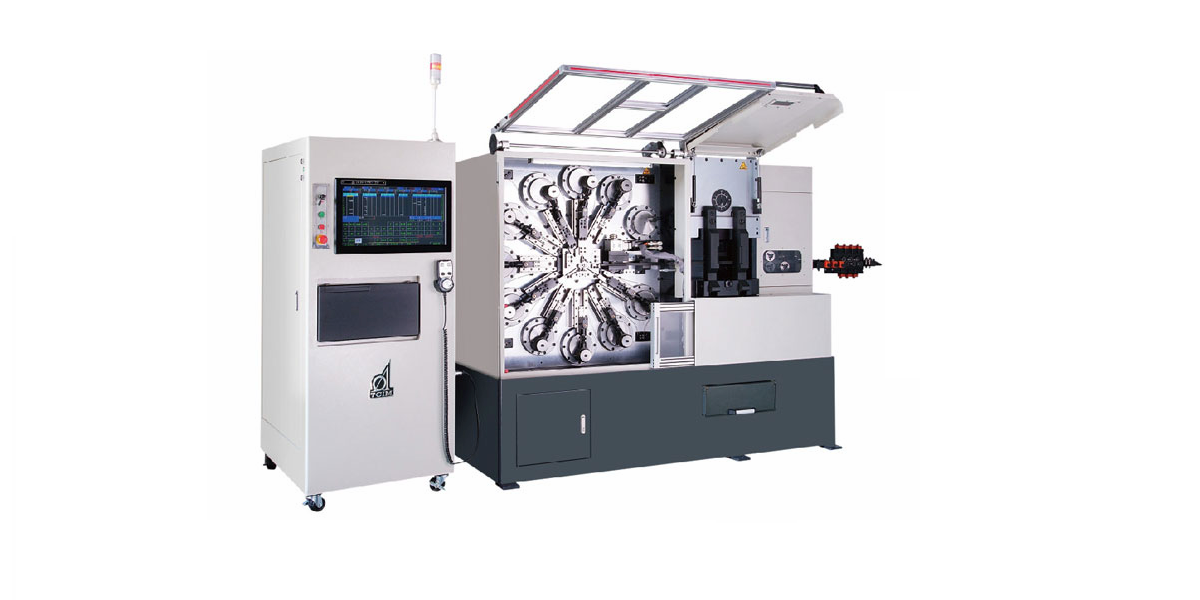
WHAT THE FACILITY HOLDS
2,500 m² housing 25 spring and clip machines. Coiling covers CNC compression, tension, torsion, ring and wave. End grinding runs downfeed and crash. Wire and strip forming covers multi-slide formers and 2D and 3D benders. Heat treatment uses box ovens to 350 °C and RJC conveyor ovens to 500 °C. Finishing and inspection complete the route.
In-house spring production runs 0.1 to 6.0 mm wire depending on type. The machines we build and sell reach considerably further — to 25 mm on the SHA large coilers — and it is worth keeping those two ranges separate, because they are frequently conflated.
WHY ONE BUILDING SHORTENS LEAD TIME
The time a part spends being worked on is a small fraction of the time it spends in the process. Most of it is waiting: for a machine, for a batch to complete, or for transport between vendors.
Every operation performed outside adds transit in both directions plus the subcontractor's own queue. A plating step with two hours of process time routinely takes two weeks of calendar time. Removing those handoffs is where the lead time saving actually comes from — not from machines running faster.
WHAT IT CHANGES WHEN SOMETHING GOES WRONG
This matters more than the routine case. When a dimension drifts, coiling, grinding, and inspection are on the same floor and the correction loop closes in hours. When those operations sit at different companies, the same loop involves a shipment, a conversation, and a queue position.
The same applies to a design change mid-development. A revised sample is a scheduling question rather than a coordination exercise.
WHAT LEAVES THE BUILDING
Being specific here is more useful than claiming everything. Specialized plating chemistries beyond our standard finishes go to outside processors. Material is bought as drawn wire to specification rather than drawn in-house. Independent laboratory certification is subcontracted to accredited laboratories — which is correct in any case, since an independent result should come from an independent party.
Those stages sit within our supplier controls and the traceability record follows them. If the boundary matters to your qualification, ask and we will tell you exactly which operation sits where.
WHAT FAST TURNAROUND REQUIRES FROM BOTH SIDES
Short lead times are frequently presented as purely a supplier capability. In practice they depend on both parties, and the customer controls more of it than is usually recognized.
A complete drawing package removes the largest single delay. A quotation waiting on a missing tolerance, an unstated finish chemistry, or an unclear inspection method sits idle while correspondence happens.
Early notice of a coming requirement lets material be ordered against a forecast rather than after an order. On common grades this makes little difference; on an unusual diameter or grade it can be the whole lead time.
Prompt approval of first articles. On regulated work the customer's own review is frequently the critical path, and it is the stage nobody schedules.
None of that reduces our obligation. It does mean the fastest projects are the ones where both sides treat the schedule as shared.
WHAT ACTUALLY DETERMINES YOUR LEAD TIME
- Whether the drawing is complete. A quotation waiting on a missing tolerance or finish chemistry is the most common delay, and the easiest to avoid.
- Tooling. New geometry needs tooling, and that is usually the longest single item on a first order.
- Material availability. Common grades and diameters are held; unusual combinations are ordered.
- Whether an outside process is required. One subcontracted finish can exceed the entire in-house route.
- Approval cycles. On regulated work, your own review time is frequently the critical path.
Sending a complete drawing package removes the first of these entirely, and it is the one fully within your control.
A note on what a facility tour actually tells you, if you visit. Look at work in progress rather than at machines. Where parts are waiting is where the constraint is, and it is the most honest thing a shop floor communicates. A tour that shows only running machines has shown you the easy half.
Send us your drawings, samples, or requirements and our engineering team — backed by 20+ years of spring and machinery manufacturing experience — will get back to you with a competitive quote and realistic turnaround.
Email: sales@seyunda.com
Phone: +65 9168 2618
We look forward to supporting your next project.
Published by the Seyunda Team · 2026