Automated storage and retrieval systems get discussed as a warehouse technology. For a manufacturer the interesting part is different: what changes on the production floor when material handling stops being manual.
WHAT THESE SYSTEMS ACTUALLY DO
An AS/RS stores material in a dense, usually vertical arrangement and retrieves it automatically on request. The storage is denser because aisles sized for a person and a forklift are no longer required, and retrieval is faster because nobody walks anywhere.
In a factory the useful consequence is not storage capacity. It is that material arrives at the machine rather than being fetched from it.
THE THREE GAINS THAT MATTER TO A SPRING SHOP
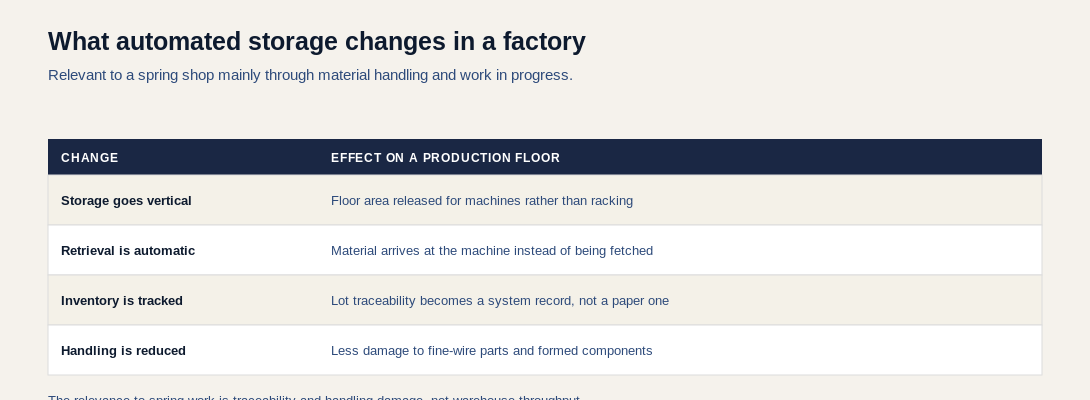
Floor area released. Storage going vertical frees floor space, and floor space in an established plant is usually the constraint on adding a machine. A shop that cannot fit another coiler often has the area — it is under racking.
Traceability becomes systematic. When material movement is recorded by the system rather than on paper, lot traceability stops depending on someone writing a number down. For IATF-certified work that is a meaningful reduction in a real risk, because traceability gaps are usually record-keeping failures rather than system failures.
Handling damage falls. Fine-wire springs and formed parts are damaged by handling more often than most people account for. Fewer manual movements means fewer opportunities to bend a 0.1 mm spring out of tolerance in transit between operations.
WHERE IT DOES NOT PAY
Being clear about this matters, because these systems are expensive and frequently oversold.
If your material variety is low and your floor space is not constrained, an AS/RS solves a problem you do not have. If your inventory turns quickly and material goes almost directly from goods-in to a machine, dense storage adds a step rather than removing one. And if the plant layout would need reorganizing around the system, that cost usually exceeds the handling saving.
The honest test is whether people spend meaningful time locating and moving material. If they do not, the system has nothing to recover.
THE PARTS THESE SYSTEMS NEED
There is a manufacturing angle worth noting, since it is where we intersect with this equipment. Automated handling systems contain a large number of springs, clips, and wire forms — in grippers, latches, retention mechanisms, and sensor mountings. They cycle constantly and are difficult to access for maintenance once installed.
That combination puts fatigue life and corrosion resistance ahead of unit cost. A retention clip that needs replacing after two years inside a storage system costs far more in access than it saved at purchase.
WHAT TO MEASURE BEFORE CONSIDERING ONE
The business case for automated storage rests on time that is currently being spent, so the first step is establishing whether it is.
- Time spent locating material. Follow a few jobs and record how long from "we need this coil" to the coil being at the machine.
- Floor area under racking, and what you would put there instead. If the answer is nothing, density buys nothing.
- Traceability gaps. How often is a lot number unclear, and what does resolving it cost?
- Handling damage, counted as a scrap category rather than absorbed into general scrap.
If those four numbers are small, the system has nothing to recover, whatever the demonstration shows. If they are large, they also tell you which capability matters most — density, retrieval speed, or tracking — and those point at different systems.
THE GENERAL PRINCIPLE
Automating material movement is worth doing when movement is genuinely consuming time, and worth deferring when it is not. The same logic applies to any automation decision: measure where the time actually goes before buying equipment to save it.
Our machine automation work covers design, assembly, calibration, and control integration for production systems. If you are considering material handling automation around a spring line, the useful starting point is a walk of the current flow rather than a specification.
One further point specific to regulated work. Where traceability is a certification requirement rather than good practice, a system that records material movement automatically removes a category of finding that manual records regularly generate. That is worth weighing separately from the handling saving, because it is a risk reduction rather than a cost reduction, and the two are justified differently.
Send us your drawings, samples, or requirements and our engineering team — backed by 20+ years of spring and machinery manufacturing experience — will get back to you with a competitive quote and realistic turnaround.
Email: sales@seyunda.com
Phone: +65 9168 2618
We look forward to supporting your next project.
Published by the Seyunda Team · 2026