When people plan a spring production line, the conversation usually starts with the coiler. It is the machine everyone pictures, and it is the one with the impressive cycle rate on its specification sheet.
It is also, on most lines, not the constraint. If you are laying out a line or deciding what to buy next, the useful question is where work actually waits.
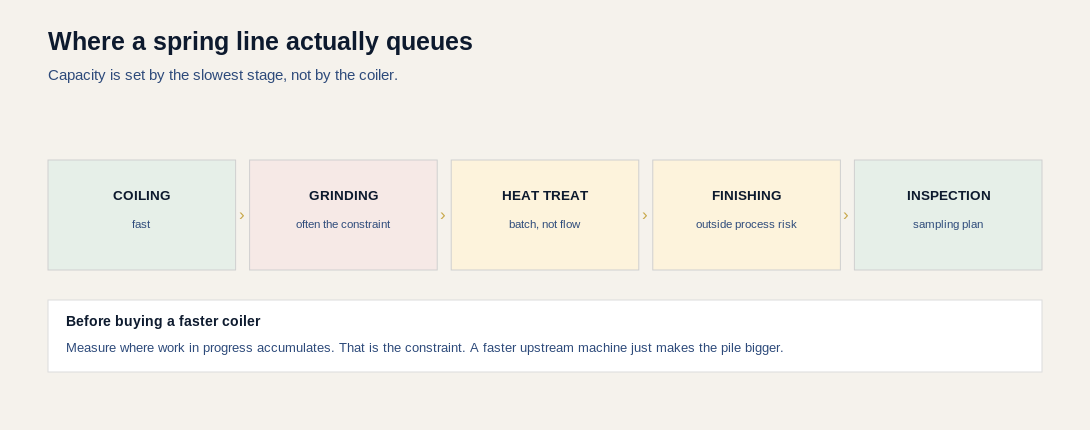
FIND THE CONSTRAINT BEFORE BUYING ANYTHING
There is a simple diagnostic that costs nothing: walk the line and look for where work in progress accumulates. Parts pile up in front of the constraint. If there are trays waiting at the grinder and the coiler is idle for part of the shift, the coiler is not your problem.
Do this over a normal two weeks of mixed work rather than during a single long run, because the constraint frequently moves with the product mix.
WHY GRINDING IS SO OFTEN THE CONSTRAINT
Compression springs needing flat, square ends have to be ground, and grinding does not scale the way coiling does. A coiler making 200 pieces a minute feeds a grinder that processes at a rate set by wheel speed, loading plate speed, and how many springs fit the fixture.
Our grinder range runs from the G-180 at 0.5 – 1.8 mm wire to the G-915 at 5 – 20 mm, with loading plate speeds of a half to 30 RPM on the mid frames. Matching grinder capacity to coiler output is a calculation worth doing before either is ordered, not after.
HEAT TREATMENT IS A BATCH IN A FLOW LINE
Stress relief interrupts flow because it is inherently a batch operation. A box oven holds a load at temperature for a set time — ours runs a constant temperature period from 60 to 1,800 seconds — which means parts accumulate before it and release in a group after it.
A conveyor oven such as the RJC series converts that batch step into something closer to continuous flow, which matters more for line balance than for throughput alone. If your line stops and starts around heat treatment, that is the reason.
THE STAGE THAT LEAVES THE BUILDING
Any operation performed outside adds transit in both directions plus the subcontractor's own queue. A plating step that takes two hours of process time can take two weeks of calendar time.
When laying out a line, mark which stages leave the building. Those are the ones that determine lead time, and they are usually invisible on a capacity calculation that only counts machine hours.
WORKING BACKWARDS FROM DELIVERY
A more useful planning method than sizing each machine independently: start from the delivery commitment you want to make, subtract the outside process lead times, subtract heat treatment batching, and see what remains for the machining stages. That number is your real available time, and it is usually smaller than expected.
Lines planned forwards from machine capacity tend to look fine on paper and miss dates. Lines planned backwards from delivery reveal the constraint immediately.
WHERE INSPECTION BELONGS IN THE FLOW
Inspection placement changes line behavior more than its cost suggests. Put it only at the end and every defect is discovered after all the value has been added. Put it everywhere and it becomes the constraint itself.
The useful principle is to inspect immediately after the operation that creates the characteristic you care about, and immediately before any operation that is expensive or irreversible.
For springs that means checking dimensions after heat treatment rather than before it, because that is when the part reaches its final size. It also means checking before anything leaves the building for an outside process, since discovering a problem after a two-week plating round trip costs the round trip as well as the parts.
One further consideration: in-cycle detection on the coiler shifts inspection earlier than any standalone station can. Catching a length drift at part forty is a different economic event from catching it at final inspection of a finished batch.
A NOTE ON REDUNDANCY
Adding shifts multiplies capacity but adds no cover. A single machine running three shifts has three times the output and no maintenance window at all. Two machines on one shift have the same output as one machine on two shifts, and a very different risk profile.
Decide explicitly which you are buying. It is the question most often left implicit in a capacity plan, and the one that gets tested on the day something breaks.
Send us your drawings, samples, or requirements and our engineering team — backed by 20+ years of spring and machinery manufacturing experience — will get back to you with a competitive quote and realistic turnaround.
Email: sales@seyunda.com
Phone: +65 9168 2618
We look forward to supporting your next project.
Published by the Seyunda Team · 2026