Medical device springs are usually smaller, held tighter, and examined more closely than springs in any other sector. A part a fraction of a millimeter out of spec does not simply underperform. It can shift dosing accuracy, jam a mechanism, or become a patient safety issue.
That raises a question worth answering before the technical detail: which regulatory obligations belong to the device manufacturer, and which to the component supplier? Getting that boundary wrong causes more program delay than any tolerance ever does.
WHAT MAKES A MEDICAL SPRING DIFFERENT
- Miniature sizes: Many applications need wire down to 0.1 mm for compact, precise mechanisms. At that gauge, handling and measurement become as demanding as the coiling.
- Biocompatible material selection: Stainless 316L is the common starting point where the part contacts tissue or requires repeated sterilization. MP35N and other cobalt alloys appear where fatigue life and corrosion resistance both have to be exceptional.
- Repeatable spring rate: For a dosing mechanism, consistency of force between parts matters more than the absolute figure. Rate variation is the specification to argue about, not free length.
- Sterilization survival: Steam autoclave runs at 121 °C to 134 °C under pressure, repeatedly. Materials, finishes, and any adhesive or coating in the assembly have to tolerate that cycle without degrading.
THE REGULATORY LINE, STATED PLAINLY
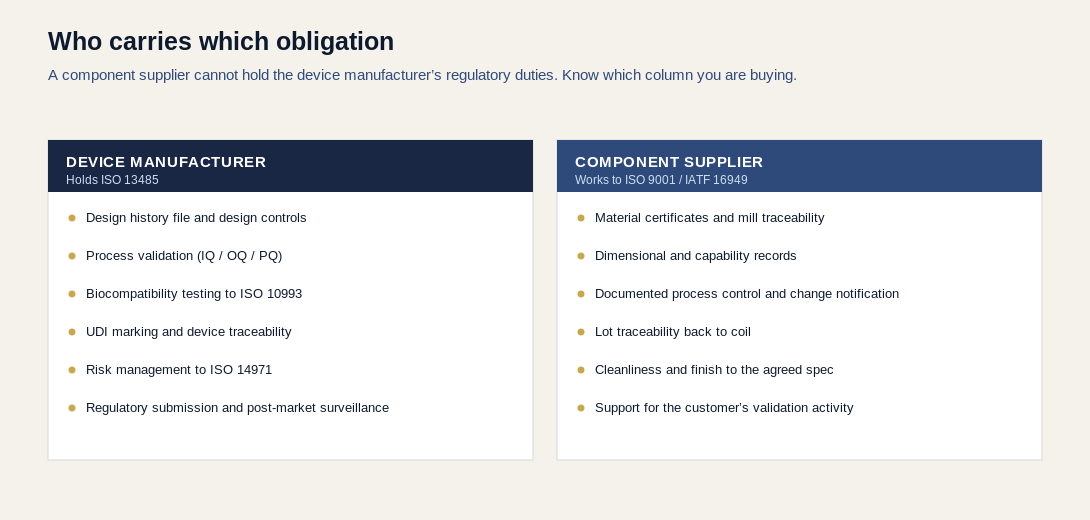
Medical device manufacture runs to ISO 13485. That standard brings design controls and a design history file, process validation as IQ, OQ and PQ, risk management to ISO 14971, UDI marking and device traceability, and post-market surveillance. Those duties sit with the device manufacturer and cannot be delegated to a spring supplier.
A point we want to correct, because we have seen it claimed and we have claimed it ourselves in the past: PPAP does not satisfy medical device requirements. PPAP is an automotive tool from the AIAG. It is well suited to proving a process can repeat, and the documentation it produces can be genuinely useful evidence in a supplier file. But it does not substitute for ISO 13485, and an ISO 13485 auditor will not accept it as though it does.
Seyunda works to ISO 9001 and IATF 16949. We supply components to your drawing and your specification, with the material and process records to support your validation. The ISO 13485 obligations remain yours.
BIOCOMPATIBILITY IS A DEVICE TEST, NOT A MATERIAL PROPERTY
This is worth being precise about. ISO 10993 evaluates biological safety of the finished device in its intended contact type and duration. A mill certificate for 316L is not a biocompatibility result.
What the material grade gives you is a defensible starting point and a traceable input. What determines the outcome is the finished part, including whatever the manufacturing process left on the surface. That is why cleanliness and finish specification belong in the drawing, not in a verbal agreement.
WHAT FINE WIRE ACTUALLY CONSTRAINS
Below about 0.3 mm, several things change together. Spring index — the ratio of mean diameter to wire diameter — needs to stay in a workable band, roughly 4 to 12. Too low and the wire is difficult to form without damage. Too high and the spring becomes unstable to handle and to measure.
Measurement becomes the limiting factor as often as manufacture. Load at height on a 0.1 mm wire spring requires equipment with resolution to match, and a fixture that does not itself deflect. If a tolerance cannot be measured repeatably, it cannot be held repeatably, whatever the drawing says.
FINISHES FOR STERILE ENVIRONMENTS
Passivation removes free iron from a stainless surface and restores the chromium oxide layer, which improves corrosion resistance through repeated sterilization. Electropolishing goes further, reducing surface roughness and removing embedded contamination, at some cost in dimensional stock.
Both change the part slightly. Specify the finish before the dimensional tolerance is fixed, not after.
WHAT TO SEND US FOR A QUOTE
- The drawing, with which characteristics are critical and how they will be inspected.
- Material grade and any restriction on source or certification.
- Sterilization method and number of expected cycles.
- Contact type and duration, so we understand what your ISO 10993 evaluation will need to cover.
- Your validation plan and what evidence you need from us to support it.
If your program requires a supplier holding ISO 13485 in its own right, tell us early. We would rather point you elsewhere at inquiry stage than at audit stage.
Send us your drawings, samples, or requirements and our engineering team — backed by 20+ years of spring and machinery manufacturing experience — will get back to you with a competitive quote and realistic turnaround.
Email: sales@seyunda.com
Phone: +65 9168 2618
We look forward to supporting your next project.
Published by the Seyunda Team · 2026