Material choice sets the ceiling on what a spring can do. It determines the force available in a given space, whether the part survives its environment, and whether it can carry current. Most of the trade-offs pull against each other.
WHY A SINGLE STRENGTH FIGURE WOULD MISLEAD
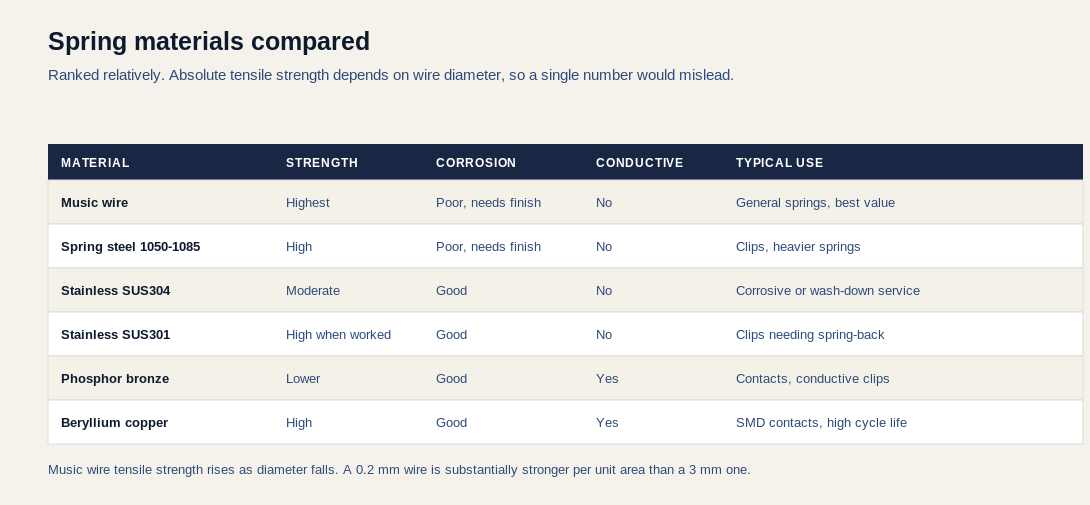
Spring wire is drawn, and drawing work-hardens it. The more a wire is drawn down, the stronger it becomes per unit area. That means tensile strength is a function of diameter: fine music wire is substantially stronger than the same material at 3 mm.
So a materials table quoting one tensile figure per material is describing a diameter it has not mentioned. Specifications handle this by giving strength as a range across diameter bands, and that is how a supplier will quote it.
MUSIC WIRE
High carbon steel, cold drawn to high tensile strength, with excellent fatigue performance and a good surface finish. For general springs it offers the best combination of strength and value, which is why so much spring work defaults to it.
Its weakness is corrosion. Bare music wire will rust, so any application with humidity, wash-down, or outdoor exposure needs a finish — and that finish becomes a failure mode of its own.
SPRING STEEL 1050, 1065, 1085
Carbon steels used for clips, clamps, and heavier formed parts. Higher carbon means higher achievable hardness and better spring-back after forming. They are formed soft and hardened afterwards, since a fully hardened part cannot be bent without cracking.
Specify the required hardness or retention force rather than the grade alone. The same grade delivers very different properties depending on heat treatment.
STAINLESS SUS304 AND SUS301
SUS304 gives good corrosion resistance with moderate strength, and is the usual answer where the environment is wet, chemically mild, or requires washing.
SUS301 work-hardens substantially during forming, so it reaches higher strength and spring-back than 304. It is common in clips that must retain force, where the corrosion resistance is in the material rather than in a coating.
Neither matches music wire for strength at the same diameter. Choosing stainless usually means accepting a slightly larger spring for the same force, and that has to fit the envelope.
PHOSPHOR BRONZE AND BERYLLIUM COPPER
These are chosen when the part must conduct. Phosphor bronze combines good spring properties with useful conductivity and resistance to stress relaxation, which suits contacts and conductive clips.
Beryllium copper is the higher-performance option: after age hardening it reaches an excellent elastic limit with good conductivity, and it holds contact force at elevated temperature far better than brass. It is what our SMD and EMI spring contacts are made from, in every one of the 31 variants.
Both cost considerably more than steel. They earn it only where conduction or non-magnetic behavior is genuinely required.
WHAT THE MATERIAL DOES TO MANUFACTURE
Material choice affects how the part is made as much as how it performs, and the manufacturing consequences are worth knowing at design stage.
Springback scales with strength. Higher-tensile material recovers more after forming, so the compensation in the program is larger and more sensitive to lot variation. That means more frequent first-off adjustment on exactly the materials where tolerance usually matters most.
Forming sequence differs. Music wire and oil-tempered wire arrive at final properties and are coiled hard, then stress relieved. Carbon steels for clips are formed soft and hardened afterwards, because a hardened part cannot be bent without cracking. Beryllium copper is formed soft and age hardened, which moves dimensions in a way that must be compensated in the tooling.
None of this changes which material is right. It changes what the drawing needs to say about tolerance and sequence.
CHOOSING, IN ORDER
- Does the part need to conduct electricity? If yes, you are choosing between copper alloys and the rest is secondary.
- What is the environment? This decides stainless against coated carbon steel.
- What force is needed in the available space? This decides whether you can afford stainless's lower strength.
- What is the cycle requirement? High cycle counts push toward music wire or beryllium copper.
- Then check cost, because by this point the field is usually down to two options.
Send us your drawings, samples, or requirements and our engineering team — backed by 20+ years of spring and machinery manufacturing experience — will get back to you with a competitive quote and realistic turnaround.
Email: sales@seyunda.com
Phone: +65 9168 2618
We look forward to supporting your next project.
Published by the Seyunda Team · 2026