Catalog springs are cheaper, immediately available, and entirely adequate for a great many applications. It is worth saying that plainly, because a custom spring supplier has an obvious incentive not to.
What follows is when a standard part genuinely stops being enough.
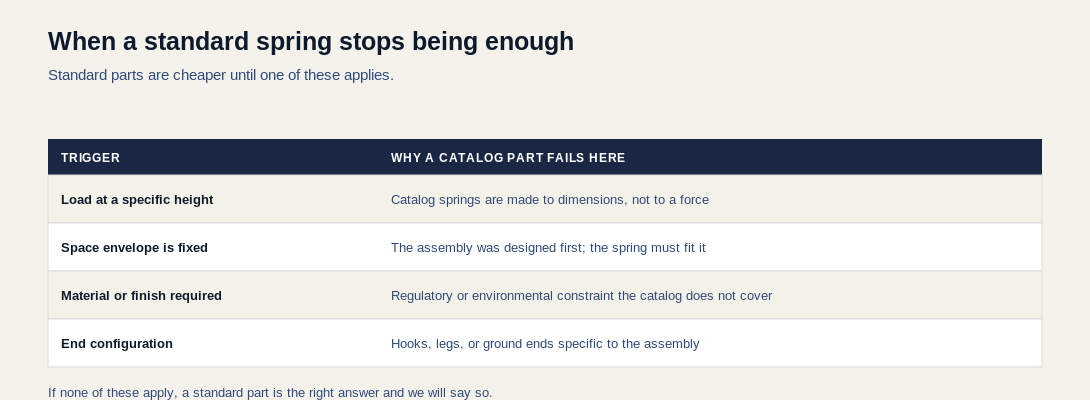
WHEN A CATALOG PART IS THE RIGHT ANSWER
If your assembly has space to accommodate a range of spring sizes, if the force requirement is loose, and if the environment is benign, buy a standard spring. It will arrive faster and cost less, and no amount of engineering will improve on that.
This describes more applications than most people assume — return springs, detents, light retention, anything where "roughly this much force" is a genuine specification rather than a shortcut.
TRIGGER ONE: LOAD AT A SPECIFIC HEIGHT
Catalog springs are manufactured to dimensions. Their load at a given height is a consequence of those dimensions rather than a controlled property.
If your assembly needs a defined force at a defined position — a dosing mechanism, a sensor preload, a valve — you need a spring made to that force. Selecting from a catalog by calculating which listed spring should produce the right load works on paper and produces wide scatter in practice, because rate varies with the fourth power of wire diameter and catalog wire tolerance is not tight.
TRIGGER TWO: A FIXED SPACE ENVELOPE
Most assemblies are designed before the spring is chosen. By the time anyone specifies it, the bore diameter, the working stroke, and the available length are already fixed by other components.
A catalog is a finite set of combinations. When your envelope falls between listed sizes, the choice is a custom spring or a design change elsewhere — and the design change is usually the more expensive of the two.
TRIGGER THREE: MATERIAL OR FINISH
Catalog ranges cover common materials in common finishes. If your part needs a specific stainless grade for corrosion, a particular finish for a substance restriction, or a material chosen for temperature or conductivity, the catalog rarely reaches.
This is increasingly the trigger in automotive and electronics work, where the substance restriction is imposed by the customer rather than chosen by the designer.
TRIGGER FOUR: END CONFIGURATION
Ground ends for a spring that must sit square. A specific hook orientation so a tension spring attaches at the right angle. Torsion legs at a defined angle to suit the mechanism. Catalog ends are standard because they have to be, and standard ends frequently do not attach to a real assembly.
THE MIDDLE OPTION PEOPLE FORGET
Between a catalog part and a fully custom design sits a third route that is often cheaper than either: a modified standard.
Taking a standard geometry and changing one thing — the end configuration, the material, the finish — keeps most of the proven design while solving the specific problem. Setup is simpler than a clean-sheet part, and the design risk is lower because the base geometry is known to work.
This is worth asking about when a catalog part is close but not quite right. Describe what the standard part gets wrong rather than starting a new specification from scratch, and the answer is frequently a small modification rather than a new design.
THE ECONOMICS, HONESTLY
Custom springs carry setup cost, so unit price falls with quantity in a way catalog pricing does not. There is a crossover volume below which a catalog part plus a design compromise is genuinely cheaper.
Where custom wins even at low volume is when the alternative is modifying the assembly around the spring. A tooling charge is usually smaller than a housing change, and it arrives sooner.
Tell us the force, the envelope, the environment, and the quantity. If a standard spring covers it, we will tell you that too.
One more consideration on timing. A custom spring needs lead time for tooling and first article, typically weeks rather than days. If a project has a fixed date, decide between catalog and custom early rather than discovering at the last moment that the catalog does not cover it — that is when a design compromise gets made under pressure and lives in the product for years.
Send us the requirement while there is still time to choose properly, even if the answer turns out to be a standard part.
Send us your drawings, samples, or requirements and our engineering team — backed by 20+ years of spring and machinery manufacturing experience — will get back to you with a competitive quote and realistic turnaround.
Email: sales@seyunda.com
Phone: +65 9168 2618
We look forward to supporting your next project.
Published by the Seyunda Team · 2026