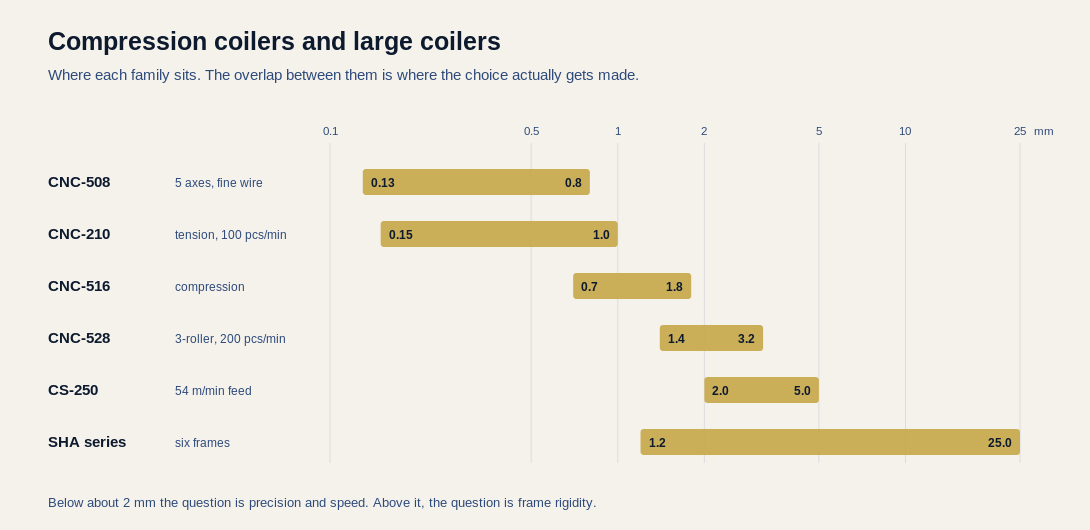
The choice between a CNC compression coiler and a large spring coiler looks like a wire diameter question. It mostly is, but the interesting part is the overlap in the middle, where either family will physically make the part and the right answer depends on what else you need from the machine.
WHAT A CNC COMPRESSION COILER IS BUILT FOR
Speed and precision on smaller wire. The CNC-508 covers 0.13 – 0.8 mm on five axes. The CNC-516 runs 0.7 – 1.8 mm. The CNC-528, with three feed rollers, handles 1.4 – 3.2 mm at up to 200 pieces per minute.
These machines are optimized around cycle time and repeatability. Programs are recalled rather than re-set, and features like in-cycle length detection catch drift at part forty rather than at the end of a batch. On fine wire the limiting factor is rarely the machine's power; it is control resolution and how consistently the wire feeds.
WHAT A LARGE COILER IS BUILT FOR
Rigidity. The SHA series spans 1.2 mm on the SHA-630 up to 25 mm on the SHA-6250, with maximum spring outside diameters from 70 mm to 250 mm.
Forming heavy wire needs a frame that does not deflect under the forming load. That is a different design problem from running fine wire quickly, and it is why large coilers are heavier, slower, and built around different axis configurations — feed, OD, upper and lower slides, push pitch, and arbor.
THE OVERLAP BAND, AND HOW TO DECIDE IN IT
Between roughly 1 and 5 mm, several machines are candidates. Four questions usually settle it.
- What spring outside diameter do you need? This constrains the choice more often than wire diameter does. A 2 mm wire spring at 150 mm OD needs a large-coiler frame regardless of the wire being modest.
- How long are your runs? Long runs of one part favor the faster compression coiler. Short runs across several parts favor the machine with better changeover.
- Where is the rest of your range going? If you expect to move heavier over the next few years, buying at the top of a compression coiler's range leaves nowhere to grow.
- What happens after coiling? If ends need grinding, the grinder's wire capacity has to match. A coiler that can make the spring in front of a grinder that cannot finish it is a bottleneck you have paid for.
THE MISTAKE THAT COSTS MOST
Buying at the very top of a machine's stated range. A machine quoted to 0.8 mm will make 0.8 mm wire, but it will do so with the least margin it has — more sensitive to material variation, more tooling wear, less tolerance for a lot that runs slightly harder than the last.
If your main part sits at the top of a range, look at the next frame up. The parts you run most should sit comfortably inside a machine's capability, not at its edge.
SPRING INDEX MATTERS AS MUCH AS DIAMETER
Spring index — mean coil diameter divided by wire diameter — affects what a machine can form as much as the wire size does. A practical range is roughly 4 to 12. Below 4 the wire is being bent very tightly and forming forces rise sharply, which is where frame rigidity shows. Above 12 the spring becomes unstable to handle and to measure.
A quotation that states only wire diameter and spring OD has already given the index; it is worth calculating before assuming a machine will cope.
WHAT THE MATERIAL DOES TO THE ANSWER
Wire diameter is only half the forming load. The other half is what the wire is made of, and it moves the machine decision more than people expect.
Music wire and oil-tempered alloy wire at the same diameter present very different forming forces from annealed stainless. A machine comfortable with 3 mm stainless may be working near its limit on 3 mm oil-tempered SiCr, because the tensile strength is substantially higher and every bend costs more force.
Springback follows the same pattern. Higher-tensile material recovers more after forming, so the compensation built into the program is larger and more sensitive to lot variation. That shows up as more frequent first-off adjustment on exactly the materials where tolerance usually matters most.
When asking about machine capability, quote the material as well as the diameter. A capability figure without a material is an incomplete specification, and any supplier quoting purely on diameter is guessing at the harder half of the question.
WHAT TO SEND US
Wire diameter and material, spring outside diameter, free length, the tolerance that matters most, annual volume, and batch size. If ends need grinding, say so at the same time — it frequently changes which coiler makes sense.
Send us your drawings, samples, or requirements and our engineering team — backed by 20+ years of spring and machinery manufacturing experience — will get back to you with a competitive quote and realistic turnaround.
Email: sales@seyunda.com
Phone: +65 9168 2618
We look forward to supporting your next project.
Published by the Seyunda Team · 2026