Landing gear springs take some of the harshest duty of any mechanical part on an aircraft. Every touchdown drives them through their full working range under sudden, high-magnitude load. They see freezing conditions at altitude and hot tarmac on the ground within the same hour. They sit in the path of humidity, de-icing fluid, and runway chemicals for decades.
All of that is true. But it is not the first question an aerospace buyer needs answered. The first question is whether the supply chain is approved to supply flight hardware at all. That is a documentation question, and it has a hard answer.
WHAT THE DUTY CYCLE ACTUALLY DEMANDS
- High-impact load at touchdown: The spring cycles through its full range under sudden force, not a gradual one. Dynamic behavior matters more than a static load figure.
- Wide temperature swing: Performance must hold from sub-zero at altitude to hot ground exposure. Modulus of elasticity shifts with temperature, and so does the load a spring delivers at a given height.
- Corrosion in a chemical environment: Humidity, de-icing fluid, and runway chemicals attack unprotected surfaces across a service life measured in decades.
- Substantiated fatigue life: Aerospace requires documented, repeatable fatigue performance. A single successful load test is not fatigue substantiation.
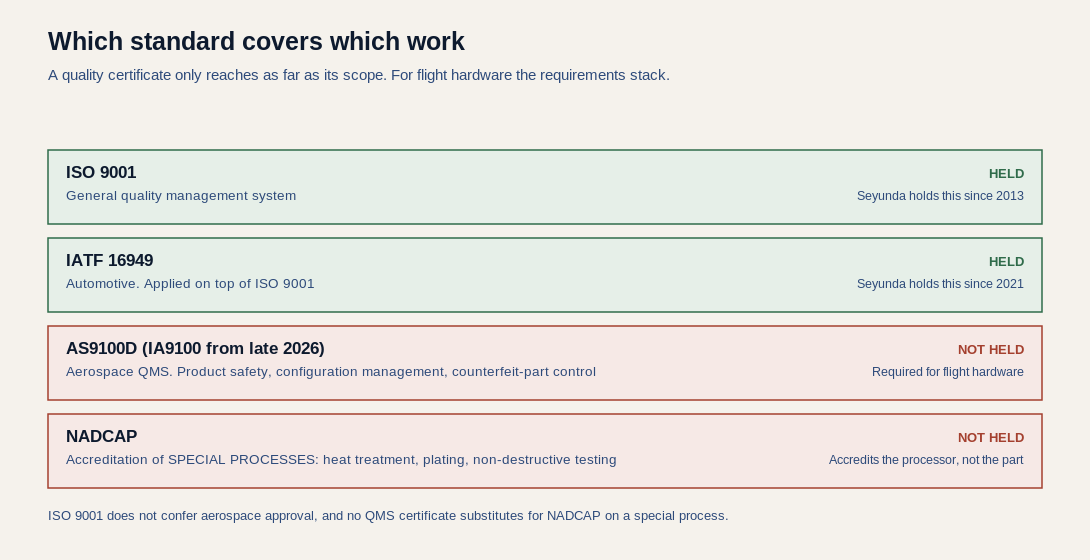
THE CERTIFICATION STACK, AND WHERE IT STOPS
This is where the industry sees the most confusion, and where we want to be exact about our own position.
- ISO 9001 certifies a quality management system in general terms. It does not confer aerospace approval, and it does not provide aerospace traceability. Any supplier who tells you otherwise has misunderstood the standard.
- AS9100D is the aerospace quality standard. It adds product safety, configuration management, and counterfeit-part prevention on top of ISO 9001. It is being replaced by IA9100, expected in late 2026 in step with ISO 9001:2026, with transition running to about 2029.
- NADCAP is separate again. It accredits special processes: heat treatment, plating, non-destructive testing, and similar. It accredits the processor performing the work, not the part.
Seyunda holds ISO 9001 and IATF 16949. We do not hold AS9100, and our finishing partners are not NADCAP-accredited. For flight-critical and primary structural hardware, that means we are not the right supplier, and we would rather say so here than in a qualification meeting.
WHY NADCAP CATCHES PEOPLE OUT
A buyer can qualify a spring maker, approve the drawing, and still fail an audit because a subcontracted plating line is not accredited. Special processes are the ones whose result cannot be fully verified by inspecting the finished part. You cannot see a heat treatment cycle in a dimensional report. You cannot measure a hydrogen embrittlement bake by looking at the surface.
That is exactly why the process, rather than the part, has to be accredited. When you audit an aerospace spring supply chain, follow the special processes out to whoever actually performs them, and ask for their accreditation, not the spring maker's.
FATIGUE SUBSTANTIATION IS NOT A LOAD TEST
A load test tells you what the spring does once. Fatigue substantiation tells you what it does after hundreds of thousands of cycles, with a statistical basis and a defined confidence level.
Doing it properly means testing to a defined cycle count at defined stress, on parts from production tooling rather than prototypes, with the surface condition the production process will actually deliver. Shot peening changes fatigue life substantially, which means an unpeened prototype tells you very little about a peened production part. Test what you will ship.
MATERIALS THAT GET SPECIFIED, AND ONE CAUTION
Common choices for demanding spring applications include 17-7 PH stainless (UNS S17700, sometimes called 631) for strength with reasonable corrosion resistance, 302 and 304 stainless for general corrosion service, and Inconel X-750 where sustained elevated temperature is involved.
One caution on finishes worth stating plainly. Dacromet contains hexavalent chromium. It is sometimes described as chrome-free, and that is wrong. Geomet is the hexavalent-free successor and is the one to specify where Cr(VI) restrictions apply. Getting this wrong in a materials declaration is a compliance problem, not a preference.
WHERE WE DO FIT
Ground support equipment, tooling, test rigs, and non-flight secondary components are work we can take on under ISO 9001 and IATF 16949, to your drawing and your inspection requirements. Fine-wire compression springs from 0.1 mm, tension springs, torsion springs, wire forms, and clips are all within our range.
If the part is flight hardware, ask us and we will tell you it needs an AS9100 supplier. That answer costs us a quotation and saves you a failed audit.
Send us your drawings, samples, or requirements and our engineering team — backed by 20+ years of spring and machinery manufacturing experience — will get back to you with a competitive quote and realistic turnaround.
Email: sales@seyunda.com
Phone: +65 9168 2618
We look forward to supporting your next project.
Published by the Seyunda Team · 2026