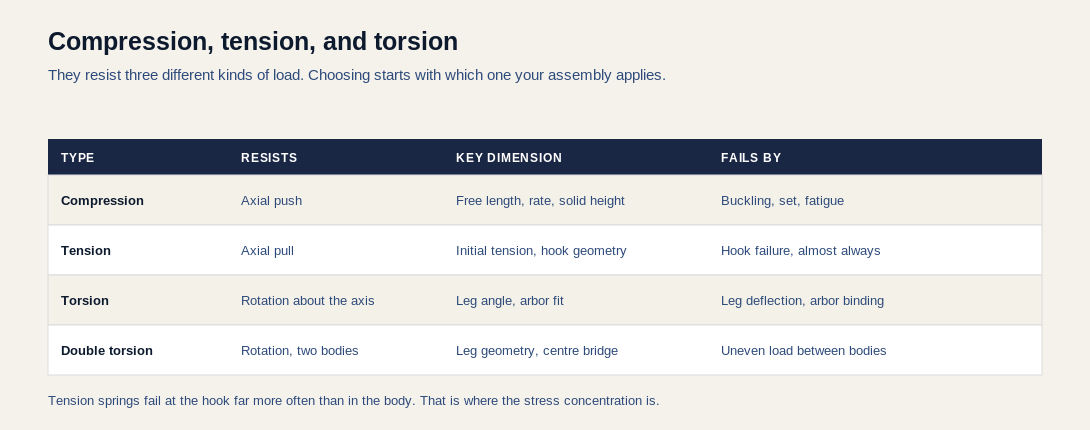
Compression, tension, and torsion springs resist three different kinds of load. Choosing between them is usually straightforward once you are clear about what the assembly actually applies — but each type has a characteristic failure mode, and knowing it changes how you specify.
COMPRESSION SPRINGS
An open-coil spring that resists an axial push. The most common type and generally the most forgiving to manufacture.
Key dimensions are free length, spring rate, and solid height — the length when fully compressed. Solid height matters because reaching it is the most damaging thing that can happen to a compression spring: at solid, stress rises sharply and the spring can take a permanent set in a single event.
If your assembly can compress the spring solid, either design in a positive stop or specify the spring so that solid height is never reached. That single decision affects fatigue life more than most others.
Buckling is the other consideration. A long, slender compression spring will buckle sideways rather than compress straight. If free length exceeds roughly four times the mean diameter, it needs guiding in a bore or over a rod.
TENSION SPRINGS
A close-coiled spring that resists an axial pull, with hooks or loops at each end for attachment.
Initial tension is the property that distinguishes them and the one most often left unspecified. It is the force built into the spring during coiling that holds the coils closed — the force that must be exceeded before the spring begins to extend at all. Two springs with identical dimensions and different initial tension behave differently in an assembly.
Tension springs almost always fail at the hook rather than in the body. The hook is a bend, and a bend is a stress concentration. That is why hook geometry belongs on the drawing in detail, and why German hooks, English hooks, and side loops are genuinely different specifications rather than styling choices.
TORSION SPRINGS
These resist rotation about the coil axis, with legs that transmit the torque. Load is expressed as torque at an angle rather than force at a height.
Two things determine whether a torsion spring works. Leg position and angle, which must be specified in the free state and toleranced, since angular tolerance is what usually causes rejects. And arbor fit — a torsion spring wound in the direction of loading reduces in diameter as it works, so it needs clearance over its arbor. Too tight and it binds; too loose and it wanders.
Double torsion springs place two coil bodies with a connecting bridge, sharing the load. The manufacturing challenge is getting both bodies to contribute evenly, which comes down to the bridge geometry.
THE DIMENSION THAT CONTROLS, AND WHY IT MATTERS
Every spring type has one dimension that must be controlled and others that follow from it. Specifying all of them tightly is over-specification, and it raises price without improving the part.
On a compression spring fitting over a rod, inside diameter controls and outside diameter follows. Fitting inside a bore, the reverse. Both cannot be held tightly at once when wire diameter varies within its own tolerance, so the drawing should say which one matters.
On a tension spring the controlling dimension is usually length inside hooks rather than body length, because that is what the assembly attaches to.
On a torsion spring it is leg angle in the free state, with the body dimensions following. Angular tolerance is what causes most torsion spring rejects, and it is frequently left unstated.
WHICH ONE DO YOU ACTUALLY NEED
- Identify what the assembly applies: push, pull, or rotation.
- Establish the force or torque required, and at what position.
- Measure the space available in the working condition, not at rest.
- Decide how the spring is retained — over a rod, in a bore, on an arbor, or by hooks.
Send those four answers and the material or environment, and we can propose a type and a geometry. Sending a spring dimension without the force requirement is the most common way to get a spring that fits and does not work.
One practical note that applies to all three types. Spring rate is not constant outside the working range: near solid on a compression spring, or beyond the elastic range on any type, the relationship between deflection and force stops being linear. Design within the range where it is linear, and specify the load at a point inside that range rather than at an extreme.
Send us your drawings, samples, or requirements and our engineering team — backed by 20+ years of spring and machinery manufacturing experience — will get back to you with a competitive quote and realistic turnaround.
Email: sales@seyunda.com
Phone: +65 9168 2618
We look forward to supporting your next project.
Published by the Seyunda Team · 2026