Most delays in quoting a spring are not technical. A drawing arrives, something essential is missing, and days disappear into correspondence before anyone can price the part. Here is what a supplier needs, and why each item changes the answer rather than merely filling a form.
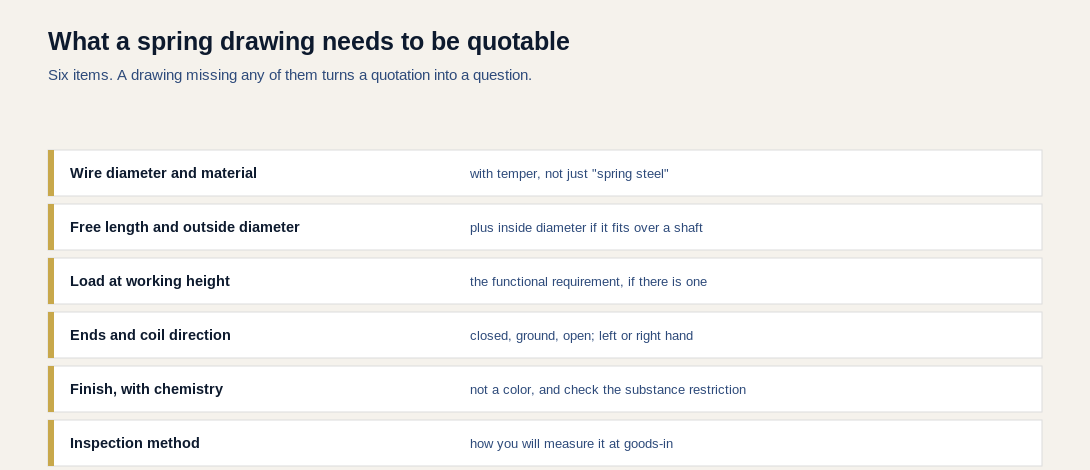
WIRE DIAMETER AND MATERIAL, WITH TEMPER
"Spring steel" is a category, not a specification. Grade determines strength and corrosion behavior. Temper determines springback during coiling and how the part behaves after heat treatment.
Stating temper alongside grade costs nothing and noticeably reduces lot-to-lot variation, because the supplier can buy to a tighter incoming specification rather than compensating for whatever arrives.
THE DIMENSIONS THAT MATTER, AND WHICH ONE CONTROLS
Free length, outside diameter, and number of coils define the geometry. But if the spring fits over a shaft or inside a bore, say which — because that decides whether OD or ID is the controlled dimension, and they cannot both be held to a tight tolerance at once when wire diameter varies.
This is the single most common ambiguity we see. A drawing controlling both OD and ID at tight tolerance is over-specified, and the part will be quoted defensively as a result.
LOAD AT WORKING HEIGHT
If there is a functional force requirement, state it directly. Dimensional tolerances alone do not control force: spring rate varies with the fourth power of wire diameter, so a wire tolerance well inside specification can move the load further than expected.
Specify load at height with its tolerance, and let the dimensional tolerances follow from it. Specify both independently and you have created a requirement nobody can consistently meet.
ENDS AND COIL DIRECTION
Closed, closed and ground, or open ends. Left or right hand wind. These are frequently omitted and both matter.
Ground ends change the number of active coils and therefore the rate, so a spring designed to a rate without allowing for grinding will measure differently once ground. Coil direction matters when a spring runs against a threaded component or nests with another spring — two springs of the same hand will interlock.
FINISH, SPECIFIED AS CHEMISTRY
Write the chemistry rather than a color or a trade name. "Yellow passivate" was historically hexavalent chromium; trivalent is the compliant replacement, and the drawing should say which.
One item worth checking on inherited drawings: Dacromet contains hexavalent chromium despite frequently being described as chrome-free. Geomet is the hexavalent-free successor. For vehicle parts the ELV Directive restricts Cr(VI), and correcting this at drawing stage is far cheaper than at declaration stage.
HOW YOU WILL INSPECT IT
The most commonly omitted item, and the one that prevents the most disputes. If you measure free length in a fixture and we measure on a surface plate, both measurements can be correct and disagree.
Tell us the method, the fixture, and the working height for any load specification. We will then measure it the way you will, and first article stops being an argument.
TELL US WHAT THE PART DOES
A drawing specifies geometry. It rarely explains function, and function is what reveals which dimension actually matters.
Knowing that a spring returns a lever, holds a seal closed, or preloads a bearing frequently shows that one characteristic controls the design and the rest are consequences. That changes what we concentrate process control on, and it occasionally reveals that a simpler or cheaper part would do the job better than the one drawn.
It also lets a supplier flag a mismatch. If a drawing calls for a tight free length tolerance but the function depends on force, we can say so before tooling rather than after first article — and tightening the requirement that matters while relaxing the one that does not usually reduces cost rather than increasing it.
WHAT A COMPLETE PACKAGE BUYS YOU
A firm price rather than a conditional one, a realistic lead time, and — most valuably — an early warning about anything difficult. A supplier who can see the whole requirement can tell you at quotation that a tolerance will need sorting, or that a finish conflicts with a substance restriction, while both are still cheap to change.
It typically takes twenty minutes to assemble and removes a week from the cycle. That trade is available on every inquiry and declined on most of them.
Send your drawings, samples, or machinery requirements to us and our engineering team — backed by 20+ years of spring and machinery manufacturing experience — will get back to you with a competitive quote and realistic turnaround.
Email: sales@seyunda.com
Phone: +65 9168 2618
We look forward to supporting your next project.
Published by the Seyunda Team · 2026